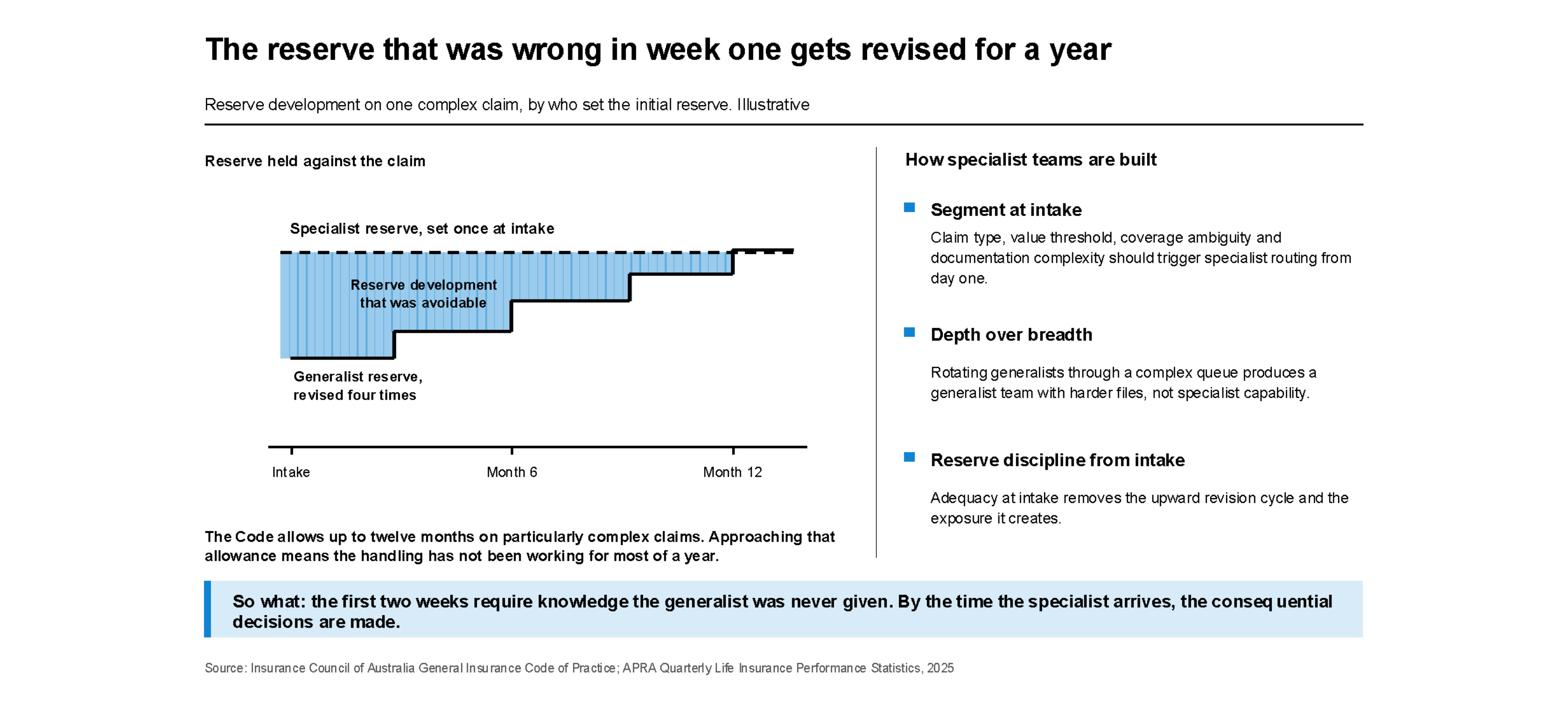


The complex claim that gets handled by a generalist team is not mishandled because the handler made a mistake. It is mishandled because the decisions made in the first two weeks - the reserve setting, the first customer communication, the routing call - required specialist knowledge the handler was never given. By the time the specialist arrives, the consequential decisions have already been made.
Complex claims are not a proportionate problem. They represent a fraction of total claim volume and a disproportionate share of total claims cost, cycle time, and customer dissatisfaction.
Australia's General Insurance Code of Practice allows up to twelve months for particularly complex claims to reach determination. When that allowance is approached, it signals that the handling process has not been working for most of that year - and the customer has known it. Leakage on complex claims does not accumulate at the point of determination. It accumulates at the handoffs, in the reserve revisions that follow under-set initial reserves, in the litigation that follows when a customer who has waited too long engages legal representation, and in the referrals to the complaints authority that arrive when internal resolution has run out of road.
The cost of mishandling a complex claim is not the complexity itself. It is the compounding.
Complex claims exceed the competence of a generalist handler - not because the handler is inadequate, but because the claim type requires domain knowledge that a generalist operating across the full portfolio has not had cause to develop.
The pattern is recognisable. A claim falls outside the standard handling guide. The handler follows procedure, escalates when uncertain, documents carefully. But the early decisions - the initial assessment, the reserve setting, the first customer communication - are made without deep knowledge of what this claim type typically involves, how it develops, and what a realistic settlement range looks like.
Those early decisions are the most consequential. An insufficient initial reserve, set without specialist knowledge, gets revised upward as the claim develops - a reserve movement that specialist input in week one would have prevented. A customer communication that does not reflect the realistic timeline creates expectation gaps that generate formal complaints before the claim is resolved.
The handoffs that follow compound the cost. Each transfer resets the file review. Each reset adds cycle time. Each day of cycle time on a complex claim is a day of cost accumulation that was not in the original reserve.
Waiting until complexity is undeniable before engaging specialists costs more in time, reserve development, and litigation exposure than proactive engagement from the first signs. The reframe on complex claims is about domain depth, not team size.
Specialist handling does not mean a larger team. It means a team with deep knowledge of specific claim types - the diagnostic categories, development patterns, settlement ranges, and communication requirements specific to those claims - handling only those claim types.
That depth changes outcomes in two directions simultaneously. On cost: the specialist who knows the claim type sets the reserve correctly at intake. The upward revision cycle does not occur. The litigation that follows from a customer managed by a handler who did not know the answer does not occur. On customer experience: the specialist communication to a customer with a complex claim reflects genuine knowledge of what they are facing, what the process involves, and what a realistic timeline looks like. That communication reduces the complaint rate on complex claims.
The operational practice that delivers specialist-level outcomes follows a clear sequence.
First: segmentation at intake. Complex claim signals - claim type, value threshold, coverage ambiguity, documentation complexity - should trigger specialist routing from day one, not after the generalist team has already made the early decisions that matter most.
Second: domain depth over breadth. Specialist handlers should work a defined set of claim types and develop genuine expertise in those types over time. Rotating generalists through a "complex claims" queue does not produce specialist capability. It produces a generalist team with more difficult files.
Third: reserve discipline from intake. The specialist who knows the claim type sets the initial reserve with domain knowledge. Reserve adequacy at intake eliminates the upward revision cycle and the cost exposure it creates. For claims approaching litigation, the specialist assessment of risk is more accurate than a generalist estimate - and the difference in accuracy has direct financial consequences.
ISSI's partnership model is structured around co-owning claims and fraud outcomes - not staffing a queue. With experience on claims-intensive platforms including PetSure's GapOnly real-time claims environment, ISSI works on an outcome-based commercial model rather than a staff-augmentation arrangement. If complex claim cycle time, reserve accuracy, or specialist routing is a live problem in the claims book, it is worth thirty minutes.
Sources: Insurance Council of Australia General Insurance Code of Practice; APRA Quarterly Life Insurance Performance Statistics (2025)