

It is 2am on Saturday. The cutover is three hours behind schedule. The go-live window closes at 6am. The migration lead is watching data reconciliation errors stack up in a system the team has never operated under live load. This is the moment that separates the teams that recover from the ones that do not.
Every platform migration has a cutover window. That window is typically 48-72 hours - a weekend, most often, chosen to limit live customer impact. Within it, everything planned in theory must execute in practice: data migration, reconciliation, validation, parallel-run checks, go-live sign-off. The margin for overrun is measured in hours, not days.
The consequence of overrun is not a timeline slip. It is a live servicing failure - policies that cannot be accessed, claims that cannot be processed, customers who cannot get answers. Under CPS 230, which came into force on 1 July 2025, a live servicing failure in an APRA-regulated environment creates an operational risk event that requires documentation. AFCA complaint exposure follows the disruption window closely.
The biggest risk in a cutover is not the technical complexity of the target platform - it is whether the team operating it has ever seen what happens when it fails.
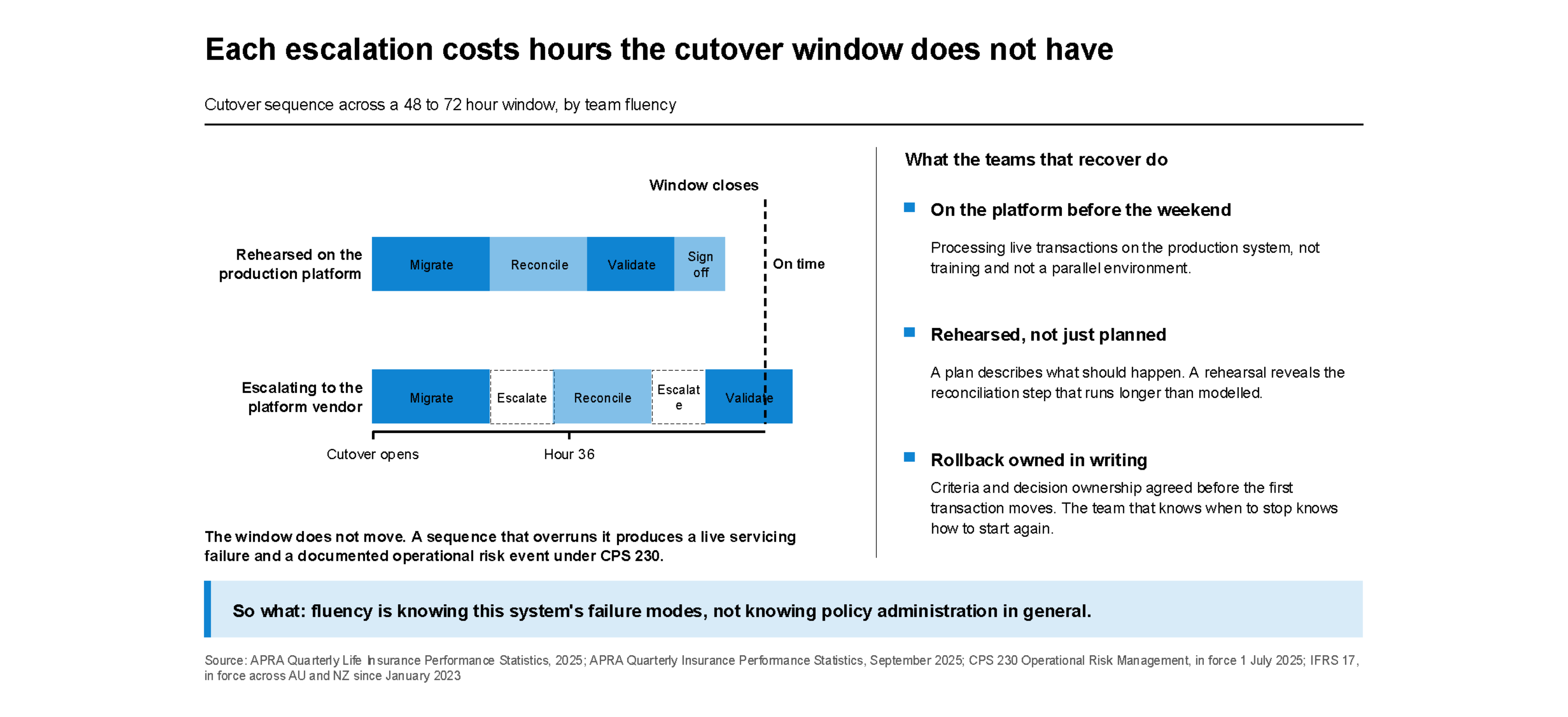
Every migration hits edge cases at go-live. The data model has quirks that only appear under live load. Exception-handling paths that were not exercised in the sandbox behave differently in production. A reconciliation rule fires that the team did not know existed. In a platform-naive team, each of these events requires escalation - to the system vendor, to the platform architect, to whoever holds the institutional knowledge. Each escalation costs time the window does not have.
Industry patterns across ANZ insurance migrations are consistent: data integrity issues discovered at cutover are among the leading causes of go-live delay. Under IFRS 17 - in force for AU and NZ carriers since January 2023 - data integrity at go-live is not merely operational. It is a financial reporting prerequisite.
Platform fluency is not the same as technical competence. Competence - knowing how to operate a policy administration system in general terms - is table stakes. Fluency means knowing this platform's specific data model, this system's exception-handling logic, this reconciliation tool's failure modes. That knowledge comes from operating time on the actual system, not from a training program.
A team that has worked production transactions on CyberLife, wmA, or Ingenium for months before a cutover begins arrives at the weekend already knowing what breaks first, how validation tools behave under load, and which reconciliation errors are recoverable without escalation. The unexpected is familiar. Recovery is a process, not a crisis.
This is why rehearsal on the live platform matters more than planning on paper. Teams that have run cutover simulations on the actual production system - not a parallel environment, not a sandbox - arrive at go-live with a practised sequence rather than a document they are reading for the first time.
The migrations that close on time share three structural features.
First: the operating team is on the platform before the cutover begins. Not in training, not in a parallel environment - processing live transactions on the production system. Weeks of live operation before the window opens is not a luxury. It is what produces the fluency that go-live demands.
Second: the cutover sequence is rehearsed, not just planned. A plan describes what should happen. A rehearsal reveals what actually does - the reconciliation step that takes longer than modelled, the validation check that surfaces data exceptions the plan did not anticipate. Each iteration closes a gap before the weekend begins.
Third: the rollback decision is pre-defined and owned in writing before Saturday morning. Migrations in ANZ life - including those associated with AIA Australia's absorptions of CommInsure (completed 2020) and Integrity Life (2021) - have shown that the teams with the lowest cutover overrun are those where rollback criteria and decision ownership were agreed before the first transaction moved. The team that knows when to stop knows how to start again.
ISSI's delivery team is already fluent on the platforms ANZ carriers run with a ramp-time track record on carrier platforms. For cutover work, that fluency means live platform experience before the weekend begins, rehearsed sequences, and the operating knowledge needed to recover without escalation.
If a migration cutover is on your planning horizon, it is worth thirty minutes to discuss what that looks like.
Sources: APRA Quarterly Life Insurance Performance Statistics (2025); APRA Quarterly Insurance Performance Statistics (September 2025); IMARC Group Australia BPO Market Report (2025)