

It is the incumbent team's last day. The knowledge transfer sessions are done. The process documents have been handed over. The shadow period is complete. And somewhere in that team, the most experienced operator knows three things about the platform that are not in any document - because she built the workarounds herself, and no one thought to ask her to write them down before she left.
Knowledge loss in a BPO transition is not a failure anyone plans for. It is the gap between what was documented and what was known - and that gap is almost always larger than the transition plan estimated.
The cost is measurable. Incoming teams that inherit incomplete knowledge take longer to reach operating competence, and defect rates in the first 60 to 90 days are higher. Insurance service expenses rose 7% year-on-year to September 2025 - and for carriers that have recently transitioned BPO arrangements, the ramp cost of knowledge gaps is embedded in that number. CPS 230, in force from 1 July 2025, requires carriers to manage operational risk in third-party arrangements. Knowledge continuity is one.
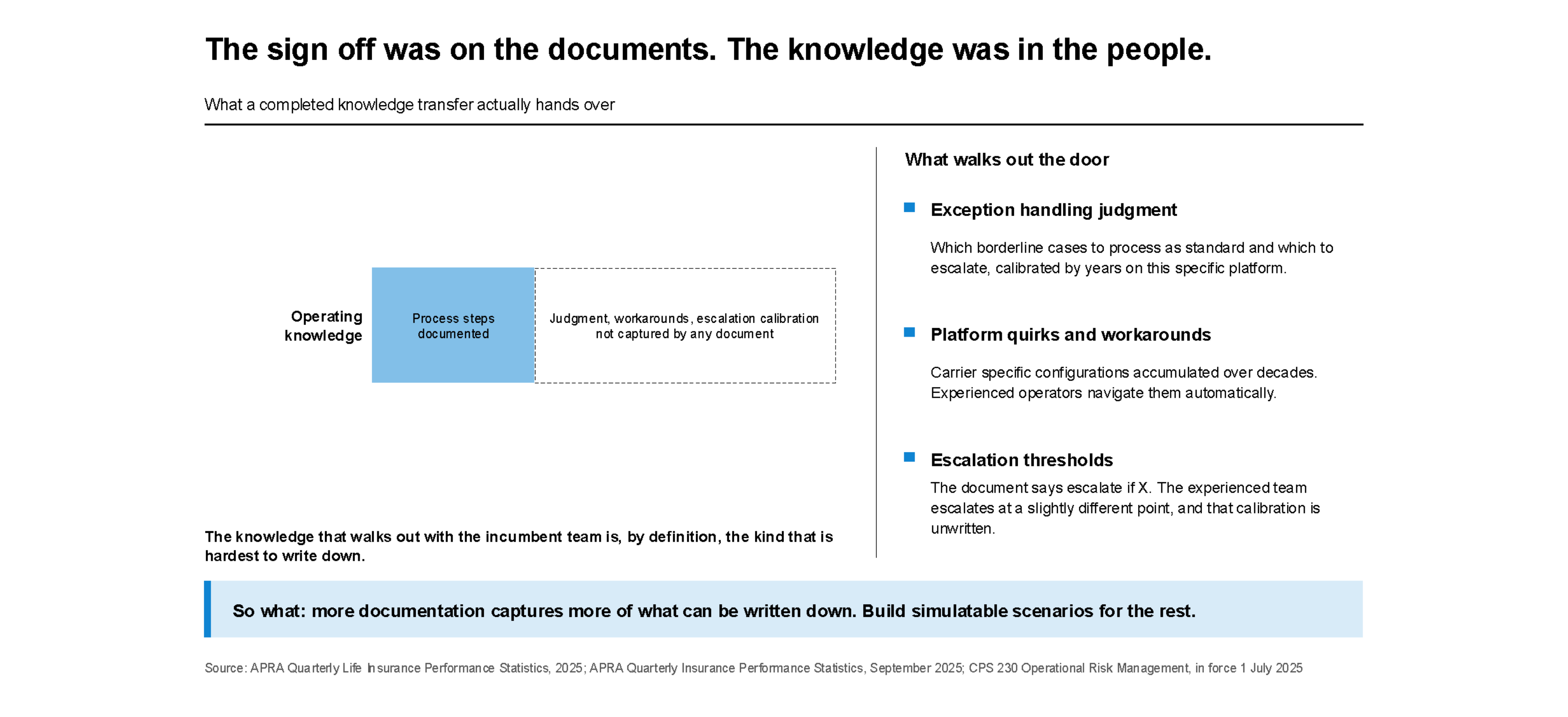
Most transition plans mark "knowledge transfer complete" when the documents are handed over. The sign-off is on the documents. The knowledge was in the people.
Three types of knowledge walk out the door that standard documentation does not hold.
Exception-handling judgment: the experienced operator knows which borderline cases to process as standard and which to escalate. That decision is not in the runbook. It is calibrated by years of practice on the specific platform.
Platform quirks and workarounds accumulate carrier-specific configurations and known workarounds over years of operation. Experienced operators navigate them automatically. New operators discover them under live conditions.
Escalation thresholds: the procedure document says escalate if X. The experienced team escalates at a slightly different threshold - because they know which escalations genuinely need senior review. That calibration is not written anywhere.
The answer is not more documentation. More documentation captures more of what can be written down. The knowledge that walks out with the incumbent team is, by definition, the kind that is hardest to write.
The answer is a different type of knowledge product: captured, structured, and simulatable.
Training simulators that replicate actual transaction types - including the edge cases and exception scenarios from the live book - allow incoming operators to encounter and practice the judgment calls before they are live. Reusable process playbooks include decision logic, not just process steps: they address the grey-area cases the flowchart does not reach.
Knowledge encoded in simulatable form does not walk out with any individual. It stays in the training infrastructure, reusable for every subsequent agent.
A knowledge capture programme has four outputs.
A scenario library: transaction types including the actual distribution of exception complexity from the live book - what operators will encounter, not just what is easy to demonstrate.
A simulation environment: an interactive tool where incoming agents practice the scenario library with performance tracking. Edge cases encountered in training, not in the live queue for the first time.
Decision playbooks: structured guides that go beyond process steps to include judgment logic - when to escalate, how to handle the grey-area exception, what the platform quirk means in this policy context.
Competence milestones: assessed checkpoints confirming the agent has worked through the relevant scenario range, not just that training hours are logged.
ISSI's delivery team is already fluent on the platforms ANZ carriers run with pre-built training simulators and knowledge bases built from live operating experience on those platforms. The simulation scenario libraries reflect actual operating conditions, including the edge cases that documentation alone does not capture.
If knowledge continuity is the risk your next BPO transition needs to address before the incumbent team leaves, it is worth thirty minutes.
Sources: APRA Quarterly Life Insurance Performance Statistics (2025); APRA Quarterly Insurance Performance Statistics (September 2025); IMARC Group Australia BPO Market Report (2025)