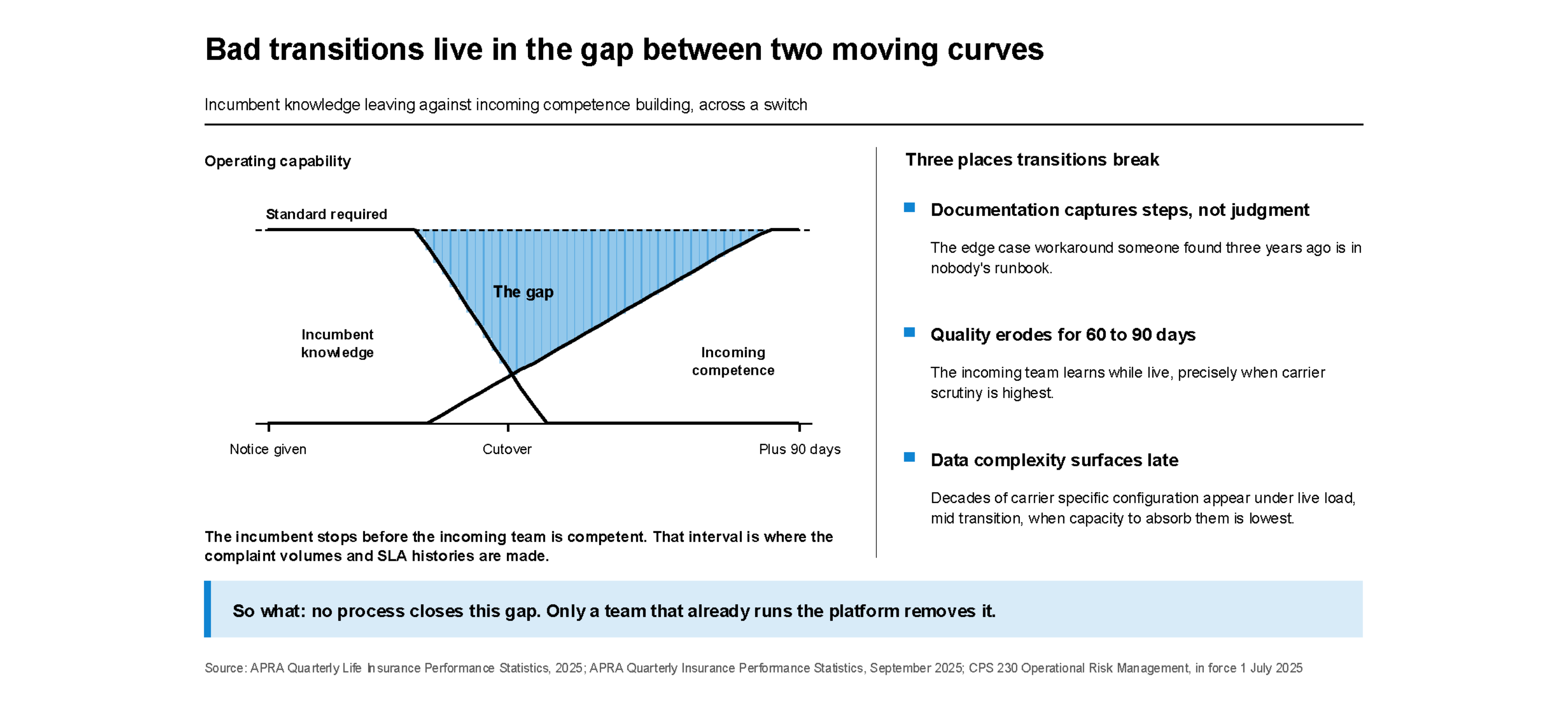


The incumbent team's last day was Friday. The incoming team started Monday. By Wednesday, the processing queue had grown. By the following week, the first complaint was escalating. The transition plan said this window would be covered by the parallel-run. The parallel-run ended two weeks earlier. The gap between where the incumbent stopped and where the incoming team became competent is exactly where bad transitions live.
A BPO transition concentrates operational risk into a window most carriers underestimate before they enter it. The incumbent team's knowledge, quality, and platform familiarity are being removed. The incoming team's competence and situational awareness are still being built. Both movements happen simultaneously.
The ANZ market is seeing more of these transitions. Insurance service expenses rose 7% year-on-year to September 2025 - cost pressure driving more carriers to review and switch operational partners. Each switch is a risk event. The ones that go wrong leave marks that persist in complaint volumes, SLA histories, and team confidence for years after the event.
The post-mortem on a failed BPO transition almost always identifies the same causes.
The first is the knowledge transfer gap. Documentation captures process steps - not judgment. The exception-handling decisions that experienced operators make without consulting a runbook, the edge cases with a workaround someone found three years ago, the platform quirks every tenured team member knows: none of this is in the handover documents.
The second is ramp-time SLA erosion. The incoming team is learning while live. Quality variance during the first 60 to 90 days is the norm - occurring precisely when carrier scrutiny is highest and the relationship is newest.
The third is data complexity surprise. Legacy policy administration platforms in ANZ carry decades of carrier-specific configurations and historical anomalies. These surface under live operating conditions, mid-transition, when capacity to absorb scope expansion is lowest.
No process closes the ramp gap. Only platform fluency does - and that is a structural answer, not a methodology one.
When the incoming team already knows the platform - the data model, the exception logic, the carrier-specific workflow configurations - the transition changes shape. The shadow period is about process handover, not platform learning. The parallel-run validates continuity rather than building competence. Cutover SLA can be committed from day one because the quality baseline is already established.
That eliminates the largest failure category before the transition begins. CPS 230, in force from 1 July 2025, requires carriers to manage operational risk in third-party arrangements. A transition with evidenced quality from cutover day one is the defensible position.
The entry conditions for a de-risked transition differ from the deliverables in a standard transition plan.
First: platform fluency is demonstrated before contract execution, not after. The test is whether the team can navigate exception-handling logic on the actual platform and explain what they would do when the runbook stops - not whether they can recite the process map.
Second: the shadow period is scoped in days, not weeks. When the incoming team already knows the platform, shadow is about observing carrier-specific process context, not learning a new environment.
Third: the cutover SLA commitment applies from day one, with quality reporting active immediately. A team that has established its quality baseline before go-live can commit to holding it at cutover - no hypercare grace period required.
In the next BPO selection, the question worth asking: if the last transition went wrong, what would have prevented it? The answer almost always names platform fluency first.
ISSI's delivery team is already fluent on the platforms ANZ carriers run with a ramp-time track record on carrier platforms. Platform fluency changes the transition: the parallel-run validates continuity, cutover SLA is committed from day one, and the largest failure category is removed before the switch begins.
If transition risk is the question your next provider review needs to resolve, it is worth thirty minutes to discuss what de-risked cutover looks like.
Sources: APRA Quarterly Life Insurance Performance Statistics (2025); APRA Quarterly Insurance Performance Statistics (September 2025); IMARC Group Australia BPO Market Report (2025)