

The cost review was not supposed to be remarkable. The CFO pulled the unit-cost data for claims processing - a routine quarterly read. The number had moved. Expense ratio was down. Cost-per-claim had improved. Nobody on the finance team had commissioned a cost programme twelve months ago. What they had commissioned was a claims engagement with a partner who co-owned the leakage outcome. The systemic fix had a cost dividend nobody had forecast.
Insurance service expenses grew 7% year-on-year at industry level through September 2025, even as carriers ran efficiency programmes. Other insurance expenses as a proportion of premium rose from 15% to 18% in the twelve months to June 2025. These numbers do not move with efficiency interventions alone, because efficiency programmes address the cost of doing the work - not the cost of doing the wrong work.
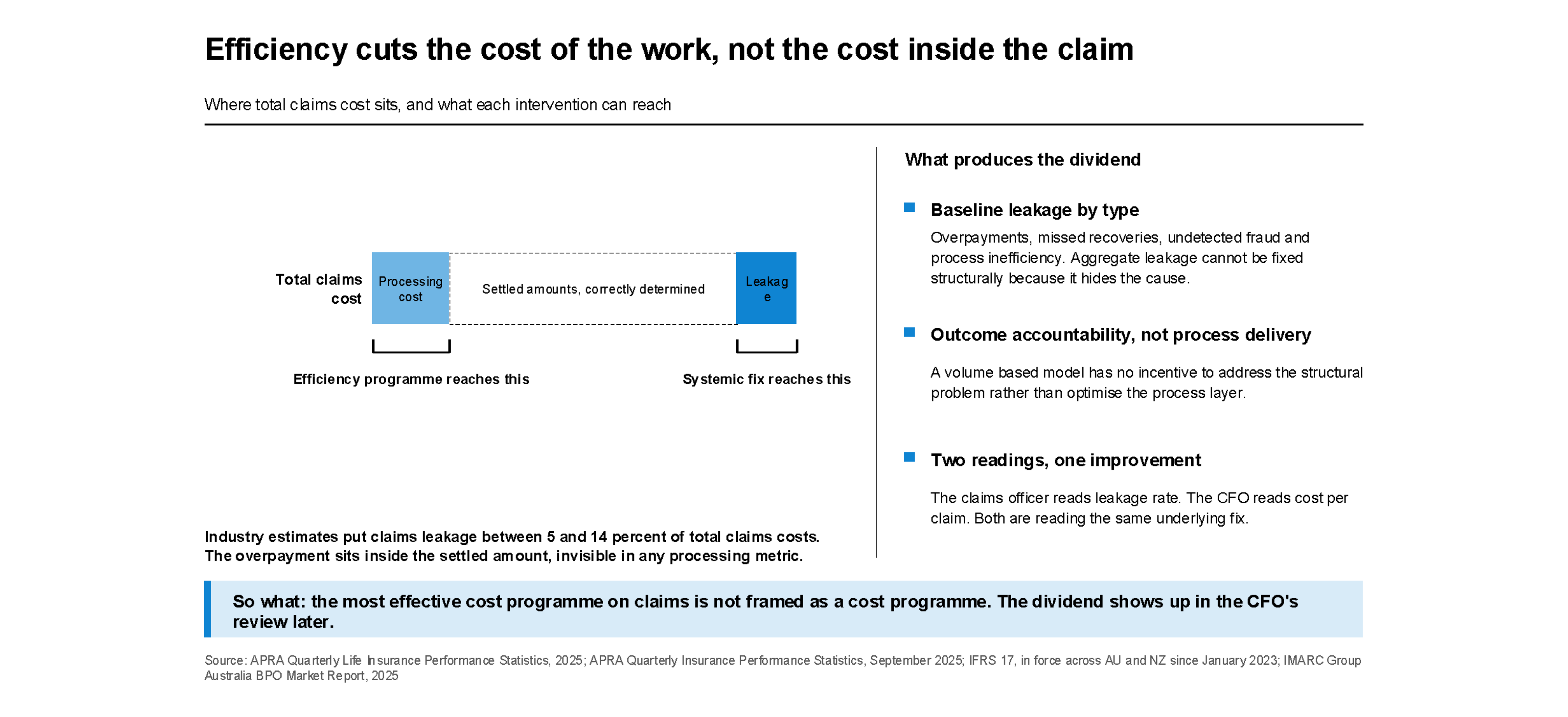
Industry estimates put claims leakage between 5 and 14% of total claims costs: overpayments, missed subrogation recoveries, undetected fraud, and process inefficiency that accumulates inside each claim. That number does not fall when you reduce processing cost. It falls when you fix the structural problem.
An efficiency programme reduces cost by removing steps, automating tasks, or renegotiating rates. The cost of processing a claim falls. The leakage that accumulates within the claim does not.
The overpayment sits inside the settled amount - invisible in the processing metric. The missed subrogation recovery never appears in the unit-cost data. The fraud that was not detected is already paid. These costs are inside the claim, not in the process steps the efficiency programme targeted.
The most effective cost programme a carrier can run on claims is not framed as a cost programme. It is framed as a claims outcome improvement - and the cost dividend appears in the CFO's quarterly review later, without anyone having forecast it.
The distinction matters structurally. An efficiency programme changes the cost of the process. A systemic fix changes the conditions that produce the loss. One produces a result that degrades when the intervention is removed. The other holds because the condition is gone.
A partner who co-owns claims outcomes is accountable for leakage rate, decision consistency, and fraud detection - not for the processing metric. That accountability creates the incentive to address the structural problem rather than optimise the process layer.
When the structural problem is fixed, three things happen simultaneously. Leakage falls. Downstream costs fall with it - fewer complaints, fewer recovery cycles, fewer rework events. And the data that the engagement generates is more granular and more attributable than anything the legacy process produced.
For carriers operating under IFRS 17, that data granularity is a finance reporting asset. IFRS 17 requires cost-per-claim data at a precision most legacy claims processes do not naturally produce. The systemic engagement that reduces leakage also generates exactly this data as a byproduct. The CFO is receiving two finance outcomes from the same engagement.
The pattern that produces a measurable, durable cost dividend from a systemic claims engagement has a recognisable shape.
Leakage is baselined by type before any intervention - not as an aggregate number, but disaggregated by category: overpayments, missed recoveries, undetected fraud, process inefficiency. Aggregate leakage data cannot be fixed structurally because it does not reveal the cause. Disaggregated data can.
The partner carries outcome accountability - not process delivery. An outcome-based commercial structure aligns the partner's interest with systemic improvement. A volume-based model does not.
The result is measured in both claims terms and finance terms. The Chief Claims Officer measures leakage rate and decision consistency. The CFO measures cost-per-claim and expense ratio movement. Both are reading the same underlying improvement, expressed in their respective measurement frameworks. The engagement satisfies both simultaneously.
ISSI's partnership model is structured around co-owning claims and fraud outcomes - not staffing a queue. With experience on claims-intensive platforms including PetSure's GapOnly real-time claims environment, ISSI works on an outcome-based commercial model. The same engagement that co-owns the claims result also produces the unit-cost improvement the CFO is measuring. If the structural problem is the conversation worth having, it is worth thirty minutes.
Sources: APRA Quarterly Life Insurance Performance Statistics (2025); APRA Quarterly Insurance Performance Statistics (September 2025); IMARC Group Australia BPO Market Report (2025)