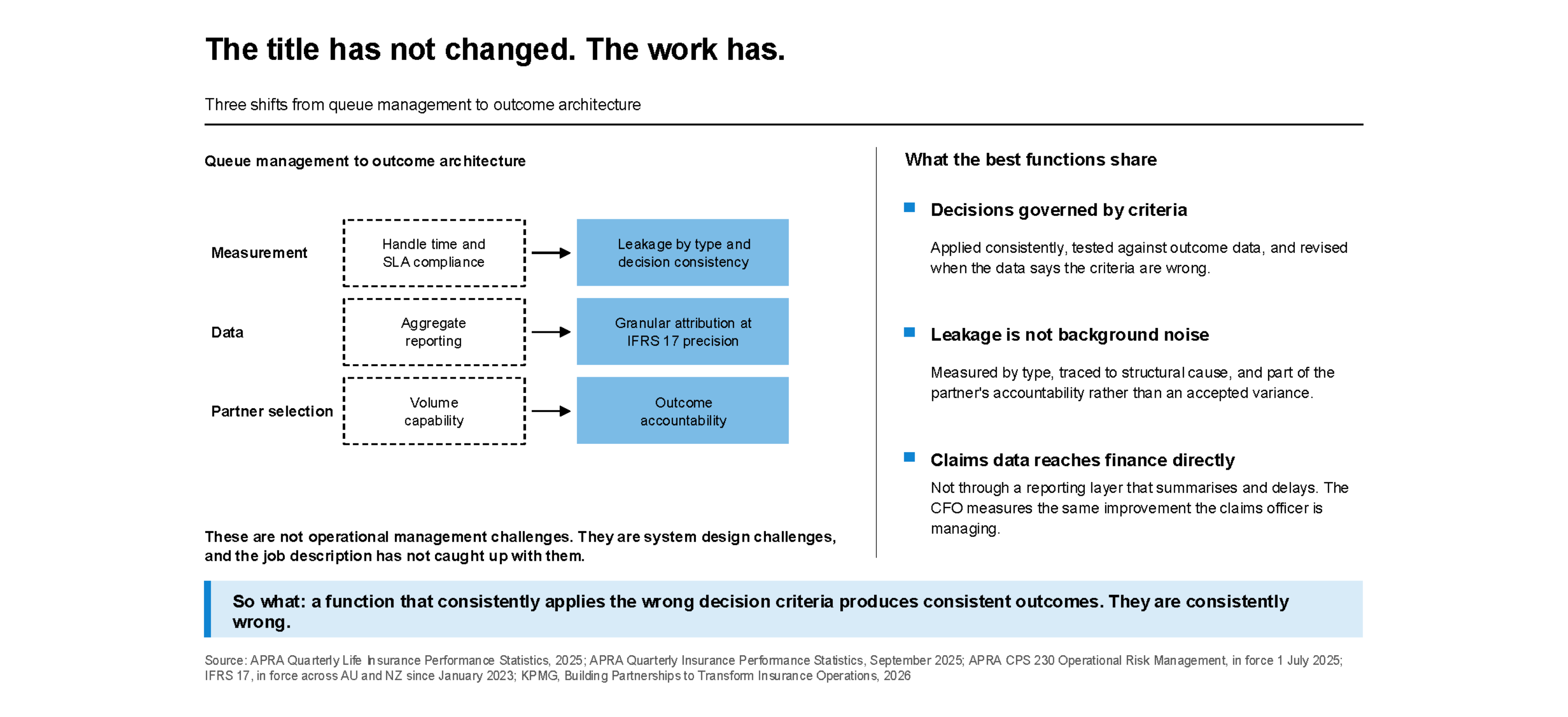


Five years ago, the Chief Claims Officer's primary job was process management. Keep the queue moving. Hit the SLAs. Manage the team capacity. Today, the best people in that role are doing something else - not a better version of the same job, but a fundamentally different one. They are not managing claims. They are architecting the system that produces the right claims outcome at scale. The title has not changed. The work has.
Most claims leader job descriptions still read like they were written for a queue-management environment. Manage the team. Deliver the SLA. Produce the quarterly report. The accountability the role actually carries in 2026 is different in character.
Systemic outcomes: leakage rate, decision consistency, fraud detection across thousands of claims. Regulatory defensibility: CPS 230 requires that critical operations - including claims - are designed to produce auditable, consistent results. IFRS 17 requires cost-per-claim precision that aggregate reporting cannot produce. These are not operational management challenges. They are system design challenges. And the claims leaders who are meeting them have made a different kind of transition than the job description reflects.
The queue-management model assumes the right combination of trained adjusters, documented protocols, and supervised workflows produces the right claims outcome. The accountability it measures: did the adjuster follow the protocol? Did the team hit the SLA? What it cannot measure is whether the claims system as a whole is producing the right result.
The best claims leaders are now accountable for the system that produces claims outcomes - not just the process that handles claims volume.
Queue management produces consistency at the process level. Outcome architecture produces consistency at the decision level. These are not the same thing. A function that consistently applies the wrong decision criteria produces consistent outcomes. They are consistently wrong.
The transition involves three specific changes, not a general cultural shift.
Measurement moves from process metrics to decision metrics. Handle time and SLA compliance give way to leakage rate by type, decision consistency, and fraud detection rate - metrics that require different data and different accountability.
Data moves from aggregate reporting to granular attribution. Cost-per-claim at IFRS 17 precision; leakage disaggregated so the structural cause is visible; decision data that allows the system criteria to be tested and revised when the results say they should be.
And partner selection moves from volume capability to outcome accountability. The partner carries a share of the claims result - not just the processing metric. That commercial structure is how outcome accountability becomes real rather than aspirational. The partner choice is also the most legible signal of where the claims function is heading - more legible, in practice, than any strategy document.
The functions furthest ahead on this journey are not defined by size or technology. They are defined by how they govern decisions.
Claims decisions are governed by a system of criteria - applied consistently, tested against outcome data, revised when the data says the criteria are wrong. Leakage is not background noise. It is measured by type, traced to its structural cause, and addressed through a programme that is part of the partner's accountability.
The claims data connects directly to the finance function - not through a reporting layer that summarises and delays, but as part of the carrier's management information. The CFO measures the same improvement the CCO is managing.
The regulatory conversation - CPS 230, equivalent regulatory governance requirements from RBNZ and FMA for NZ carriers, IFRS 17 - is not a compliance exercise for these functions. It is a natural consequence of how the claims system was designed. The standard asks for defensible, auditable outcomes. A well-designed claims system produces them.
ISSI's partnership model co-owns claims and fraud outcomes - not staffs a queue. With experience on claims-intensive platforms including PetSure's GapOnly real-time claims environment, ISSI works on an outcome-based commercial model rather than a staff-augmentation arrangement. If the claims function is being rebuilt around outcome ownership rather than volume management, it is worth thirty minutes to discuss what that partnership looks like in practice.
Sources: APRA Quarterly Life Insurance Performance Statistics (2025); APRA Quarterly Insurance Performance Statistics (September 2025); KPMG, "Building Partnerships to Transform Insurance Operations" (2026); IMARC Group Australia BPO Market Report (2025)