

The most valuable thing a cost-reduction engagement can produce is not a lower cost-per-claim. It is a problem you did not know you had. When you map cost at the task level, you see more than the task. You see the decisions inside it - and sometimes those decisions are what is making claims expensive.
Insurance service expenses across the AU market rose 7% year-on-year to September 2025, according to APRA's Quarterly Insurance Performance Statistics. For claims operations already under pressure - from IFRS 17 reserve scrutiny, CPS 230 operational risk requirements, and rising AFCA referral volumes - the response is typically a cost-reduction programme.
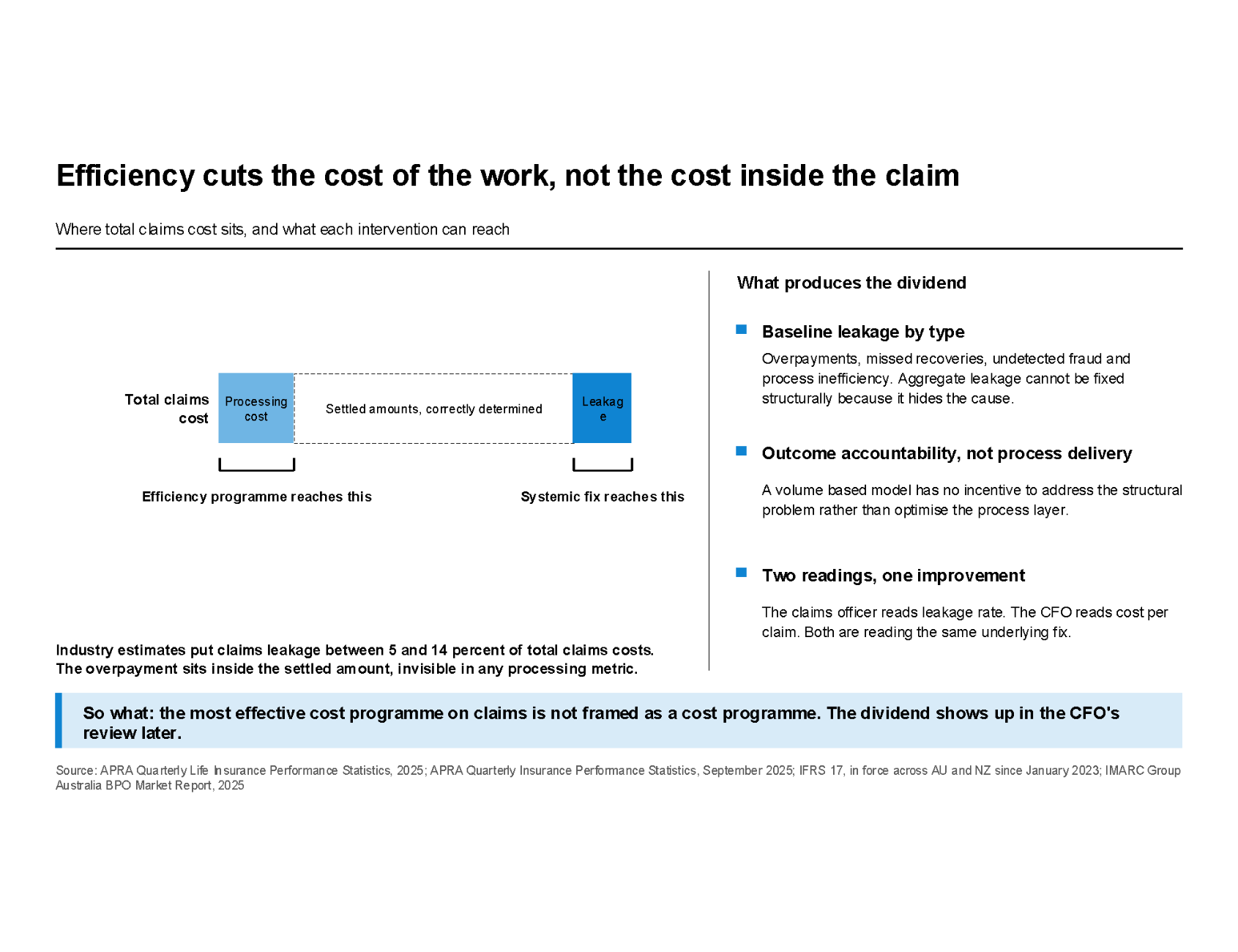
That response is appropriate. But efficiency work has a structural limit. It can find and fix what it is looking for. It cannot find what it is not looking for. And the most expensive problems in claims are often hiding in plain sight.
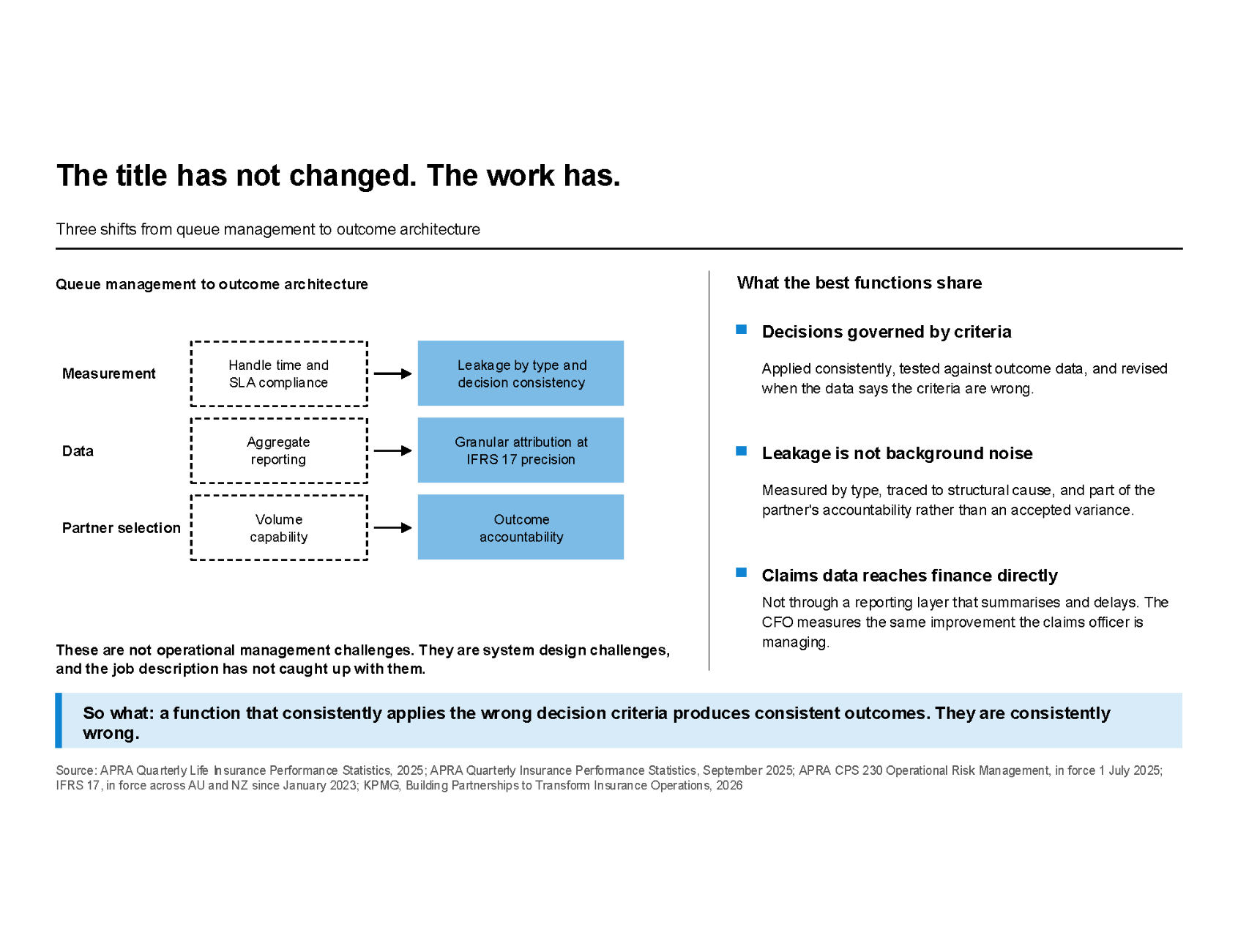
Leakage is not the same as inefficiency. An inefficient process takes too long or costs too much. A leaking process produces the wrong outcome - under-reserved claims, inconsistent decisions, disputes that could have been avoided.
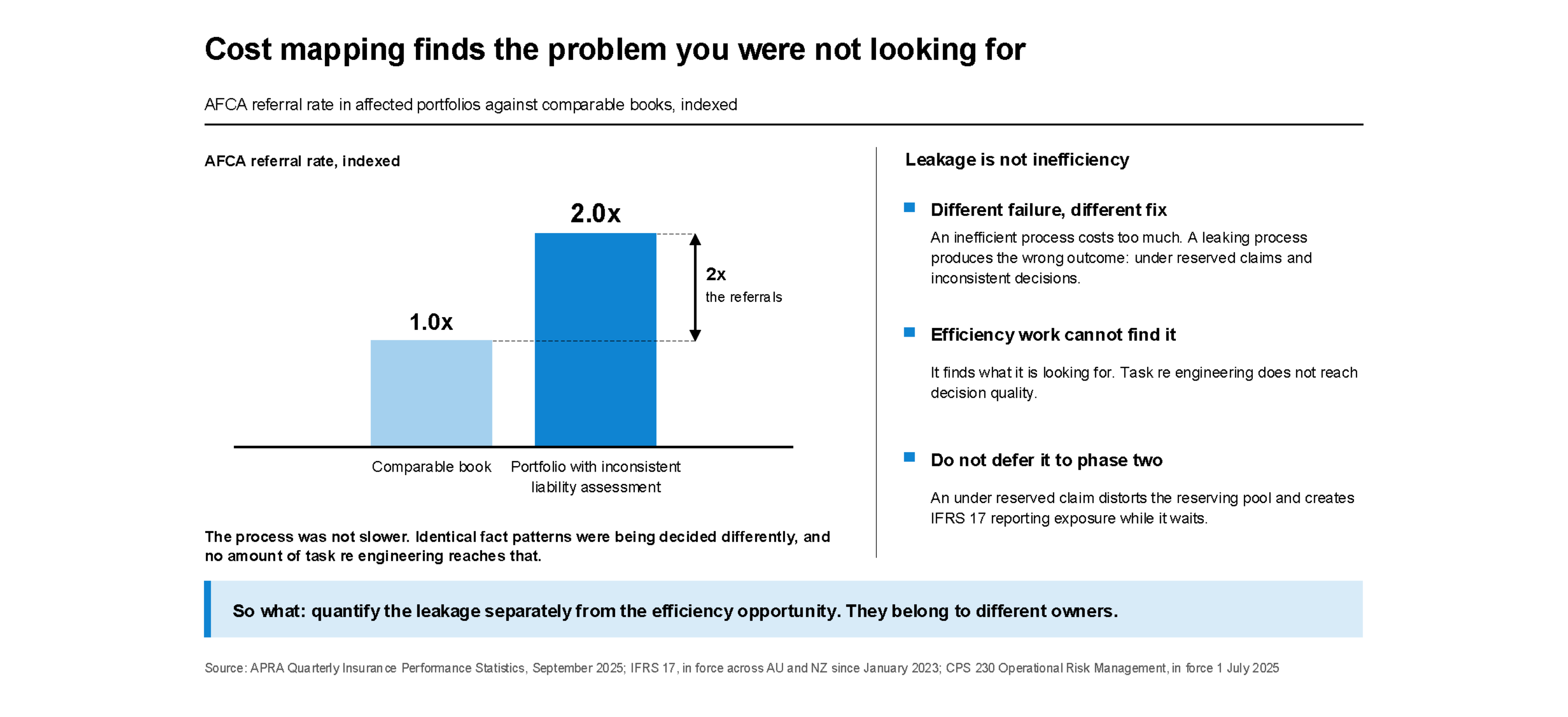
When task-level cost mapping is done carefully, it sometimes surfaces a pattern the original efficiency brief did not anticipate: a subset of claims - typically in high-complexity categories - where cost is not driven by process time but by decision quality. Reserves set too low. Liability assessments that vary across identical fact patterns. In some portfolios, AFCA referral rates running at twice the level of comparable books - not because the process is slow, but because the decisions are inconsistent.
This is not an operations problem. It is a decision quality problem. And no amount of task re-engineering fixes it.
The instinct, when cost mapping reveals leakage, is to treat it as a second project. Fix the efficiency problem first, then address the structural issue later. That sequencing is understandable - but it is usually the wrong call.
Leakage at the task level compounds over time. An under-reserved claim does not just cost more at settlement - it distorts the reserving pool, creates reporting exposure under IFRS 17 (in force across AU and NZ since January 2023), and, if the pattern is systemic, draws prudential attention from APRA. In NZ, fair insurance conduct requirements add another dimension: decision inconsistency is not just a cost issue, it is a conduct matter under NZ regulatory governance requirements.
The cost-anatomy work has done the hard part. It has found the problem. The question is whether the engagement is structured to fix it.
A claims operation that treats cost-anatomy work as the beginning of a diagnostic process - not the end - typically follows a different path.
First: the leakage pattern is quantified separately from the efficiency opportunity. The two numbers belong in different conversations with different owners - operations for the first, the Head of Claims or COO for the second.
Second: the structural root cause is identified. Is the decision inconsistency a training gap? A workflow problem? A data problem? In high-volume environments, inconsistency typically traces to the absence of a decision-support layer at the point of assessment - a structured view of comparable claims, prior settlements, and reserve adequacy signals.
Third: the commercial model for addressing it is separate from the cost-reduction contract. Co-owning a claims outcome - including leakage exposure and dispute rate - is a different engagement from running a queue efficiently. It requires a different partner with different accountability.
ISSI's partnership model is structured around co-owning claims and fraud outcomes - not staffing a queue. With experience on claims-intensive platforms including PetSure's GapOnly real-time claims environment, ISSI works on an outcome-based commercial model rather than a staff-augmentation arrangement. The right cost-reduction engagement surfaces the structural problem. If leakage, dispute patterns, or reserve adequacy is the conversation worth having, it is worth thirty minutes.
Sources: APRA Quarterly Insurance Performance Statistics, September 2025. IFRS 17 in force AU and NZ since January 2023. CPS 230 in force 1 July 2025.