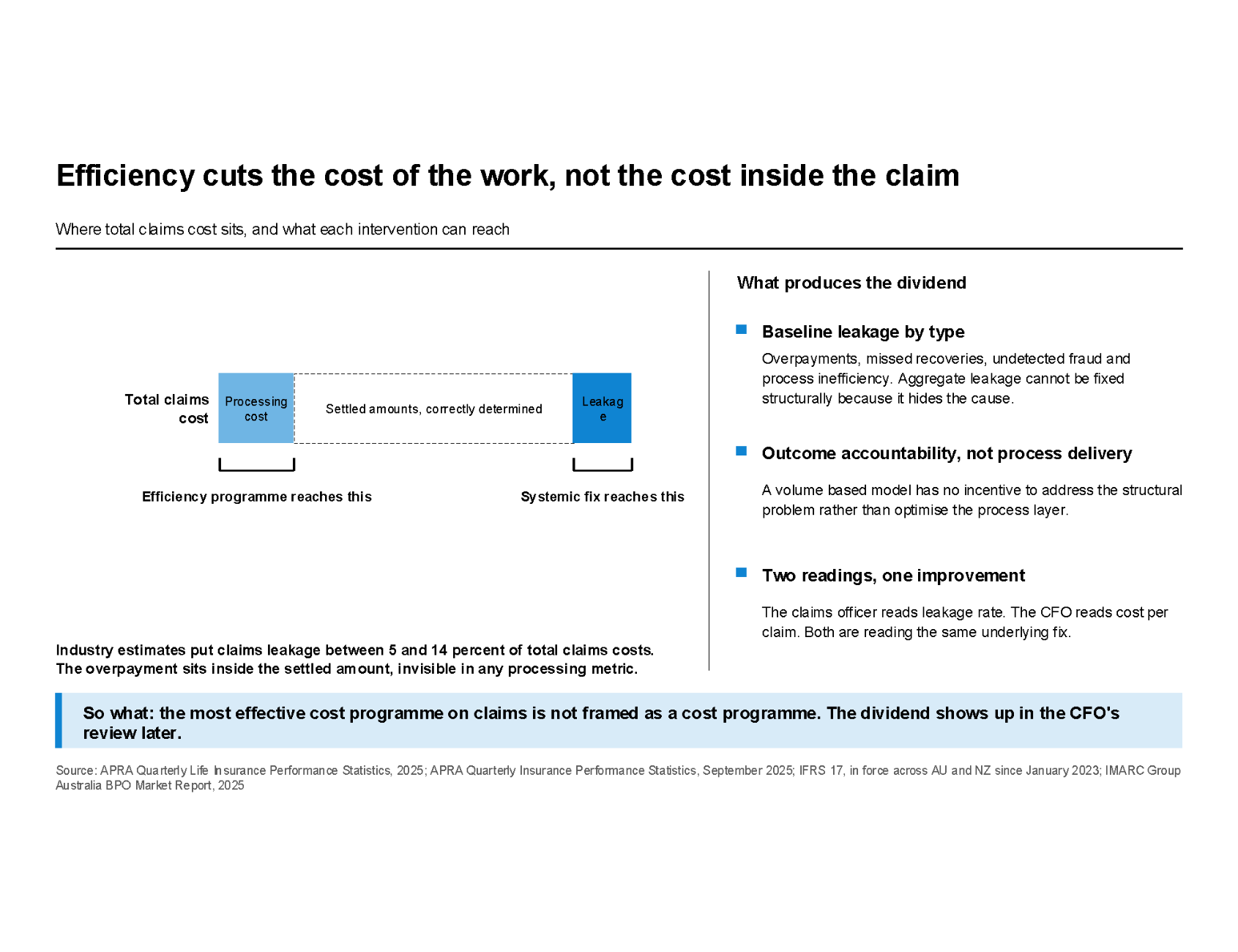


A claims dashboard full of green numbers is not evidence of a well-functioning claims operation. It is evidence of a well-functioning claims dashboard. The metrics most carriers track - volume, cycle time, settlement amount - are operational throughput measures. None of them predicts leakage. None of them predicts disputes.
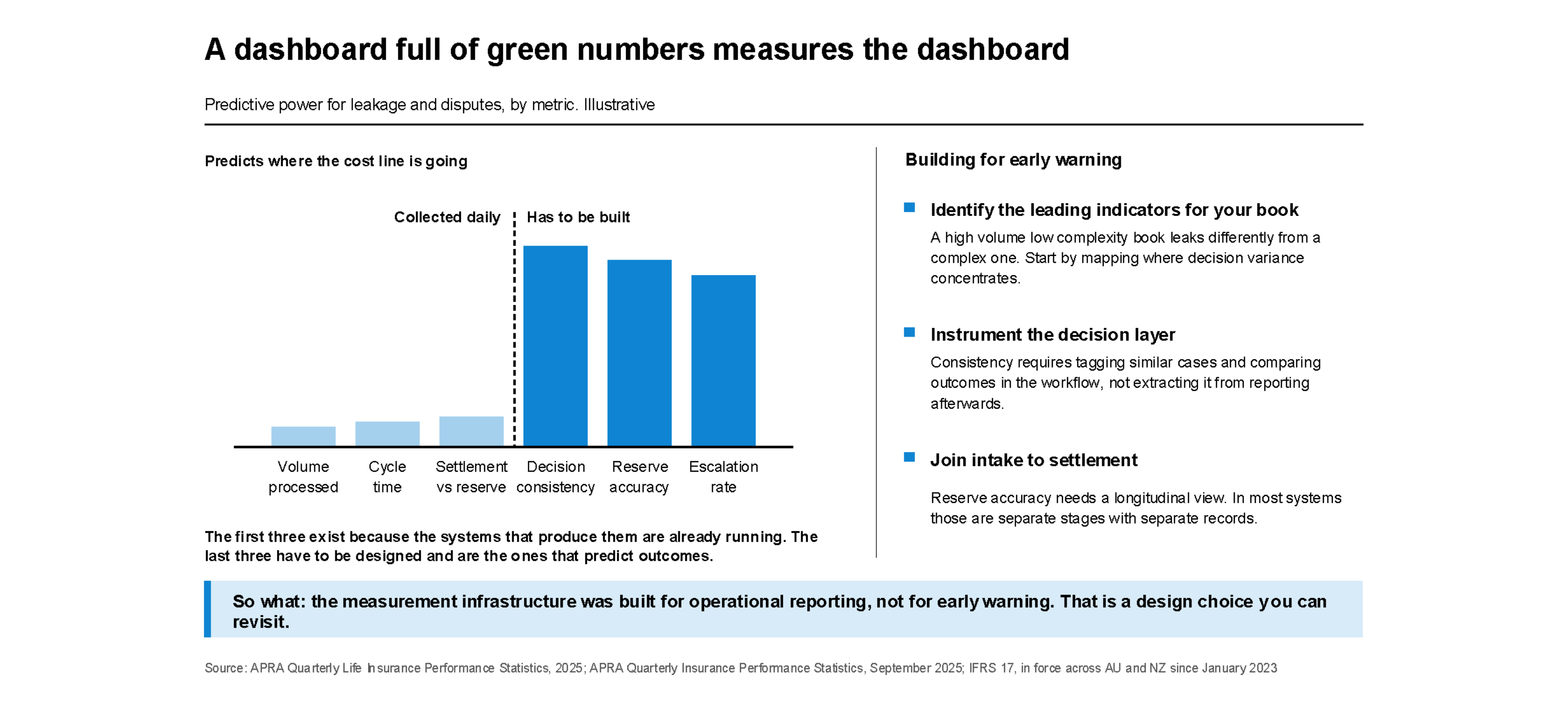
Claims measurement in most carriers is built around what is easy to collect: volume processed, average handle time, settlement amount against reserve, cycle time to close. These metrics exist because the systems that produce them are already running. They are not the metrics that predict the outcomes that matter. APRA data shows insurance service expenses grew 7% year-on-year at industry level through September 2025, while carriers ran efficiency programs measured against exactly these metrics. The efficiency programs moved the numbers. The underlying cost drivers were not reflected in the dashboard.
Which of the metrics on your claims dashboard would tell you, today, that leakage is rising? For most claims operations, the answer is: not the ones reviewed daily.
Volume metrics tell you how many decisions were made. Cycle time tells you how quickly. Settlement amount tells you what they cost. None tells you whether the decisions were consistent, whether reserves were accurate, or whether escalation pathways were being used.
The metrics that predict leakage are structural. Decision consistency score - how often handlers reach similar outcomes on similar cases - measures the decision architecture. Reserve accuracy - how often initial reserves match eventual settlements - measures intake assessment quality. Escalation rate by handler - how often cases are referred rather than decided unilaterally - measures whether the process is being used as designed. These metrics are harder to collect. They are also the ones that predict where the cost line is going.
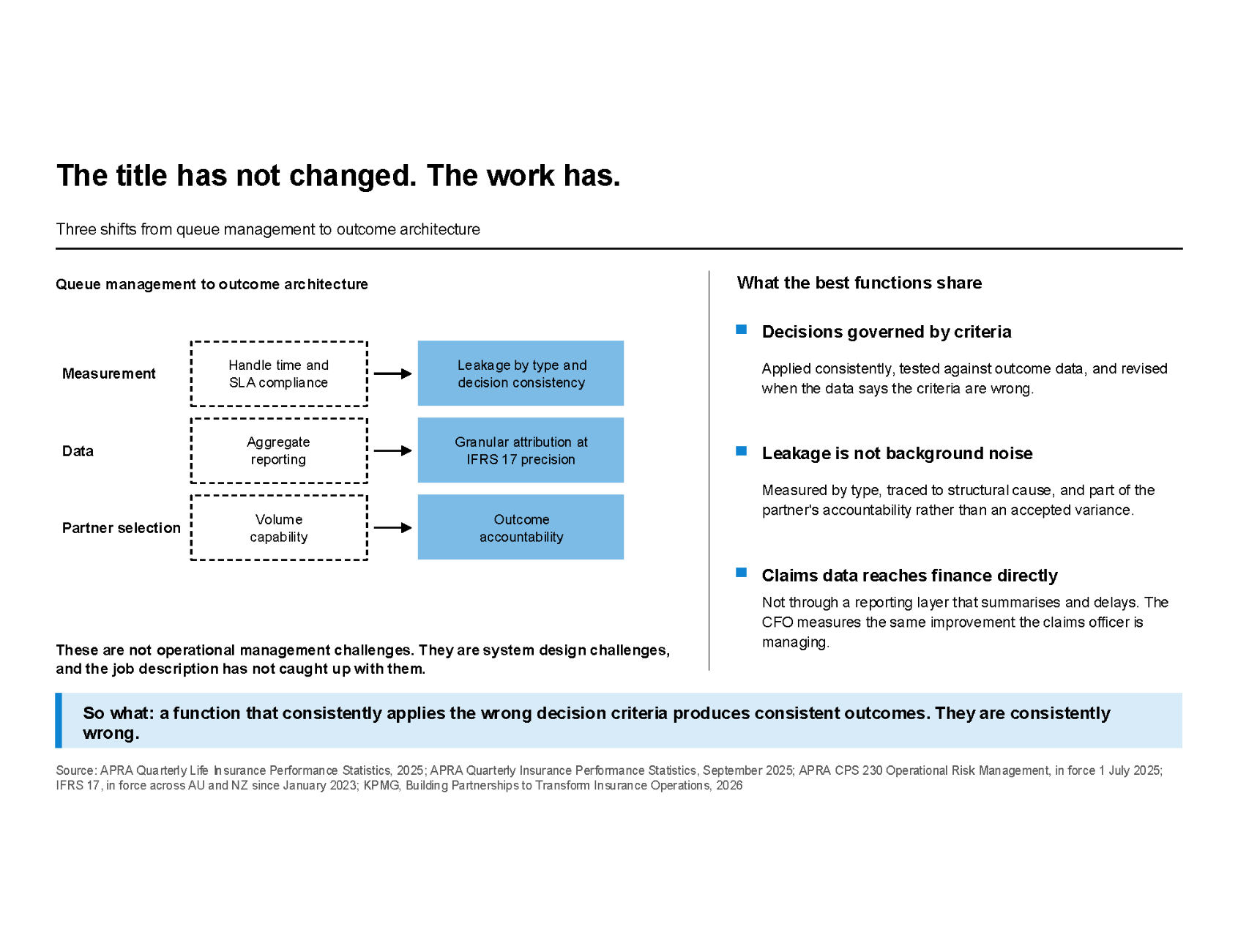
The problem is not that carriers are measuring the wrong things by choice. It is that the measurement infrastructure was built for operational reporting, not for early warning.
Operational metrics answer: are we processing on time, at volume, within budget? They are designed for day-to-day management. They are not designed to surface structural signals that predict where leakage will accumulate six months from now.
Predictive metrics require a different data architecture. Decision consistency cannot be calculated without a comparison layer: cases genuinely similar, assessed against the same policy provisions, reaching different outcomes. Reserve accuracy cannot be calculated without a longitudinal view: reserves set at intake against final settlement amounts. Neither is a standard output of a claims administration system.
IFRS 17, in force across AU and NZ since January 2023, adds a governance dimension. Under-reserving that was not externally visible under previous standards now appears in external reporting through the contractual service margin disclosures. Reserve accuracy is no longer solely an internal leakage concern.
Building a predictive claims measurement capability follows three steps.
First, identify the leading indicators for your specific book. Not all claims books leak in the same places. A book with high-volume, low-complexity claims leaks differently than a book with complex cases. The starting point is mapping where decision variance is concentrated.
Second, instrument the decision layer. Decision consistency is a metric that requires tagging similar cases, comparing outcomes across handlers, and building the comparison layer into the workflow rather than extracting it from reporting after the fact. This is a workflow design question as much as a data question.
Third, close the feedback loop between intake and settlement. Reserve accuracy requires joining intake records to eventual settlement outcomes deliberately. In most claims systems, these are separate workflow stages with separate data records. Building the longitudinal view requires that join to be designed.
ISSI's partnership model is structured around co-owning claims and fraud outcomes - not staffing a queue. With experience on claims-intensive platforms including PetSure's GapOnly real-time claims environment, ISSI works on an outcome-based commercial model rather than a staff-augmentation arrangement. If what gets measured in your claims operation - and what should - is the conversation worth having, it is worth thirty minutes.
Sources: APRA Quarterly Life Insurance Performance Statistics (2025); APRA Quarterly Insurance Performance Statistics (September 2025); IMARC Group Australia BPO Market Report (2025)