

The traditional claims model is organised around sequential verification. The real-time claims model is organised around front-loaded verification. One is designed for a world where information arrives late and decisions happen afterward. The other is designed for the moment the claim occurs.
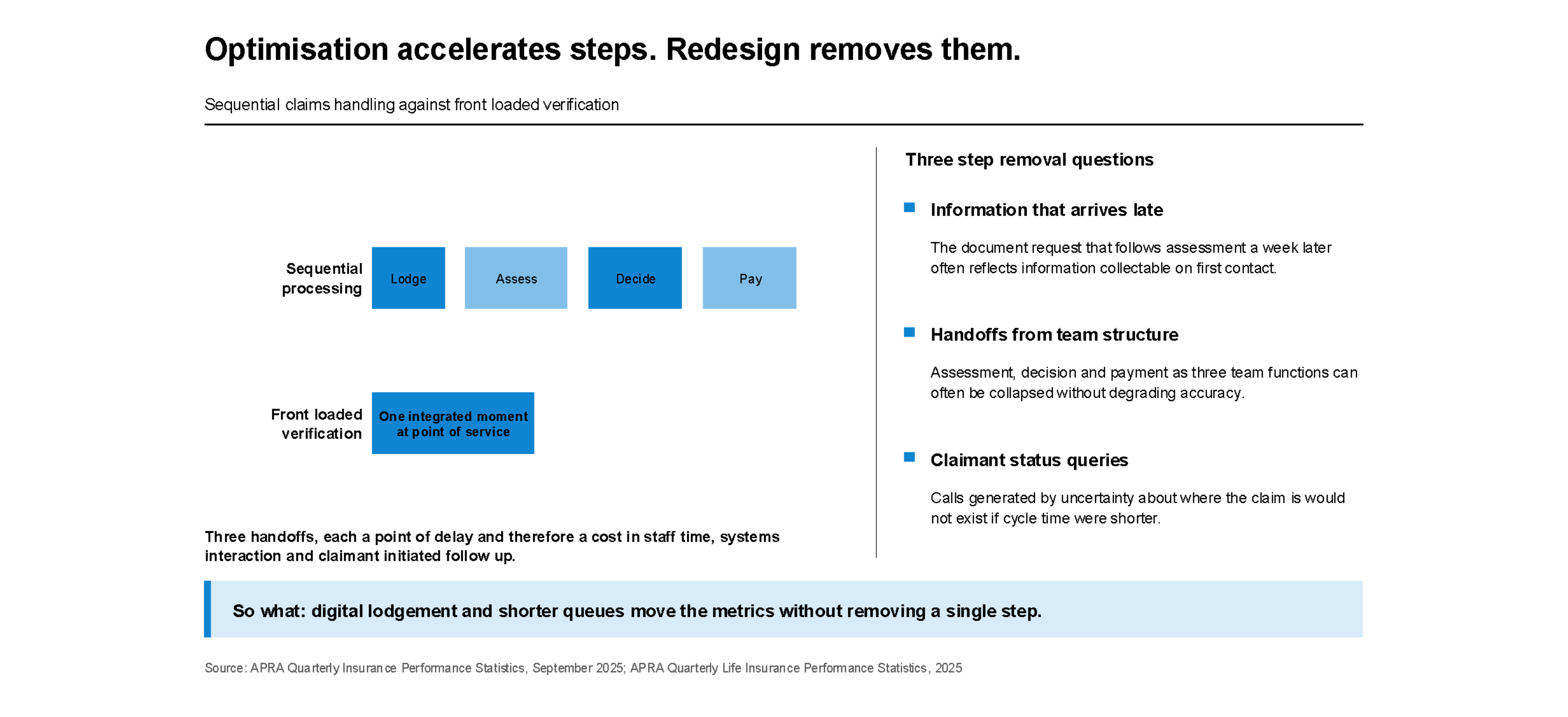
Sequential claims processing has a structural cost embedded in its design. Lodge, assess, decide, pay: each function is executed separately, by a different team or system, with a handoff between them. Each handoff is a point of delay. Each point of delay is a cost - in staff time, systems interaction, repeat contacts, and claimant-initiated status follow-up. APRA data shows insurance service expenses grew 7% year-on-year at industry level through September 2025, even as Australian carriers ran efficiency programs aimed at the claims cost line. The expense kept moving because the step count did not change.
Most claims improvement programs work within the existing process structure. Digital lodgement replaces paper. Automated acknowledgement replaces manual contact. Assessment queues are shortened. Each of these moves the metrics in the right direction. None of them removes a step.
If you could settle a claim at the point of service - before the claimant left the provider - what would that do to your cost-per-settlement? Most Australian carriers have not calculated it because the design has seemed impractical in conventional lines. But the model exists. ISSI has operating experience on PetSure's GapOnly real-time claims platform, which processes claims at point-of-service for veterinary gap payments. The model is not a technology novelty. It is a demonstration that front-loading the verification eliminates the downstream steps - and with them, the downstream cost.
The insight from real-time models is not that technology makes existing processes faster. It is that the goal is step removal, not step acceleration.
Sequential processing is designed for a world where information arrives late: the claimant lodges after the event, documents are requested and gathered, assessment occurs when the file is complete, decision follows. When verification is front-loaded - at the moment when the claimant and provider are both present and policy terms are applied to the real event in real time - the downstream steps become unnecessary. Assessment, document request, and decision are not three separate functions. They are a single integrated moment.
Cost savings from real-time models come from step removal. Process optimisation programs accelerate the steps that remain. They do not remove them.
The design principle from real-time claiming translates to conventional claims contexts as a diagnostic framework.
Three questions identify the step-removal opportunities in any claims operation. First: which steps exist because information arrives late, and could be eliminated by front-loading that information at intake? The document request that follows assessment a week later often reflects information that could have been collected on first contact. Second: which handoffs exist because of team structure rather than claim logic? Handoffs that move a claim from assessment to decision to payment as three team functions can often be collapsed without degrading accuracy. Third: which communication touchpoints are claimant-initiated status queries - calls generated by uncertainty about where the claim is - that would not exist if cycle time were shorter?
Each question is a redesign candidate, not an optimisation candidate. The operations that have moved cost-per-settlement have done it by redesigning the sequence.
ISSI's partnership model is structured around co-owning claims and fraud outcomes - not staffing a queue. With experience on claims-intensive platforms including PetSure's GapOnly real-time claims environment, ISSI works on an outcome-based commercial model rather than a staff-augmentation arrangement. If claims process redesign - rather than claims process optimisation - is the conversation worth having, it is worth thirty minutes.
Sources: APRA Quarterly Insurance Performance Statistics (September 2025); APRA Quarterly Life Insurance Performance Statistics (2025); IMARC Group Australia BPO Market Report (2025)