

The ramp model said eight weeks to functional competence. That was six months ago. The team is at week fourteen. Quality variance is still outside the SLA band. The operations planning lead has been asked again when the team will be fully productive.
The ramp period is the highest-risk interval in any outsourcing engagement. It is the window where the team is processing live customer transactions while still building the competence to handle them fully. Quality variance during this period is not a training statistic - it is a live service risk.
In APRA-regulated carriers, quality variance during outsourced operations sits within CPS 230 scope. AFCA complaint exposure in the months following an outsourcing go-live is predictable and consistently elevated. The plan treated ramp as a milestone to pass through. The actuals treat it as a cost centre with a customer harm dimension.
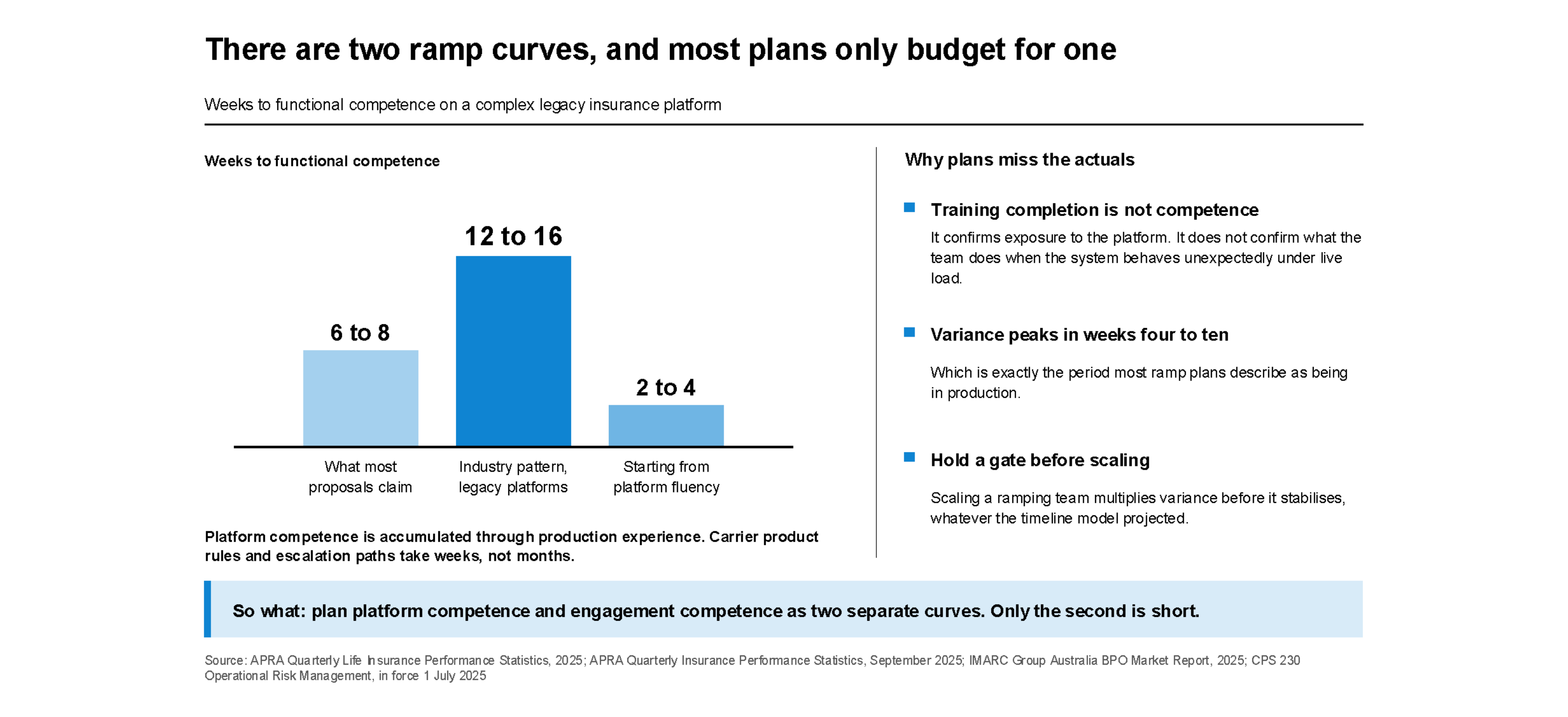
Industry patterns for insurance operations on complex legacy platforms consistently show 12-16 weeks to functional competence - most proposals claim 6-8 weeks. The gap between those two numbers is where the ramp period actually lives.
The planning model fails not because the training investment is inadequate, but because it conflates two different things. Training completion tells you the team has been exposed to the platform. It does not tell you the team knows what to do when the system behaves unexpectedly under live load.
On complex legacy insurance systems - CyberLife, wmA, Ingenium - the platform-specific knowledge that constitutes functional competence is accumulated through production experience, not training programs. The exception-handling logic. The data model quirks that only surface under real transaction volumes. The validation rules that fire differently in production than in the test environment. A team at training completion has been introduced to these variables. They have not yet encountered them under the conditions that matter.
Quality variance is highest in weeks four through ten. That is the period most ramp plans describe as "in production."
The confusion in ramp planning comes from treating it as a single curve. It is not.
There are two distinct competence requirements in any insurance BPO engagement. The first is platform competence: knowing how the specific system handles exceptions, understanding the data model, recognising which validation rules apply to which transaction types. On complex legacy platforms, this curve typically runs 12-16 weeks from a standing start. The second is engagement-specific competence: the carrier's particular product rules, escalation paths, reporting requirements, and exception categories. This curve runs weeks, not months.
A partner who arrives with pre-existing platform fluency - who has worked production transactions on CyberLife, wmA, or Ingenium for months before this engagement - has already completed the first curve. Only the second curve remains. The 12-16 week industry timeline compresses to weeks for system orientation and carrier process familiarisation, because the hard part is already done.
The ramp models that match actuals share three structural features.
First: they distinguish the two curves and plan them separately. Platform competence and engagement-specific competence are different timelines. A model that treats them as one will not predict either accurately. A partner who arrives with platform fluency changes the planning equation at the source.
Second: they measure quality variance during ramp, not just milestone dates. A team technically "in production" at week eight but running elevated quality variance is not meeting the operational standard. Quality variance is where service risk and AFCA complaint exposure live. The milestone date does not capture it.
Third: they hold a competence gate before scaling. Scaling a ramping team multiplies variance before it stabilises. Carriers with the lowest ramp-period SLA exposure are those that held the quality gate before increasing volume - regardless of what the timeline model projected.
The Australian BPO market is growing at 7.2% CAGR as more carriers use operational outsourcing to manage capacity. The ramp curve is the operating risk underneath every one of those decisions.
ISSI's delivery team is already fluent on the platforms ANZ carriers run with a ramp-time track record on carrier platforms. The ramp conversation ISSI has is honest about what the industry curve looks like and specific about where the starting point differs.
If ramp time is a planning constraint in your current outsourcing evaluation, it is worth thirty minutes to discuss what starting from fluency changes.
Sources: APRA Quarterly Life Insurance Performance Statistics (2025); APRA Quarterly Insurance Performance Statistics (September 2025); IMARC Group Australia BPO Market Report (2025)