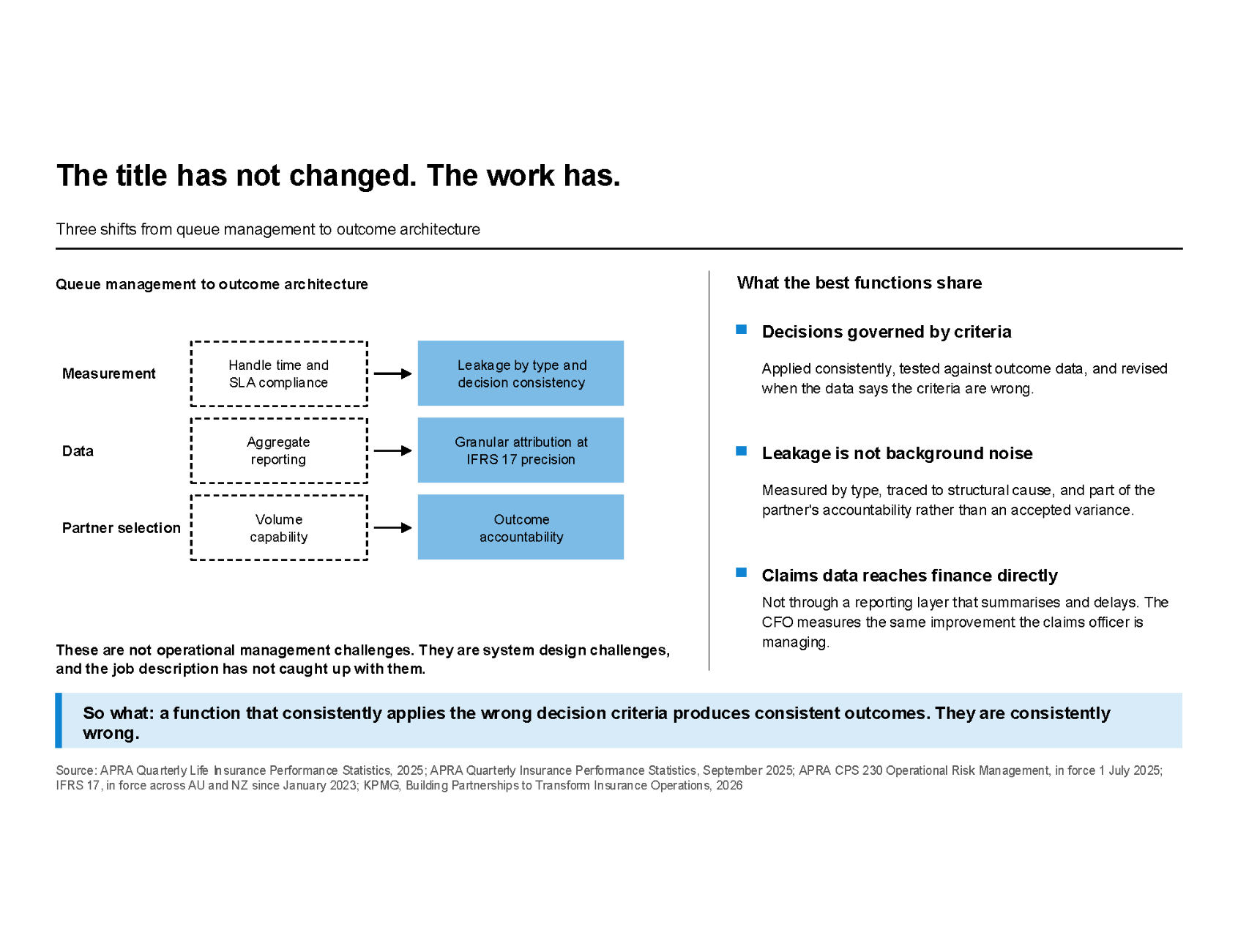


The Head of Claims can make the case for an operational improvement and get it approved. They cannot make the case for an outcome-based strategic partnership - because approving that kind of commercial arrangement is not in their authority. The deal that would have worked at EVP level never got there because it was pitched at the wrong level.
Systemic solutions get bought at the top. That is not a sales observation. It is a structural fact about how insurance carriers allocate resources to problems that exceed the authority of a single operational leader.
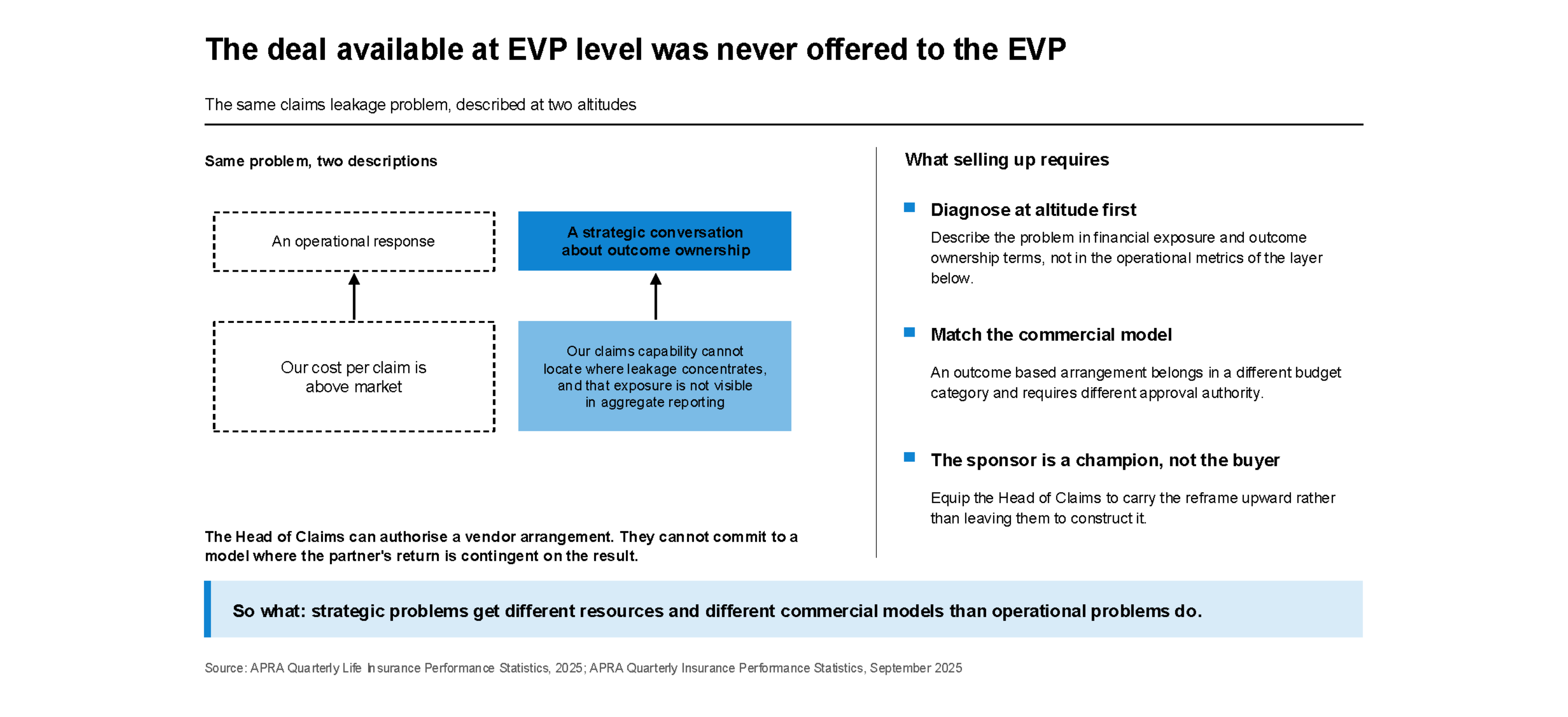
The Head of Claims can authorise a vendor arrangement. They cannot commit to the commercial model that a strategic partnership requires - shared outcome ownership, co-invested KPIs, an arrangement where the partner's return is contingent on the result. Those decisions sit at EVP or CEO level.
A pitch that starts at the operational level and aims to escalate almost never does. The deal that was available at the EVP level was never offered to the EVP. The operational sponsor reframes the conversation in the terms they are comfortable with: headcount, SLAs, cost-per-transaction. By the time it reaches the next layer, the language that would prompt a principal-level conversation has been translated out.
The claims-cost pitch is effective at operational level because claims cost is an operational metric. The Head of Claims measures it. The conversation is fluent. The pitch lands.
It does not land at EVP level because the EVP does not measure claims cost as their primary variable. The EVP measures outcome ownership, risk exposure, strategic positioning, and business improvement at the enterprise level. A pitch framed in operational terms - cycle time, handler ratio, SLA performance - does not connect to those measures.
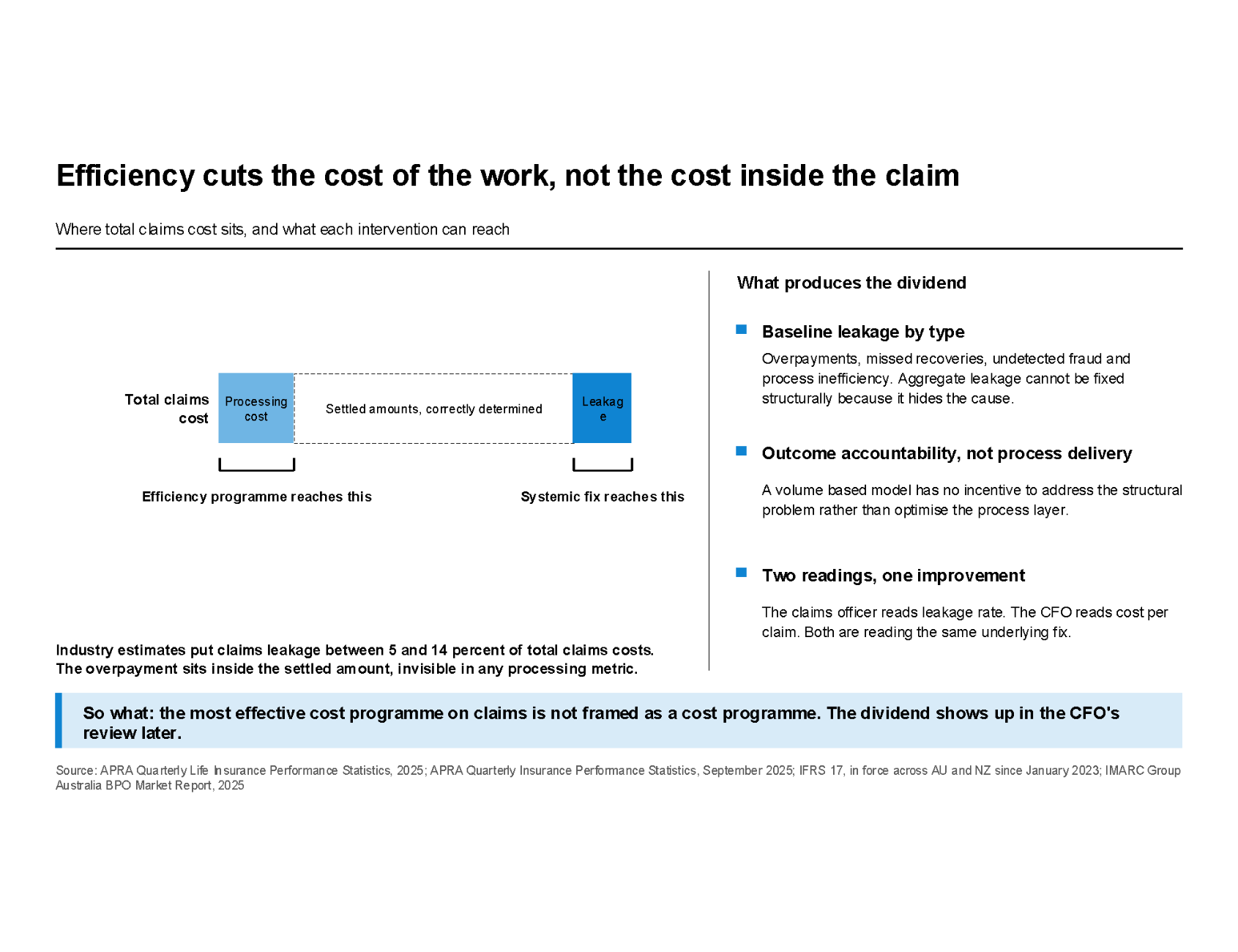
The translation problem is a framing problem. The systemic problem in the claims operation - leakage that headcount cannot fix, dispute rates that process improvement has not moved, fraud exposure that exceeds the team's analytical capability - is a strategic risk when described at sufficient altitude. It is an operational problem when described in operational terms. Strategic problems get different resources, different commercial models, and different levels of organisational commitment than operational problems do.
The conversation that reaches principal level is not about fixing the operational problem. It is about the systemic risk that the operational problem creates.
A claims leakage problem described to the EVP as our cost-per-claim is above market is an operational observation. The same problem described as our current claims capability does not have the analytical depth to locate where leakage is concentrating, and that creates material financial exposure not visible in our aggregate reporting is a strategic risk. The first invites an operational response. The second invites a strategic conversation about outcome ownership.
The commercial model matters here. An outcome-based partnership - where the partner's return is tied to the financial improvement they produce - is a conversation that makes sense at EVP level because the EVP is measured on outcomes. A staff-augmentation arrangement is an operational cost line. The two conversations are different in kind, not just in degree.
The discipline required to reach the principal-level conversation is specific.
First: diagnose at altitude before framing the problem. The systemic problem in the claims operation needs to be described in the EVP's terms - financial exposure, strategic risk, outcome ownership - rather than the operational metrics of the layer below.
Second: the commercial model has to match the altitude. An outcome-based arrangement - where the partner co-owns the financial improvement - belongs in a different budget category, requires different approval authority, and generates different internal advocacy from the operational sponsor.
Third: the operational sponsor needs to be a champion, not the decision-maker. The Head of Claims who understands the systemic problem is a valuable entry point. The goal is to equip them to take the conversation upward with the altitude reframe built in - not left to them to construct.
The pitch that stayed in procurement did so because it was framed at procurement level. The conversation that reaches the EVP is the one that starts there.
ISSI's partnership model is structured around co-owning claims and fraud outcomes - not staffing a queue. With experience on claims-intensive platforms including PetSure's GapOnly real-time claims environment, ISSI works on an outcome-based commercial model rather than a staff-augmentation arrangement. If systemic claims or fraud outcomes are not being addressed because the conversation has stayed at the operational level, it is worth thirty minutes with the right people in the room.
Sources: APRA Quarterly Life Insurance Performance Statistics (2025); APRA Quarterly Insurance Performance Statistics (September 2025)