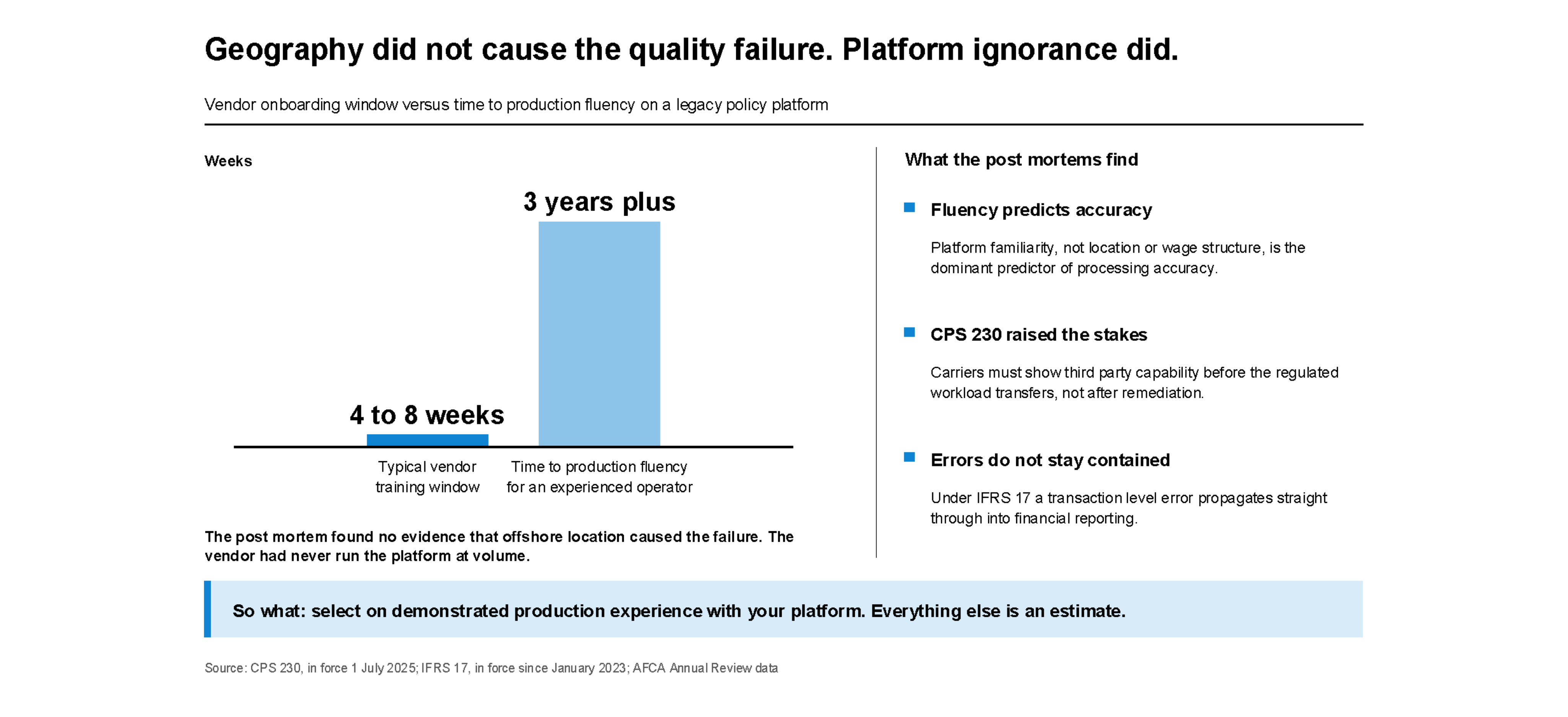


A Head of Quality at a mid-tier insurer signed off on an offshore BPO engagement eighteen months ago. SLA performance dropped in the first quarter. AFCA referrals ticked up by the third. The relationship was unwound by month ten. The post-mortem found no evidence that geography caused the problem - the vendor had never operated the carrier's policy administration system at production volume.
The wariness is earned. Offshore operations have failed in regulated insurance environments - not rarely, but often enough to make quality the primary objection in vendor procurement conversations. Under CPS 230, in force 1 July 2025, carriers must now demonstrate that third-party operators can meet their quality and resilience standards. The regulatory bar has raised the cost of a bad offshore decision. SLA breaches, complaint volumes, and AFCA referrals are no longer just operational metrics. They carry board-level visibility.
Quality failures in offshore insurance BPO share a pattern. The vendor is onboarded. Training runs for four to eight weeks. The team goes live on a policy administration platform - CyberLife, wmA, Ingenium, or a legacy variant - that takes experienced operators years to navigate at production volume. Exception queues grow. Manual overrides accumulate. Processing errors generate complaints that become AFCA referrals.
The difference is not management quality or staff turnover. It is platform knowledge from day one.
Geography does not determine quality. Platform ignorance does. The APRA supervisory expectation under CPS 230 is that outsourced operators demonstrate capability before taking on regulated workloads - not after eighteen months of rework and remediation.
Insurance BPO quality research consistently identifies platform familiarity as the dominant predictor of processing accuracy - not location, not wage structure, not team size. When offshore teams operate on systems they have run at production volume across multiple carrier environments, exception rates fall and quality metrics approach onshore benchmarks.
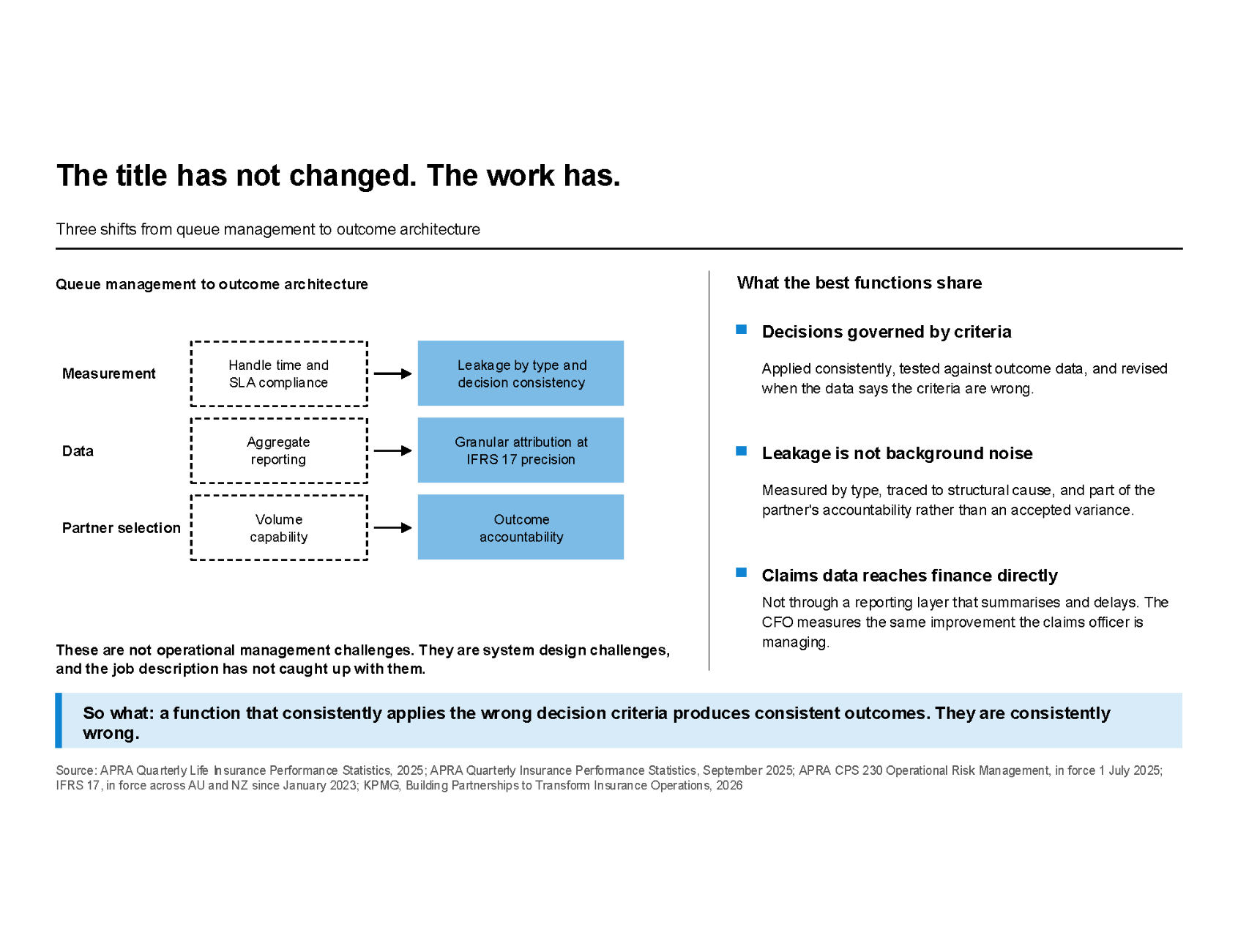
The regulated insurance context matters here. IFRS 17, in force since January 2023 across AU and NZ, depends on accurate transaction-level data. A processing error in a claims or policy record does not stay contained - it propagates through financial reporting. Carriers managing consolidated books face compounding accuracy requirements. The QA threshold for outsourced operations is the same as any internal team would hold.
Platform fluency is the mechanism. It is not a soft differentiator.
Carriers that have sustained quality outcomes from offshore operations share four characteristics.
First, operator selection is based on demonstrated platform experience - not general BPO capability or headcount. If the team has not operated your system at volume before, training timelines will be optimistic.
Second, QA frameworks are defined before go-live: SLA thresholds, error rate tolerances, escalation triggers, and AFCA referral rate bands - agreed in writing with measurable review intervals.
Third, a sandbox or pilot phase establishes a quality baseline before full migration. Ninety days of parallel running will surface platform gaps that no proposal document will disclose.
Fourth, regulatory governance is continuous, not a point-in-time audit. Under CPS 230, the board must be satisfied that third-party operations meet ongoing quality standards. The vendor's QA reporting cadence must match that expectation.
When these four elements are in place, the quality risk is not eliminated. But it is managed - with data, not assumptions.
Across regulated carrier environments, ISSI's QA framework tracks SLA performance, error rates, and complaint attribution at a level that satisfies CPS 230 board reporting requirements. If SLA degradation or complaints management is live in your organisation, it is worth thirty minutes to discuss what ISSI's platform-fluent operating model could show.
Sources: APRA Quarterly Life Insurance Performance Statistics, 2025; APRA Quarterly Insurance Performance Statistics, September 2025; CPS 230 Operational Risk Management (APRA, in force 1 July 2025); IFRS 17 Insurance Contracts (AASB 17 / NZ IFRS 17, in force January 2023); IMARC Group Australia BPO Market Report, 2025; AFCA Annual Review data.
PIPELINE RECORD
Blog number: 11
Status: PUBLISH-READY
Hook selected: C (Scenario) | Score: 13/15
S11 ANZ Localisation: PASS
S12 Persona Tone: PASS
S13 Brand Voice: PASS
S14 Claim Substantiation: PASS
S15 Regulatory Accuracy: PASS
S16 Persona Resonance: 22/25
Word count: 597 words (body only)
Hard limit (700 words): WITHIN LIMIT
Em dashes: 0
Produced: 2026-07-30