

The launch is three weeks late. The CFO has been given a timeline extension. The revenue model has not been updated. Nobody has calculated what three weeks of revenue that did not arrive actually costs.
Launch delays in insurance do not cost a timeline. They cost premium income. Every week a new product line is not in the market is a week of premium income that was modelled but not received. That income is not deferred to the next period. It is absent from the financial year.
In a book absorption, the cost structure is different but the financial logic is the same. Every week the acquired book operates outside the target operating model is a week of above-target cost-to-serve and delayed synergy realisation. The business case was built on a go-live date. When that date moves, the model's assumptions move with it. The CFO who accepts a timeline extension without updating the revenue model has accepted a hidden loss.
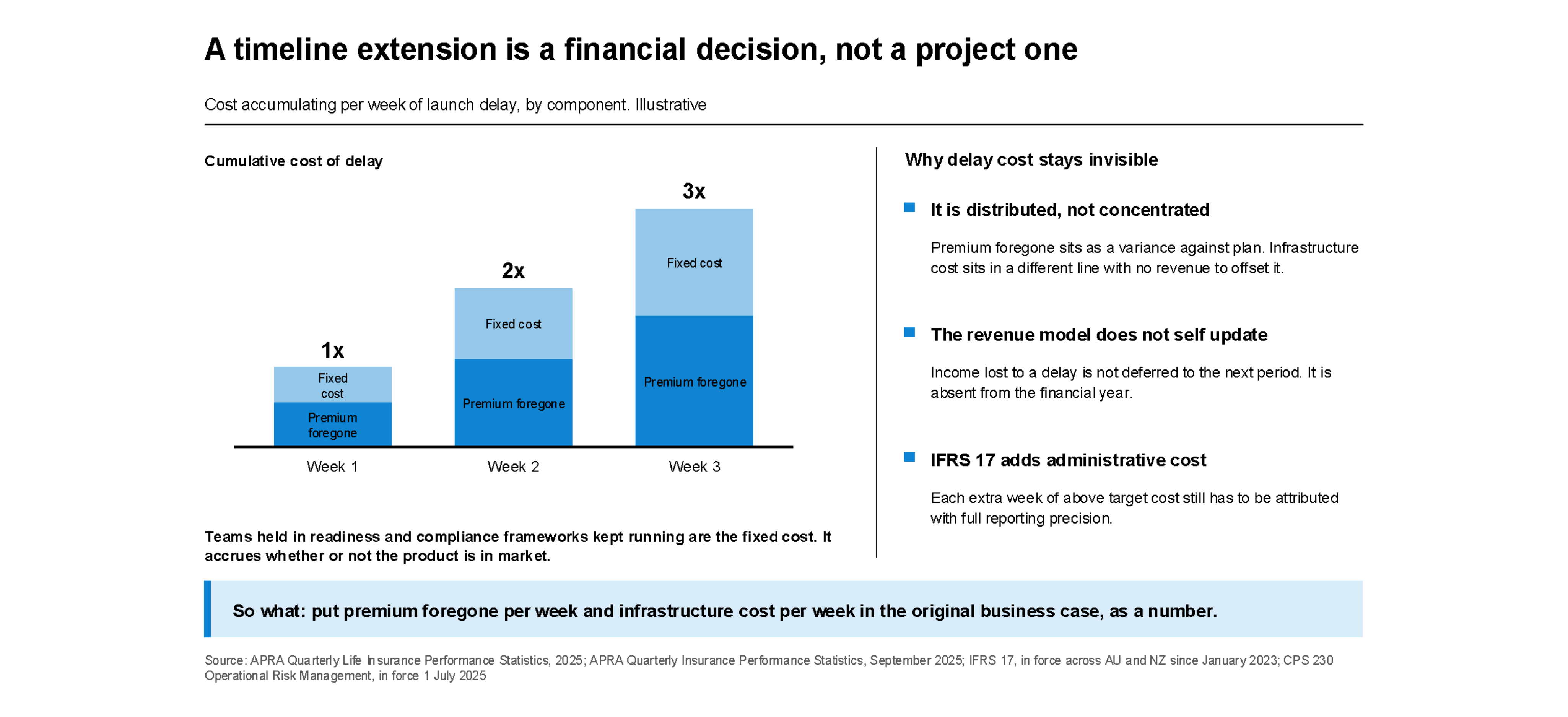
A timeline extension in a product launch is not a project management decision. It is a financial one - and the difference shows in whether the CFO updates the revenue model when the date moves.
Delay cost is invisible because it is distributed across line items rather than concentrated in a single number. The premium income foregone sits in the product P&L as a variance against plan. The fixed infrastructure cost - teams in readiness, systems maintained and active, compliance frameworks running - continues to accumulate during the delay without a corresponding revenue line to offset it. In a book absorption, AFCA complaint exposure increases with each additional week of transitional service quality.
Under IFRS 17, in force for AU and NZ carriers since January 2023, a delayed integration creates cost allocation complexity. Each additional week of above-target infrastructure cost must be attributed with the same reporting precision as the target operating model - adding administrative cost to the financial cost of the delay.
Treating operational speed as a delivery quality indicator - a sign of a good vendor, not a P&L driver - is the framing that allows delay costs to go untracked.
Speed is a financial metric. Revenue protection and cost compression, simultaneously. The cost-of-delay calculation is not complex: premium income foregone per week of delay, plus infrastructure cost incurred per week, minus any recovery mechanism if the timeline slips. A carrier launching a new product with a meaningful weekly premium run-rate will find that this number is material. A CFO who has not run it has not made a decision about delay. They have accepted one by default.
Once the calculation exists, the financial weight of operational speed becomes a procurement criterion. A partner who compresses the ramp to weeks rather than quarters is not offering a qualitative advantage. They are offering a quantifiable reduction in expected delay cost.
The launches and absorptions that reach their revenue model on schedule share three features in how they were planned.
First: the cost-of-delay calculation is in the original business case - not as a risk register item, but as a number. Premium income foregone per week of delay. Infrastructure cost per week. This number creates the financial justification for investing in operational speed rather than treating it as a secondary criterion.
Second: the time-to-live milestone carries CFO-level scrutiny alongside the financial milestones. When the go-live date moves, the revenue model updates. The delay cost is stated explicitly - not absorbed as a project management variance. This is financial discipline applied to an operational event.
Third: partner selection is based on a demonstrated ramp track record, not a projected timeline. The distinction changes the probability in the delay calculation. A demonstrated track record reduces the probability of delay. A projection does not. Under CPS 230, in force since 1 July 2025, the governance basis for partner selection is documentable. A track record is a governance document. A projection is not.
ISSI's delivery team is already fluent on the platforms ANZ carriers run with a ramp-time track record on carrier platforms The cost-of-delay calculation looks different when the operational partner can demonstrate a go-live timeline rather than project one.
If a launch or book absorption with a CFO-visible timeline is active, it is worth thirty minutes to discuss what that looks like.
Sources: APRA Quarterly Life Insurance Performance Statistics (2025); APRA Quarterly Insurance Performance Statistics (September 2025); IMARC Group Australia BPO Market Report (2025)