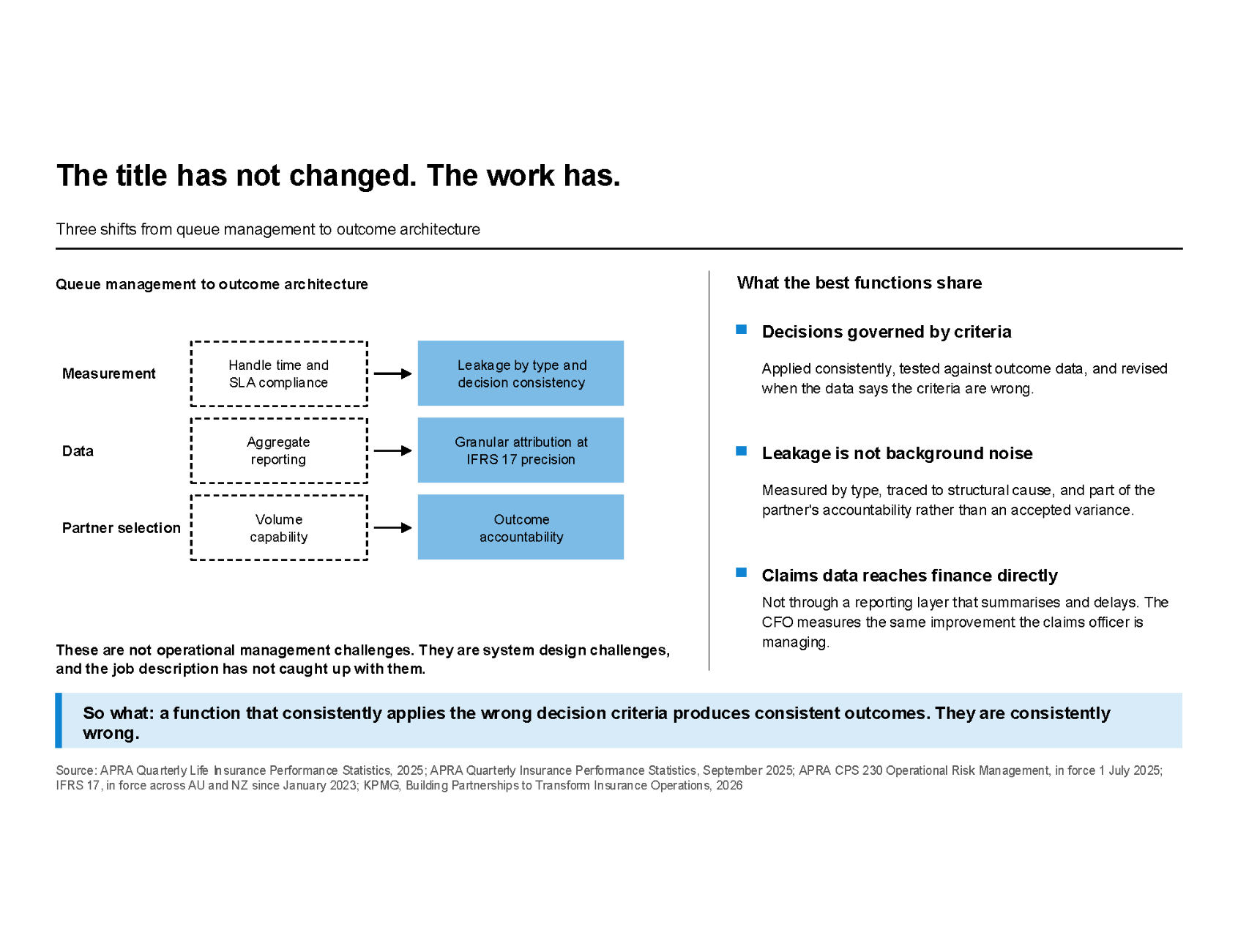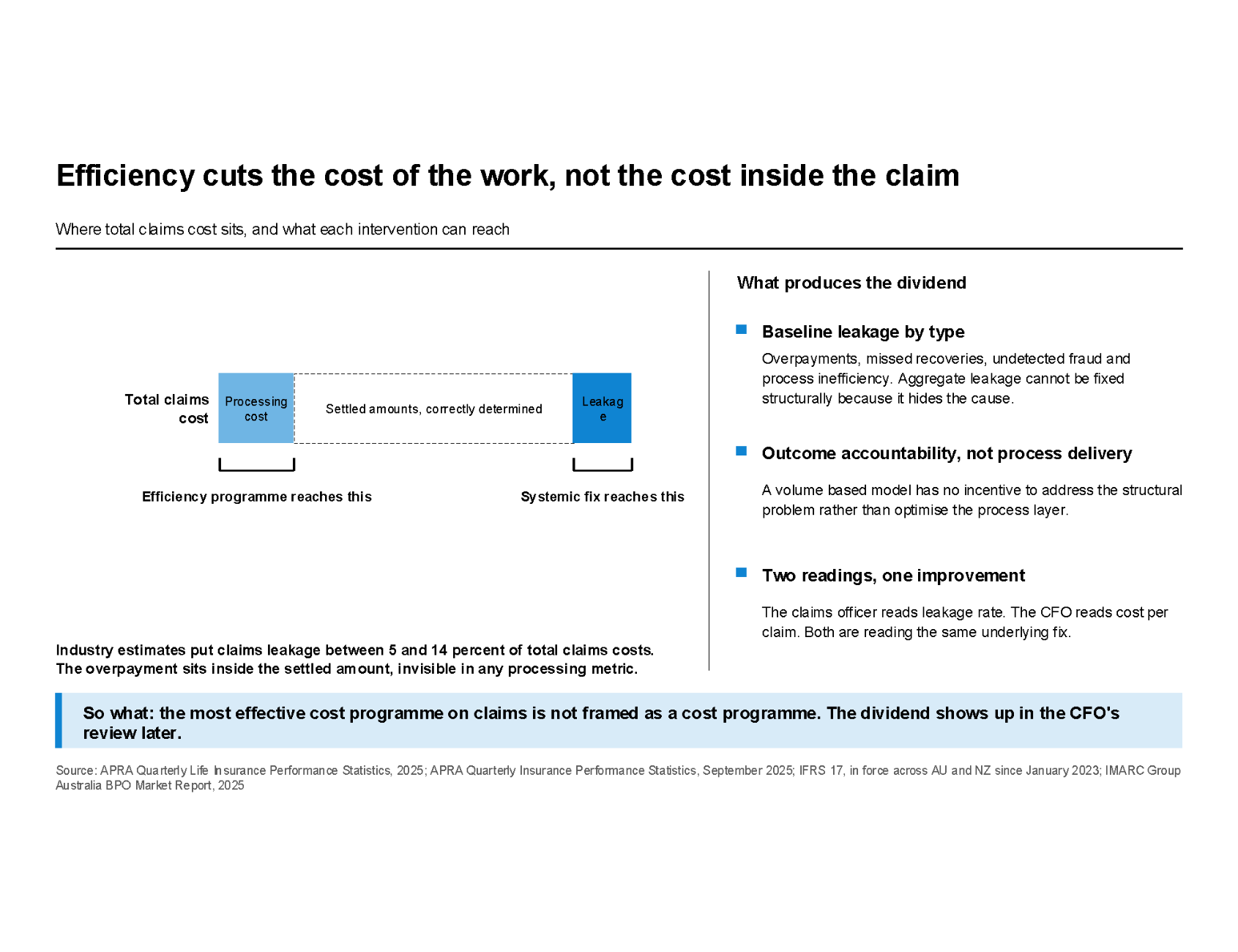


A CFO at a post-merger carrier is staring at an expense ratio that has moved in the wrong direction. The board report is six weeks out. Three BPO vendors have already been through the door. None of them brought a number the CFO could verify independently.
Insurance service expenses across AU rose 7% year-on-year to September 2025, according to APRA data. Life insurance expense ratios moved from 15% to 18% of premium over the 12 months to June 2025. These are public figures. The board can read them.
For the CFO, that creates a specific pressure: the question is not whether to reduce operational cost - it is how to bring a credible answer into the next board paper. A projection will not survive scrutiny. A number derived from the carrier's own data, auditable by the finance team, and defensible under CPS 230 might.
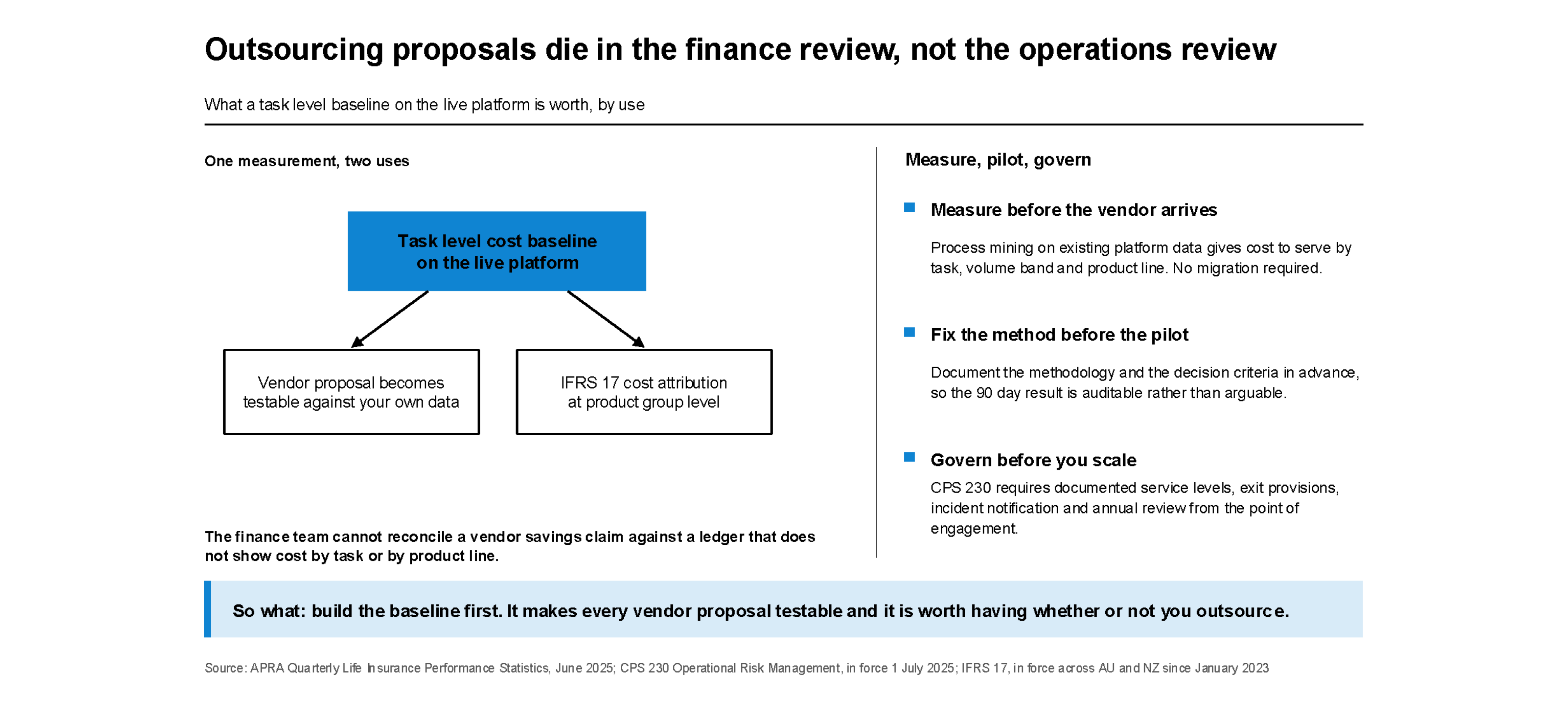
Most BPO proposals to insurance CFOs fail at the same point. The savings projection is built on benchmark data from peer carriers - not the carrier's own task-level costs. The finance team cannot reconcile a vendor's savings claim against a general ledger that does not show cost by task or product line.
IFRS 17, in force across AU and NZ since January 2023, compounds this. The standard requires insurance service expenses to be allocated at the product group level. Many carriers still report these as a consolidated line item. Without task-level measurement, the carrier lacks the baseline IFRS 17 demands - and any outsourcing decision rests on a projection the finance team cannot audit.
Vendors pitch projected savings. CFOs need measured baselines. That gap is where most outsourcing proposals die in the finance review - not in the operations conversation, but in the numbers conversation.
The CFO who has a framework before the vendor arrives controls the conversation. That framework has three parts: Measure, Pilot, Govern.
The insight is not that outsourcing is good or bad. It is that decision quality depends entirely on what gets measured before any commitment is made. A carrier that knows its cost-to-serve by task, by product line, and by policy count has a baseline. That baseline makes the vendor's proposal testable - and testable means auditable.
IFRS 17 creates a secondary benefit here. Task-level cost data - the output of a BPO diagnostic - is the same data IFRS 17 product group cost attribution requires. The CFO who builds this measurement infrastructure is not only preparing for a vendor decision. They are building reporting precision that survives the next audit cycle.
Measure. Process-mining applied to existing policy administration platform data produces cost-to-serve by task type, volume band, and product line. No migration required. No parallel build. The output is a baseline derived from the carrier's own transaction data - a number the finance team can verify and that makes any vendor proposal testable.
Pilot. Run a bounded scope: one product line, or a closed book. Document the methodology before the pilot begins. The 90-day result is auditable because the methodology was fixed before it started. Define decision criteria in advance: if the pilot produces X, the board decision is Y. A measured result - even a modest one - survives board scrutiny in a way a projection does not.
Govern. In AU, CPS 230 (in force 1 July 2025, with transitional arrangements expiring 1 July 2026) requires documented third-party arrangements: service levels, exit provisions, incident notification, and annual review. In NZ, RBNZ prudential requirements and FMA conduct obligations apply. The governance structure belongs before the pilot scales - not after. A vendor that cannot operate inside a documented governance framework introduces regulatory risk, not cost reduction.
The baseline diagnostic that underpins a CFO-credible BPO decision can be run on the carrier's existing platform - no migration required, no parallel build. If the expense ratio conversation needs a number that survives board scrutiny, it is worth thirty minutes to discuss what task-level measurement on your existing platform could show.
Sources: APRA Quarterly Life Insurance Performance Statistics, June 2025; APRA Quarterly Insurance Performance Statistics, September 2025; CPS 230 Operational Risk Management (APRA, in force 1 July 2025); IFRS 17 Insurance Contracts (in force January 2023, AU and NZ)