

The claim looked routine. It was lodged, acknowledged, assessed, and determined within the standard timeframe. The handler followed procedure. Three months later, an AFCA referral arrived. The question is not how the dispute was handled. It is when the claim actually went wrong.
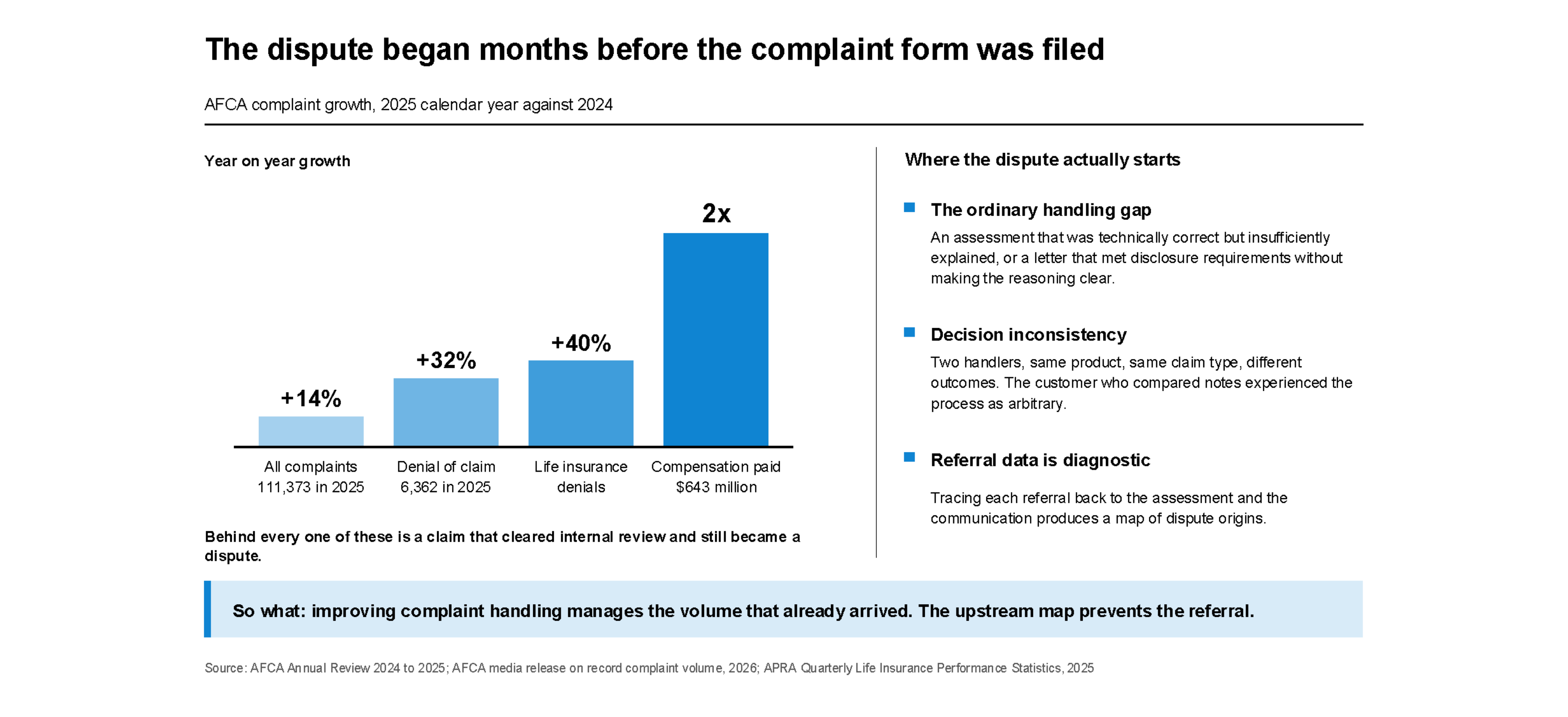
AFCA received 111,373 complaints in the 2025 calendar year - the highest annual volume in the authority's history, up 14% on the year before. Denial of claim complaints rose 32% to 6,362. Life insurance denials rose 40% year-on-year. Carriers collectively paid $643 million in compensation - more than double the prior year.
Behind every one of those referrals is a claim that cleared internal review and still became a dispute. The financial exposure is real. But the primary problem is not the cost of the compensation paid. The primary problem is that most of those disputes started long before the complaint form was filed.
The AFCA referral is not where the dispute begins. It begins at the moment the customer experienced a decision - or a communication, or a delay - as unfair. That moment is almost always upstream.
The most common upstream cause is not malfeasance. It is the ordinary handling gap: an assessment that was technically correct but insufficiently explained; a determination letter that met the regulatory disclosure requirement but did not make the reasoning clear to the customer; a decision that was defensible within policy wording but misaligned with what the customer reasonably understood the cover to provide.
The second upstream cause is decision inconsistency. Two handlers, same product, same claim type, different outcomes. Neither decision is necessarily wrong. But the customer who received the less favourable determination - and later compared notes - experienced the process as arbitrary. That experience generates complaints that would not exist if decisions were consistent and consistently explained.
The instinct is to manage the complaint better. Improve the internal dispute resolution process. Train the team on AFCA requirements. Respond faster. These steps are necessary. They are not where the systemic value is.
The upstream map is the intervention. That means tracing each referral back to the assessment, the communication, and the decision that preceded the complaint - and identifying the pattern. In most disputes, the pattern is findable. A specific product line where assessment documentation does not hold up to scrutiny. A handler cohort where determination letters fail to explain the decision clearly. A claim type where policy wording creates ambiguity that handlers resolve differently.
Fixing those upstream conditions changes the dispute rate. Improving the complaint-handling process manages the volume that has already arrived. The intervention that prevents the referral is worth more than the process that handles it after it arrives.
The practice that moves the dispute rate starts with using referral data as diagnostic input rather than compliance output.
Every AFCA referral contains information about where handling failed. Working backwards from the referral - to the assessment stage, the decision, and the communication - produces a map of dispute origins. That map is a handler-training brief, an assessment-quality checklist, and a communication-improvement agenda in one document.
Decision consistency is the second lever. Where handler discretion exists within a claim type, that discretion should follow documented criteria producing consistent outcomes across the team. Inconsistency is one of the most common upstream generators of complaints, and it is invisible in aggregate reporting.
Third: communication quality as a measurable standard, not a formality. The determination letter is the document the customer reads to understand why a decision was made. When it fails to answer that question in plain terms, it generates a complaint. Carriers who track communication quality at individual letter level - not just outcome level - find it is a leading indicator of dispute rate before complaints arrive.
ISSI's partnership model is structured around co-owning claims and fraud outcomes - not staffing a queue. With experience on claims-intensive platforms including PetSure's GapOnly real-time claims environment, ISSI works on an outcome-based commercial model rather than a staff-augmentation arrangement. If upstream handler quality, decision consistency, or communication gaps are driving a dispute rate that is not responding to internal improvement, it is worth thirty minutes.
Sources: AFCA Annual Review 2024-25; AFCA Media Release, "AFCA receives record number of complaints in 2025 calendar year" (2026); APRA Quarterly Life Insurance Performance Statistics (2025)