

The compliance sign-off came in yesterday. The product team is celebrating. The launch date is twelve weeks away. The launch lead is looking at the operational readiness plan - and the part of it that does not have a confirmed answer yet: is the servicing team going to be ready? The product is not the question. The operations are.
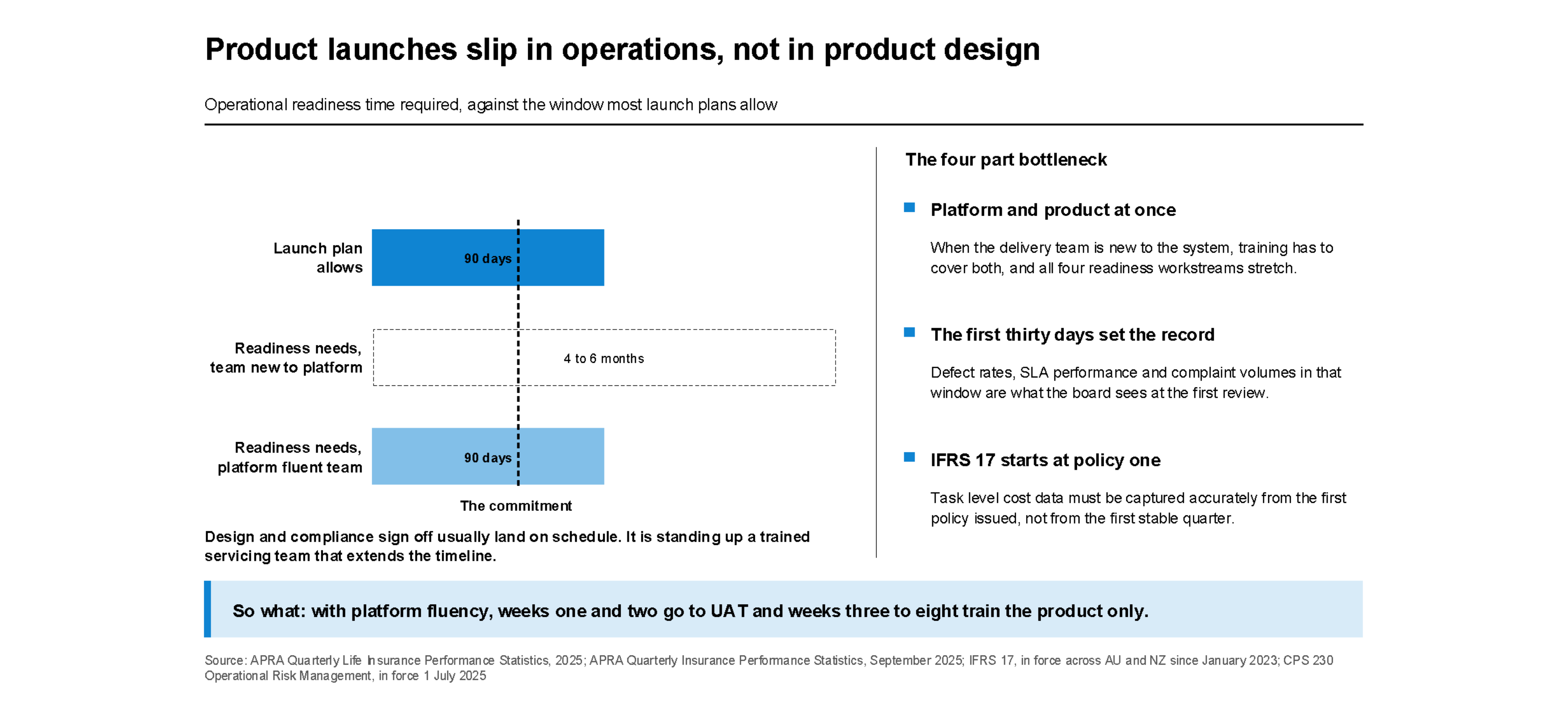
Product launches in ANZ insurance slip in operations, not in product design. Design and compliance sign-off typically land on schedule. What extends the timeline is the operational readiness phase: standing up a trained servicing team, building the QA framework, and validating the claims process.
The first thirty days post-launch set the product's quality trajectory. Defect rates, SLA performance, and complaint volumes in this window are the numbers the board sees at the first post-launch review. IFRS 17, in force in both Australia and New Zealand since January 2023, adds a financial reporting dimension: task-level cost data must be captured accurately from the first policy issued. Operational readiness from day one is an IFRS 17 requirement, not just a programme milestone.
The product is ready. The compliance work is done. The operational readiness is what determines whether the launch date holds - and it is almost always the last question to get a confirmed answer.
The bottleneck has four components: platform configuration and user acceptance testing, staff training, QA framework build, and process documentation. When the delivery team is new to the carrier's platform, all four take longer - because training must cover both the product and the system.
The policy administration platforms ANZ carriers run are not intuitive environments. Learning them under time pressure, while simultaneously learning a new product's logic, extends the readiness timeline. Industry pattern puts operational readiness, where the BPO team is new to the platform, at four to six months. Most product launch plans allow ninety days.
When the delivery team is already fluent on the carrier's platform, the bottleneck compresses.
Platform UAT participation happens from week one because the team already knows the system. Staff training covers the product only, not the platform. The QA framework extends from existing platform quality infrastructure rather than being built from zero. Process documentation moves faster when the team already understands the exception-handling context.
That compression makes the 90-day window real, not aspirational. Ninety days from compliance sign-off to live operations is achievable when platform fluency is the starting point.
CPS 230, in force from 1 July 2025, requires carriers to have documented and governed third-party operational arrangements in place from go-live. A team that is operationally ready from day one produces that documentation. One that is still learning the platform at launch does not.
A launch that holds the commitment organises the operational readiness work in four phases.
Weeks one and two: product configuration support. The delivery team participates in UAT because they already know the platform. Configuration issues surface before training begins.
Weeks three to eight: product-specific training only. All training hours go to the product's servicing and claims logic. The QA framework for the new product is built on the platform's existing quality infrastructure.
Weeks nine to eleven: parallel run at reduced volume. Defect rates from the parallel run give the launch lead a first-30-day quality forecast before go-live.
Week twelve: go-live at full volume. SLA and quality metrics reported from day one. IFRS 17 cost data captured accurately from the first policy. The product's quality record starts clean.
ISSI's delivery team is already fluent on the platforms ANZ carriers run with a ramp-time track record on carrier platforms. Platform fluency compresses the operational readiness timeline: UAT support from week one, product-only training, and quality reporting from launch day.
If operational readiness is the unanswered question in a 90-day product launch, it is worth thirty minutes to discuss what that looks like.
Sources: APRA Quarterly Life Insurance Performance Statistics (2025); APRA Quarterly Insurance Performance Statistics (September 2025); IMARC Group Australia BPO Market Report (2025)