

Every vendor in the room claims to ramp in six to eight weeks. The procurement team asked each one to put a time-to-live commitment in the contract. None of them did.
The ramp claim is the most common unverified number in an insurance BPO evaluation. Every vendor includes it in the proposal. Almost none of them will include it in the contract with a commercial consequence for missing it.
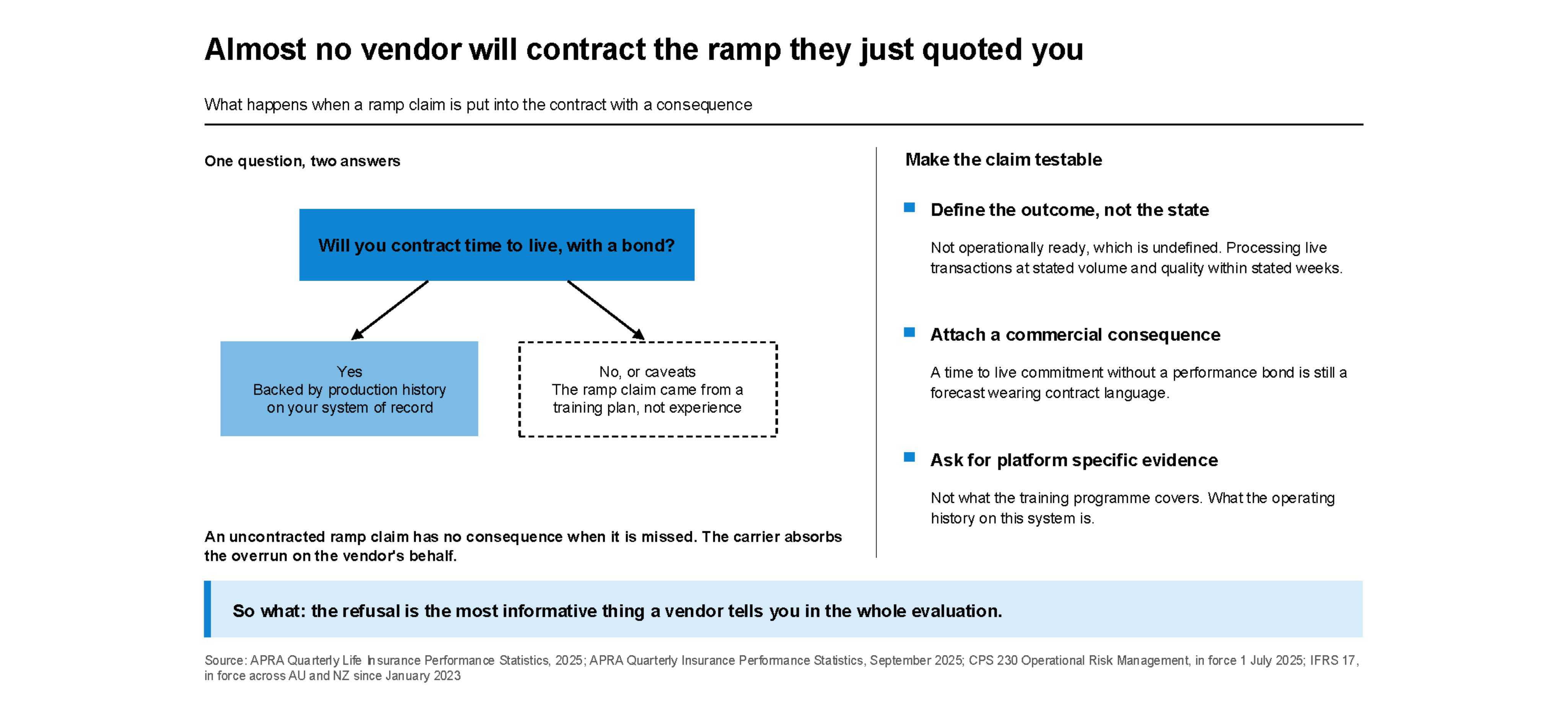
This is not an incidental oversight. An uncontracted ramp claim has no commercial consequence when it is not met. The buyer accepted a forecast and signed it as though it were a commitment. In a regulated insurance environment, every week of operational overrun carries a cost: service SLA exposure, AFCA complaint risk, and a measurable cost-to-serve impact that was not in the operational plan. The carrier absorbs that cost on the vendor's behalf.
Almost none of them will commit. That answer is the most informative thing they will tell you in the evaluation.
A contractual time-to-live SLA is a liability. It commits the vendor to a specific operational outcome - processing live transactions at defined quality and volume thresholds - within a defined timeframe, with financial consequence if it is not met. For a vendor whose ramp timeline is derived from a training program rather than from prior platform operating experience, that commitment is not a service level. It is a penalty clause for something they cannot guarantee.
CPS 230, in force since 1 July 2025, requires APRA-regulated carriers to document the governance basis for third-party arrangements. A procurement decision based on an uncontracted vendor claim is not a documentable governance position. A procurement evaluation that required vendors to commit to a time-to-live SLA - and documented each vendor's response - is.
Asking vendors to contractualise their ramp claim is a capability test, not a negotiating tactic. It has a binary answer.
A vendor who says yes has a reason to say yes. Pre-existing platform fluency - operating history on the carrier's actual system of record - makes a time-to-live commitment commercially deliverable. The 12-16 week industry ramp for a platform-naive team compresses to weeks for a team that has already worked production on CyberLife, wmA, or Ingenium. That compression is what makes the commitment contractually defensible.
A vendor who says no - or deflects into conditions and caveats - has told the procurement team what the ramp claim is actually worth. The evaluation has done its job.
The procurement frameworks that produce contractual time-to-live commitments share three features.
First: they define time-to-live as a specific operational outcome. Not "operationally ready" - that phrase is undefined and untestable. A time-to-live SLA specifies: processing live transactions at defined volume and quality thresholds within a defined number of weeks from contract execution. This is measurable. It survives scrutiny.
Second: they include a performance bond or equivalent commercial consequence. A time-to-live commitment without a penalty is still a forecast. The bond converts the commitment into an incentive - the vendor has a financial stake in meeting the timeline they claimed.
Third: they require a platform-specific evidence submission as part of the procurement process. The question is not "what does your training program cover?" It is "what is your operating history on this specific platform?" A vendor with production history on the carrier's system can answer it. One who has only training history cannot.
Under CPS 230, a procurement process documented with platform-specific capability evidence is a defensible audit position. Under IFRS 17 - in force for AU and NZ carriers since January 2023 - operational readiness from day one affects cost-allocation reporting precision. The time-to-live commitment has reporting implications, not just operational ones.
ISSI's delivery team is already fluent on the platforms ANZ carriers run with a ramp-time track record on carrier platforms. A time-to-live commitment built on pre-existing platform fluency is a commitment ISSI can have a substantive conversation about.
If contractual time-to-live is a criterion in your current BPO evaluation, it is worth thirty minutes to discuss what that looks like.
Sources: APRA Quarterly Life Insurance Performance Statistics (2025); APRA Quarterly Insurance Performance Statistics (September 2025); IMARC Group Australia BPO Market Report (2025)