

It is 6am. A storm event came through overnight. The claims queue is already running at three times normal volume. The resourcing lead is calling the agency - they can have staff on site by next Thursday. Overtime has been approved for the permanent team. By Wednesday, complaint escalations are coming in. The surge response plan worked exactly as designed. It just was not designed to hold quality.
In Queensland and Northern NSW, cyclone and storm season runs from October to April. The peak in claims volume is not a surprise - it is on the calendar. New Zealand faces its own pattern: tropical remnants and weather events hitting the northern and eastern regions on a seasonal cycle.
Every year the surge arrives. Every year the scramble follows. Insurance service expenses rose 7% year-on-year to September 2025 - and the reactive surge cost, including agency markups, overtime premiums, and rework, is embedded in that number.
The readiness gap is not accidental. It is the default architecture of a surge plan that responds rather than pre-positions.
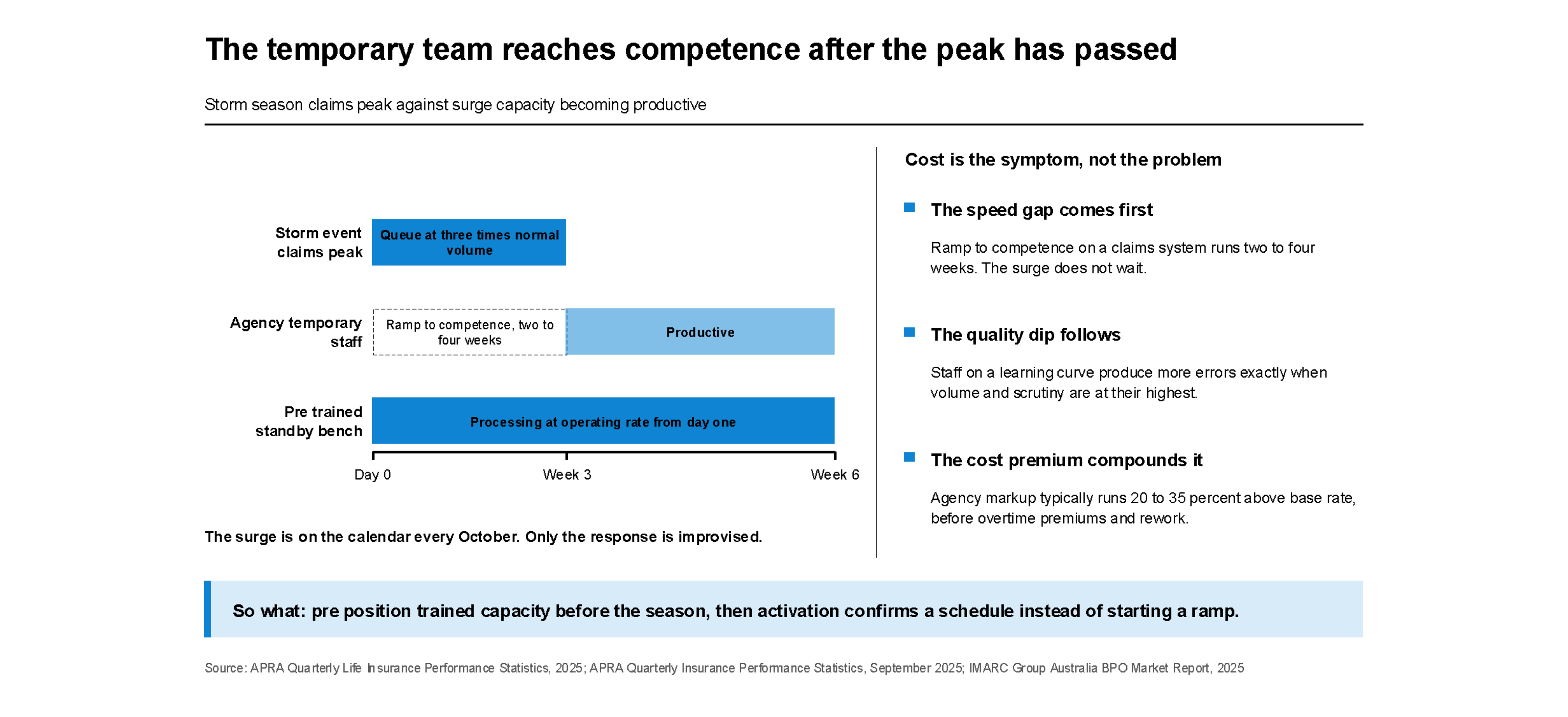
The problem with reactive surge capacity is not the cost. The cost is the symptom. The real problem is quality: temporary staff still learning the platform make more mistakes at exactly the moment when volume and scrutiny are highest.
The speed gap comes first. Temporary claims staff cannot operate a carrier's platform productively in 24 to 48 hours. Industry pattern puts ramp-to-competence on a claims system at two to four weeks. During that window, surge volume is absorbed by permanent staff at overtime rates or it sits in the queue.
The quality dip follows. Temporary staff on a learning curve produce more errors than experienced operators. Rework accumulates. Complaint escalations appear in week two. The WFM report after the peak has an accuracy section that needs explaining.
The cost premium adds up. Agency markup on temporary staff typically runs at 20-35% above base rate. Add overtime premiums and rework cost, and the total surge bill is significantly higher than the agency invoice alone.
A trained standby bench changes all three costs at once.
Speed: the bench is already fluent on the carrier's platform and process. Activation takes days, not weeks. The 6am call confirms schedule - it does not start the ramp period.
Quality: the bench already knows the system, the exceptions, the carrier-specific workflows. Processing accuracy from day one of surge activation tracks closer to steady state than to a training curve.
Cost: the pre-positioned retainer cost is the comparison against agency markup plus overtime premium plus rework. When rework is included in the reactive surge calculation, pre-positioned trained capacity is typically the lower-cost option.
ISSI's delivery team carries a ramp-time track record on claims-intensive carrier platforms including PetSure - a high-volume claims environment with significant seasonal variation. Surge capacity with quality held is an operational reality, not a promise.
With two days' notice, a trained bench confirms schedule and begins processing from day one of the surge.
Day one: processing volumes at operating rate. System access already confirmed. Exception-handling logic already understood. First-day output is production output, not training output.
Quality tracked from the first hour. Error rates and processing speed are measured from activation. If quality is holding, the WFM lead knows it immediately.
The annual cycle looks different. The surge arrives. The bench is confirmed. Processing holds. The quality report after the peak does not have a two-week accuracy-drop explanation to write.
The Australian BPO market is growing at 7.2% CAGR. The carriers extracting value fastest are the ones whose surge capacity is operational before the surge, not after it.
ISSI's delivery team is already fluent on the platforms ANZ carriers run with a ramp-time track record on claims-intensive carrier platforms. When the bench is already trained, surge activation takes days, quality holds from day one, and the WFM report after the peak looks different.
If seasonal surge capacity is a readiness question your team revisits every year, it is worth thirty minutes to discuss what pre-positioned trained capacity looks like.
Sources: APRA Quarterly Life Insurance Performance Statistics (2025); APRA Quarterly Insurance Performance Statistics (September 2025); IMARC Group Australia BPO Market Report (2025)