

You have been told to cut the contact centre budget. You have been here before. The last round of cuts hit CSAT within a quarter. Six months later, you were rebuilding capacity to recover the score. You missed the cost target anyway.
Insurance service expenses across AU grew 7% year-on-year to September 2025, per APRA. That pressure lands directly on contact centre budgets. For insurers managing high-volume policyholder and claims contacts, the contact centre is one of the largest variable cost lines in operations. Leaders are being asked to cut costs materially while holding or improving CSAT. On the surface, those goals contradict each other. They do not - but only if the right lever is pulled.
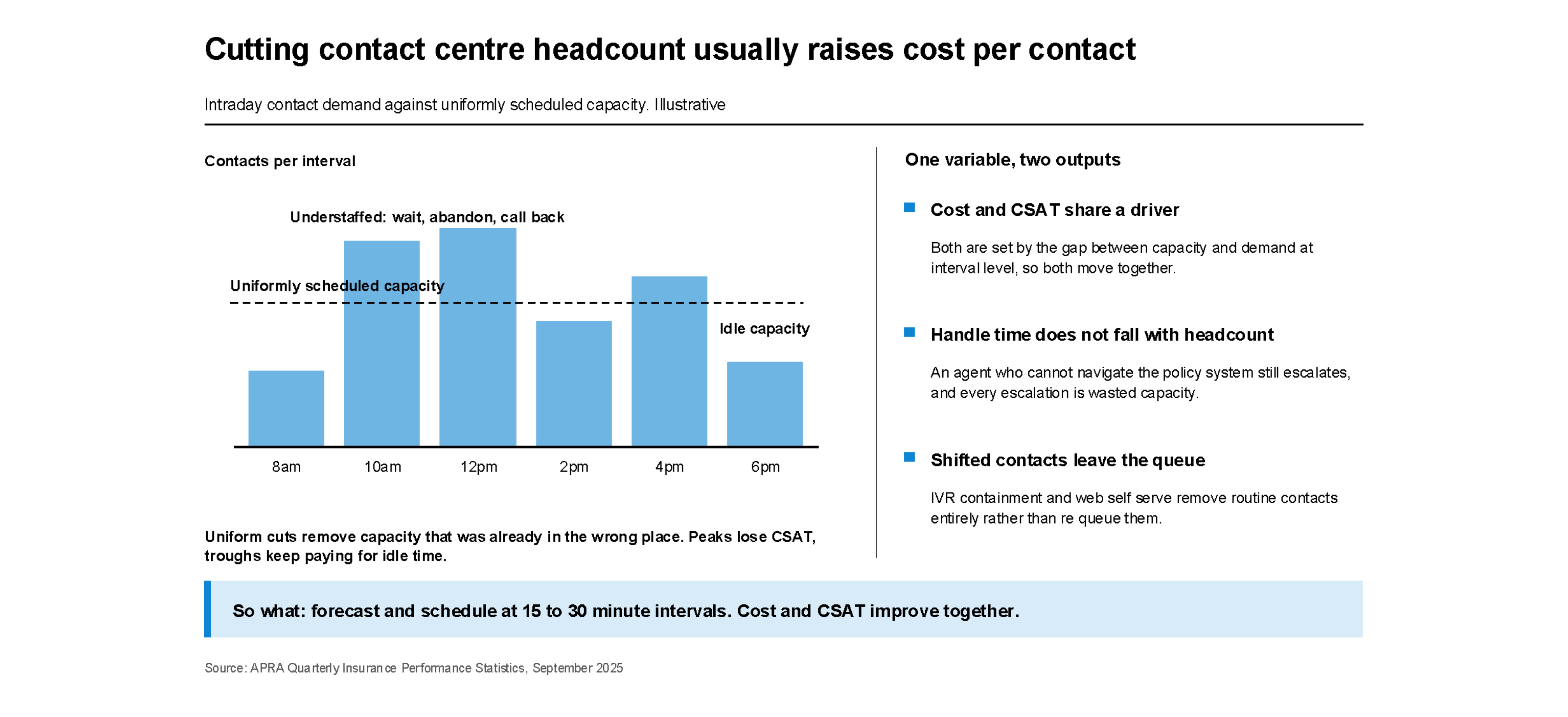
The lever most teams reach for is headcount. It is visible, measurable, and responds quickly to instruction. It is also the bluntest instrument available. Reducing headcount uniformly removes capacity that was already distributed unevenly. Morning peaks go understaffed. Abandonment climbs. CSAT drops. Afternoon troughs remain overstaffed - cost that produces nothing. The same pattern repeats at week and month level, and around renewal cycles.
Cutting contact centre headcount typically raises cost-per-contact. Handle times do not improve when bodies are removed. Agents who cannot resolve a query without escalating to a policy system they cannot navigate will always take longer. Each escalation is wasted capacity multiplied across contact volume. Headcount reduction did not fix any of this. It removed bodies from a system that was already inefficient.
Cost-per-contact and CSAT are driven by the same variable: the gap between capacity and demand at the interval level. Where demand exceeds capacity, customers wait, abandon, or call back - raising cost and lowering CSAT simultaneously. Where capacity exceeds demand, idle time accumulates - pure cost with no CX return.
Closing that gap does both things at once. A contact centre running interval-level workforce management with accurate forecasting can right-size headcount without creating service failures. A contact centre that has shifted routine contacts to IVR or web self-serve has removed them from agent queues entirely - reducing cost and removing friction for customers who would rather not call in the first place.
Three disciplines, run together, compound the result.
Interval-level WFM. Forecast at 15 or 30-minute intervals - not daily or weekly - and schedule to match. Skill-based routing puts the right agent on the right contact type, cutting transfers and reducing handle time without touching headcount targets.
Channel shift. IVR containment handles routine queries: claim status, payment confirmations, policy balance. Web self-serve covers endorsements and policy detail. Each contact shifted out of the agent queue reduces cost-per-contact - and often improves satisfaction. A customer who can self-serve at 10pm did not want to call at 9am.
System fluency. In insurance, an agent who can navigate the policy administration system without escalation shortens average handle time by eliminating hold and transfer events. That reduction flows directly to cost-per-contact and to CSAT scores, without a single position being cut.
ISSI's contact centre teams carry direct policy administration system fluency - reducing handle time at source rather than through generic training. If the cost-versus-CX trade-off in your contact centre is live, it is worth thirty minutes to discuss what interval-level WFM and system-fluent agents could show.
Source: APRA Quarterly Insurance Performance Statistics, September 2025.
PIPELINE RECORD: Blog 12 | Status: PUBLISH-READY | Hook: E (Contrast) 14/15 | S11-S15: PASS | S16 Persona Resonance: 23/25 | Word count: 544 | Em dashes: 0 | Produced: 2026-07-30