

The regulatory approval came through on Tuesday. The operations team was told on Thursday: be ready to service in 90 days. Everyone celebrated the approval. Nobody had mapped what compliance readiness actually required before the first claim could be handled.
Launching a new insurance line in a regulated environment is not simply an operational exercise. It carries conduct obligations from day one. In Australia, APRA oversight and the AFCA complaints framework apply from the moment the first policy is written. In New Zealand, FMA conduct rules and RBNZ prudential requirements hold from the same point.
The 90-day mandate does not suspend those obligations. Every customer interaction in the opening weeks of a new product line is a conduct event. Every claims decision is a compliance action. The question is not whether the regulatory framework applies - it is whether the operating team is ready for it before the first transaction runs.
A 90-day mandate is achievable - but only if the compliance framework already exists when the countdown starts.
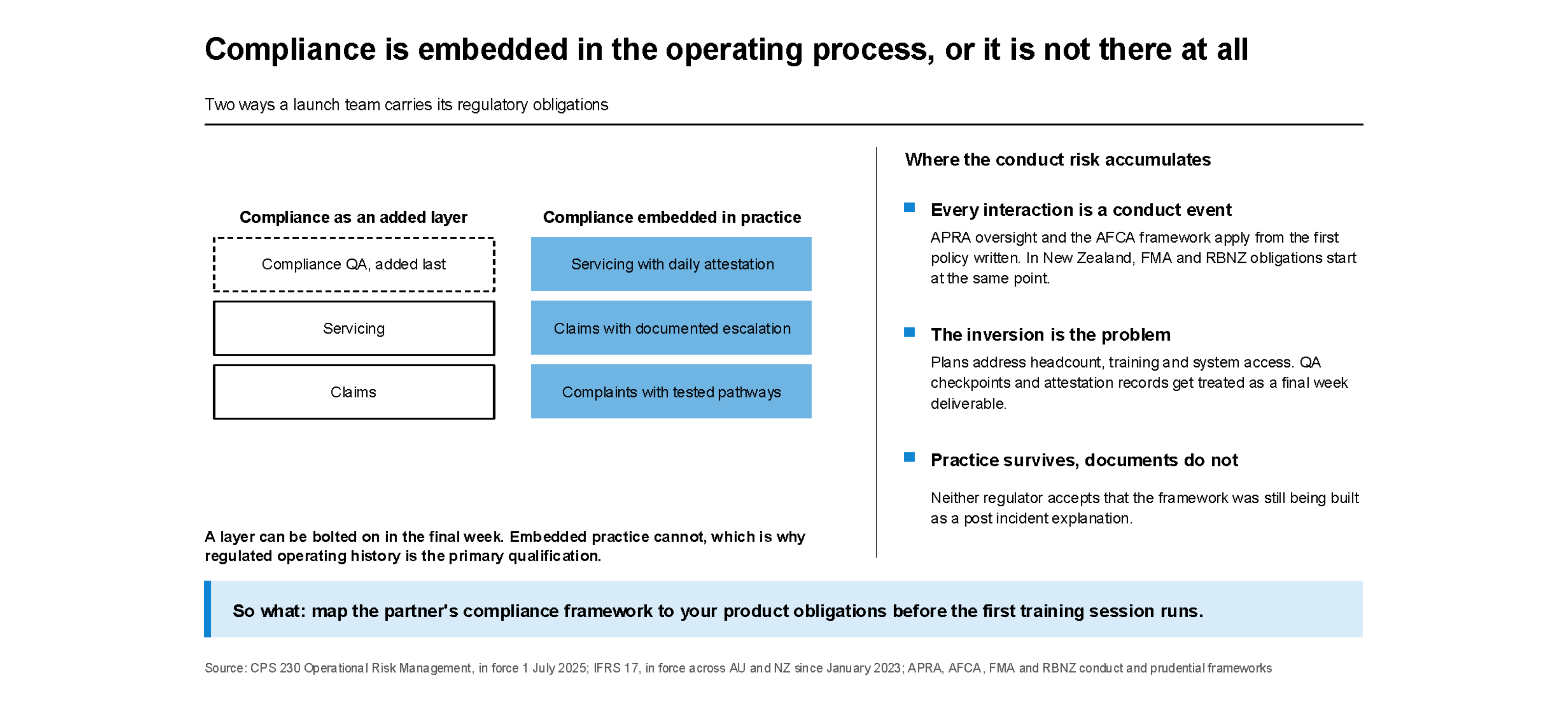
When an operations team is told to be ready in 90 days, the plan typically addresses headcount, training timelines, and system access. Compliance readiness - the QA checkpoints, documented procedures, staff attestation records, complaint handling protocols, and exception escalation paths that regulators expect to see from day one - is treated as a final-week deliverable rather than a launch prerequisite.
That inversion is where conduct risk accumulates. An operations team beginning to service a new line without a functioning compliance framework generates regulatory exposure with every transaction. CPS 230, in force since 1 July 2025, requires carriers to demonstrate governance of outsourced arrangements from the point of engagement - not after go-live. In New Zealand, the FMA holds equivalent conduct expectations. Neither regulator accepts "we were still building the framework" as a post-incident explanation.
The framing that creates this gap is treating compliance as a QA layer to be added on top of operations. It is not. Compliance is embedded in the operating process itself - or it is not there at all.
A team already operating in a regulated AU/NZ insurance environment has not built compliance frameworks as a project. They have operated within them. Daily attestation, documented exception handling, complaint escalation pathways used under live regulatory conditions - these are practised routines, not documents written for the occasion. The distinction matters: embedded practice survives an early complaint, an APRA enquiry, or an FMA review. Documentation does not.
This is why the regulated operating experience of the launch partner is not a background credential. It is the primary qualification. A team that has serviced insurance products across the APRA, FMA, and AFCA frameworks brings compliance readiness as a function of how they work - not as a workstream they manage in parallel.
The new line launches that maintain compliance posture from the first transaction share a consistent structure.
The operating partner's compliance framework is mapped to the carrier's product-specific obligations before the first training session runs - not after onboarding, before. QA processes are drawn from operating history: they have been applied to real transactions. Staff attestation records exist before day one of servicing. Complaint handling pathways are documented, tested, and assigned before the first claim arrives.
Under IFRS 17 - in force for AU and NZ carriers since January 2023 - cost allocation for a new product line is a financial reporting obligation from the first transaction. An operating partner whose data practices are already calibrated to the standard contributes to reporting accuracy from day one. Under NZ regulatory governance requirements, the same structural discipline applies - the FMA's conduct baseline does not reduce for new lines or new market entrants.
ISSI's delivery team is already fluent on the platforms ANZ carriers run with a ramp-time track record on carrier platforms. For regulated new line launches, compliance readiness is embedded in existing operating practice - not stood up as a parallel workstream alongside servicing.
If a new line launch with a 90-day mandate is live in your organisation, it is worth thirty minutes to discuss what compliance-ready from day one looks like.
Sources: APRA Quarterly Life Insurance Performance Statistics (2025); APRA Quarterly Insurance Performance Statistics (September 2025); IMARC Group Australia BPO Market Report (2025)