

The go-live date was set by the board. The BPO partner has just come back with a revised readiness timeline - they need another quarter to complete platform training. You have a programme commitment on one side and a ramp gap on the other. The only variable that closes that gap without moving the date is a team that is already trained.
Launch timelines in ANZ insurance are rarely set by operations teams. They are set by boards, deal structures, product commitments, and regulatory obligations. When a programme sponsor accepts a go-live date, they accept it on the assumption that the operational partner can match it.
The ramp period is the variable that breaks that assumption. Every week a new BPO team spends learning a platform is a week the programme milestone does not move. Insurance service expenses grew 7% year-on-year at industry level through September 2025 - and the ramp period is a direct contributor to that number.
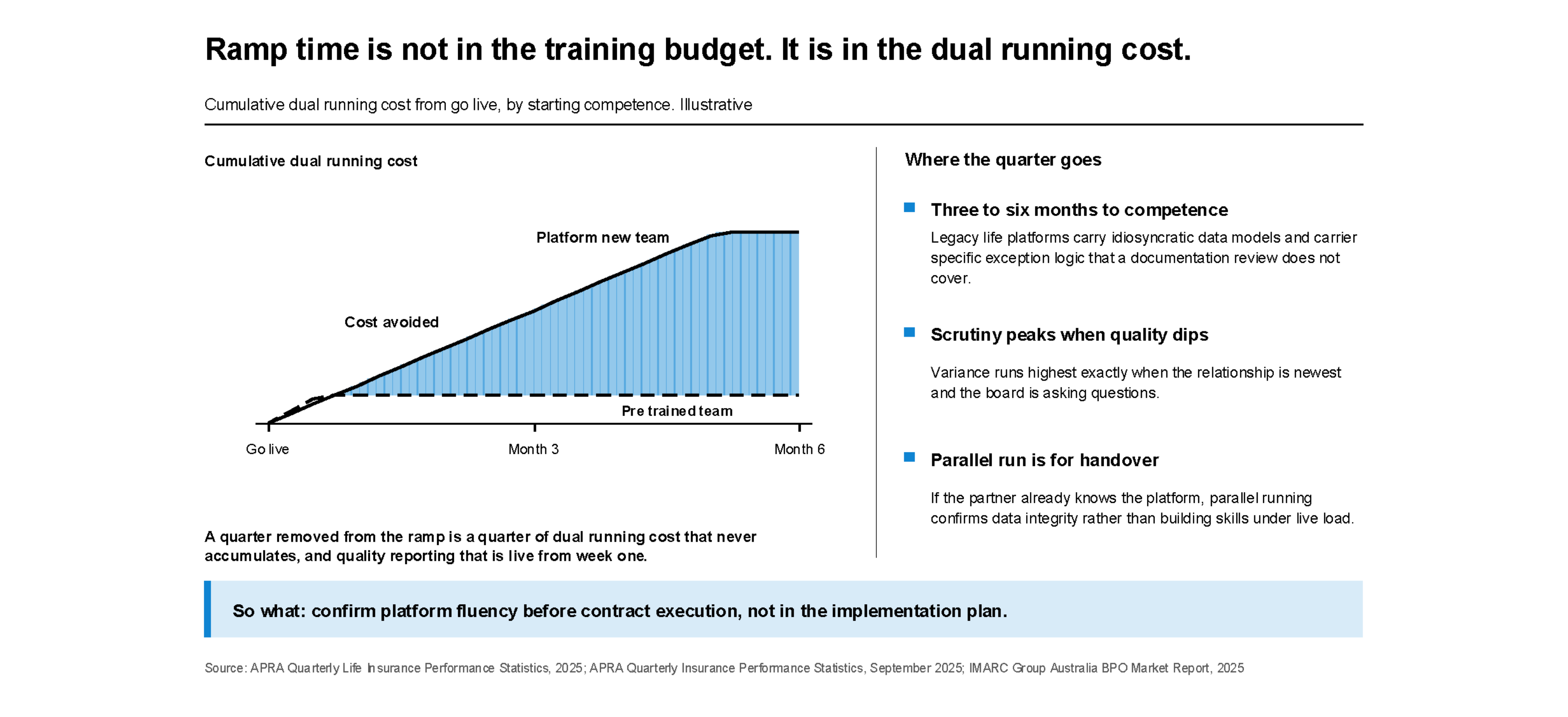
The cost of ramp time rarely appears in the training budget - it shows up in the programme timeline and in the dual-running cost that accumulates while the new team finds its footing.
In ANZ life insurance, that footing means learning legacy policy administration environments. These are not intuitive systems. They have idiosyncratic data models, carrier-specific exception logic, and workflow configurations that take genuine operating experience to navigate - not a documentation review. Industry pattern puts ramp-to-operating-competence on legacy life platforms at three to six months before quality reaches target.
During that period, the programme is parallel-running at full dual cost. Milestones slip. The board asks questions. And the quality variance during ramp - precisely the period when the relationship is newest and scrutiny is highest - is the exposure that most programme risk registers underestimate.
The pre-trained team is not a staffing buffer that can be activated when needed. It is a capability investment that has already been made - and the question is whether the programme is the one that benefits from it.
When the delivery team already knows the platform, the programme clock starts differently. Day one is operating day one, not training day one. The QA framework is already calibrated to the environment. The exception-handling logic is already mapped. The data model is already understood.
That compression is measurable in programme economics. A quarter eliminated from the ramp period is a quarter of dual-running cost that does not accumulate. CPS 230, in force from 1 July 2025, requires carriers to document and manage third-party operational arrangements. A partner who is operationally ready from day one is a more defensible position: quality metrics are available from go-live, not after a grace period.
A programme that removes the ramp gap does three things differently from the start.
First, platform fluency on the target environment is confirmed before contract execution - not promised in the implementation plan. The partner demonstrates operating knowledge on the actual platform: exception-handling, data model, carrier-specific workflow. This is an entry condition, not a deliverable.
Second, the parallel-run period is scoped to handover logistics, not competence acquisition. If the partner already knows the platform, parallel running is about confirming data integrity and process continuity - not about building skills under live conditions. That distinction compresses the dual-running window from months to weeks.
Third, quality metrics are live from week one. First-contact resolution, processing accuracy, and exception-handling rates are measured and reported from the first operating week - not after a grace period for the team to find their feet. A team that has found its feet before day one does not need one.
The Australian BPO market is growing at 7.2% CAGR as more carriers use operational outsourcing to address cost and capacity pressure. The engagements extracting value fastest start from platform fluency, not from a training plan.
ISSI's delivery team is already fluent on the platforms ANZ carriers run with a ramp-time track record on carrier platforms. When the team is already trained, the parallel-running window is measured in weeks rather than quarters, and quality reporting is available from day one.
If a go-live timeline is the constraint the programme is carrying, it is worth thirty minutes to discuss what that looks like.
Sources: APRA Quarterly Life Insurance Performance Statistics (2025); APRA Quarterly Insurance Performance Statistics (September 2025); IMARC Group Australia BPO Market Report (2025)