

The promise of a new core system is that it will solve the cost problem. It will not. The cost problem in insurance servicing is almost never the platform. It is the operating model running on the platform. Changing the platform without changing the model delivers a more expensive version of the same outcome.
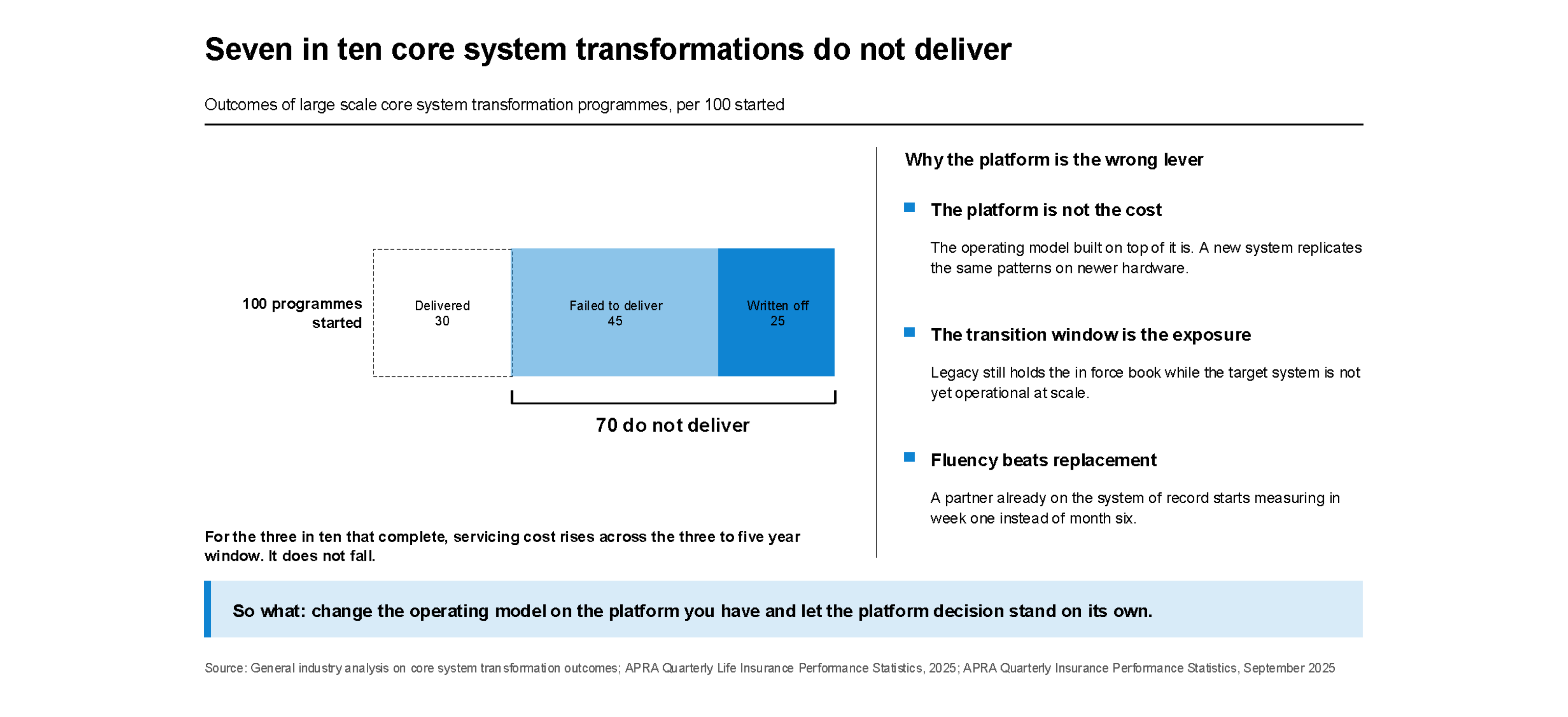
Industry analysis of large-scale core system transformations shows failure rates exceeding 70%, with roughly a quarter becoming full write-offs. For the carriers that do complete a migration, the timeline matters as much as the end state. During a three-to-five year migration, the carrier runs two environments simultaneously. The legacy system still holds the in-force book. The target system is not yet operational at scale. Servicing cost does not fall during a migration. It rises.
Insurance service expenses rose 7% year-on-year at industry level through September 2025. That cost pressure has no patience for a three-to-five year project window.
The common assumption is that a legacy platform's age makes it expensive. The cost of operating on a legacy system comes from the operating model built on top of it, not from the platform's capability.
The specific cost locations are predictable. Manual exception handling embedded in workflows designed for growth volume, not run-off efficiency. Data quality interventions applied every processing cycle because the admin system and downstream reporting environment were never properly reconciled. Rework clusters at the handoffs between the core system and adjacent environments.
These patterns are enabled by the platform's design, but they are not caused by it. Replacing the platform does not remove them. It replicates them on a newer system, after a multi-year migration, at the cost of the transition window.
The carriers that have materially reduced operating cost on legacy platforms have done it through operating model changes, not platform projects.
Three changes drive the result. First: task-level process mapping on the live system - not a future-state design exercise, but a map of what is actually running on the legacy platform, where exception handling adds cost, and where rework is concentrated.
Second: automation scoped within the existing system. No new integration layer, no migration as a prerequisite. Automation applied to the tasks where it reduces cost without adding an error correction burden.
Third: a platform-fluent operating partner who does not need a knowledge-transfer runway. Platform fluency is the variable. A partner who already operates on the legacy system of record can begin measuring cost from day one. A partner who needs months to learn the platform consumes the measurement window before delivering any result.
The practical sequence runs in four steps.
Task-level mapping on the live system identifies where cost accumulates. Automation is scoped to the right task types within the existing platform - no new integration project required. Skilled assessors are repositioned to judgment tasks where their cost is justified. A 90-day structured pilot produces a measured before-and-after: cost-per-transaction on the live system, before any intervention, then after.
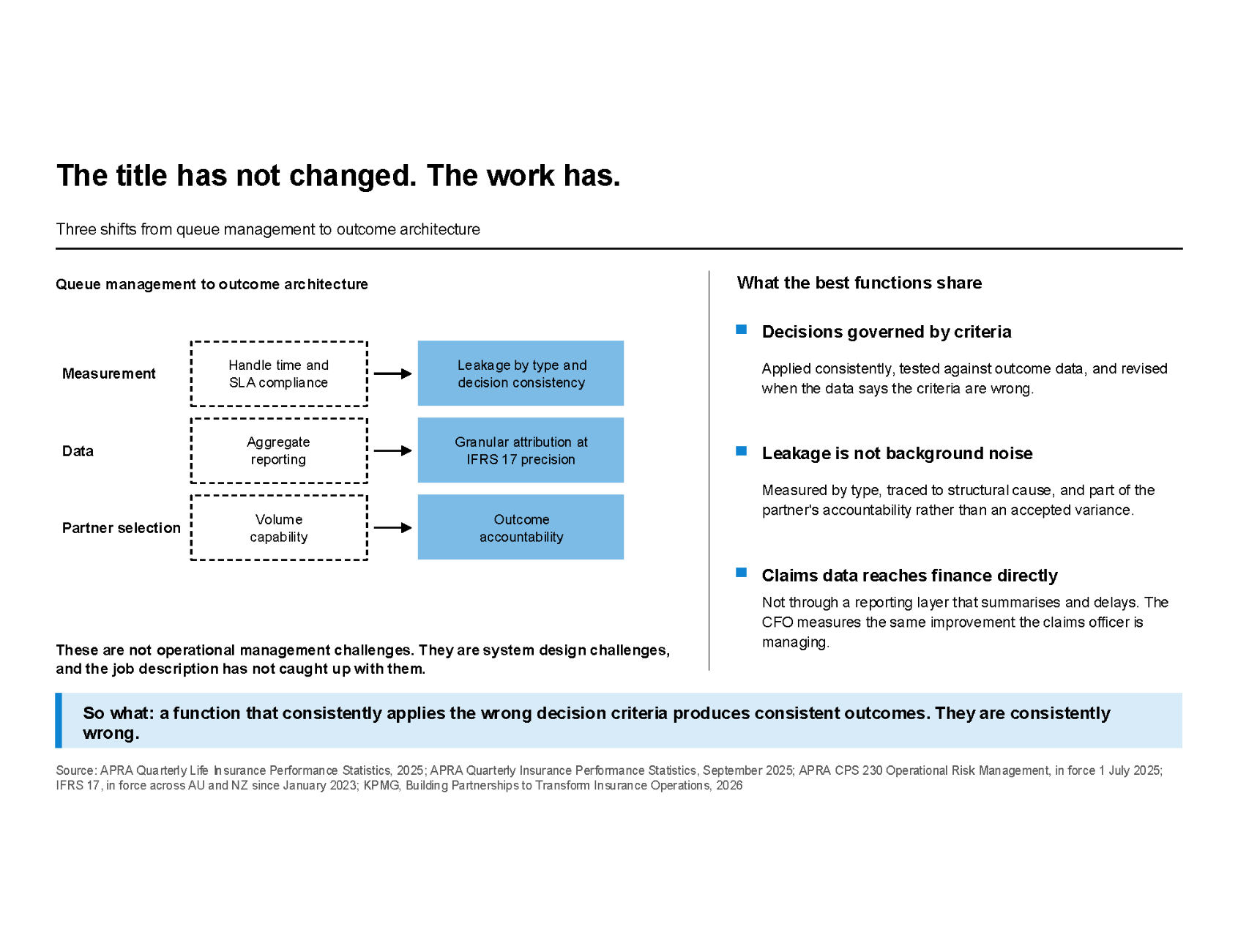
That result is documentable today. Under CPS 230, in force from 1 July 2025, a BPO arrangement on the carrier's existing system with a platform-fluent partner is a defensible third-party arrangement. A migration-contingent arrangement whose value depends on a future state that has not been reached is not documentable in the same way. For carriers operating under IFRS 17, the task-level cost data this process produces is also the granular input cost attribution precision requires.
Cost reduction begins on the existing system - no migration required, no onboarding runway before measurement starts.
If the legacy platform cost is rising and replatforming is three to five years away, it is worth thirty minutes to discuss what cost reduction on your existing platform looks like starting now.
Sources: APRA Quarterly Life Insurance Performance Statistics (2025); APRA Quarterly Insurance Performance Statistics (September 2025); IMARC Group Australia BPO Market Report (2025); general industry analysis on core system transformation outcomes