

The decision was made. The contract was signed. The transition began. Within six months, the work was coming back in-house - at a cost that exceeded the original transition, and with a leadership team that would not seriously consider outsourcing again for years. That scenario plays out more often than the business case projections acknowledge.
More ANZ insurance carriers are considering outsourcing for the first time. APRA data shows that other insurance expenses as a proportion of premium rose from 15% to 18% in the twelve months to June 2025, and insurance service expenses grew 7% year-on-year at industry level through September 2025. The pressure to find a different cost model is real, and it is not easing.
The Australian BPO market is growing at 7.2% CAGR. Some of that growth is existing BPO customers expanding. Much of it is carriers making the move for the first time. The decision to try outsourcing is not the hard part. Executing it without the whiplash is.
First-time outsourcing fails on change management, not technology. The platform can be learned. What cannot be learned on a training program is the institutional knowledge that lives in the heads of the team who have been servicing the book for years.
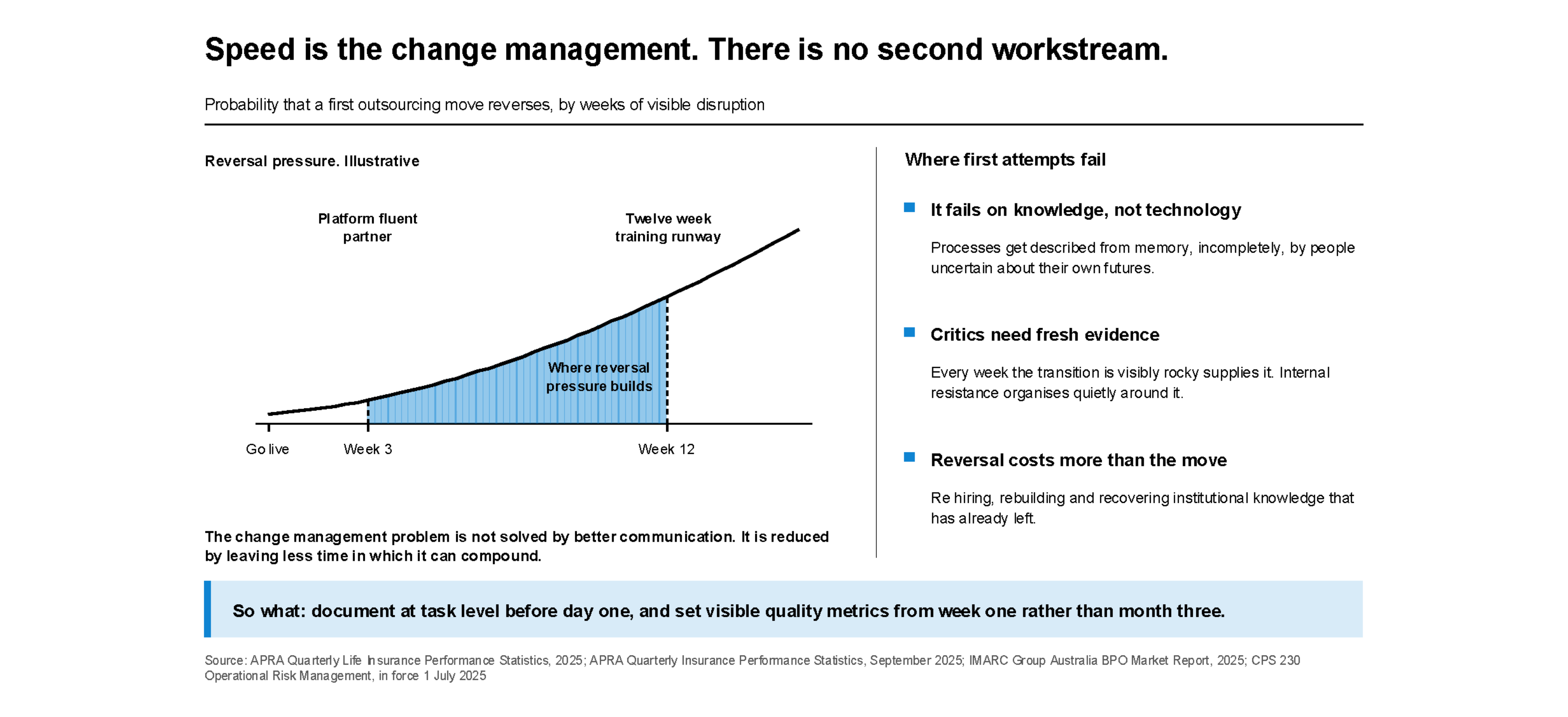
The failure pattern is consistent. Processes are not documented before the transition begins - they are described from memory, incompletely, by team members who are uncertain about their own futures. Internal resistance organises quietly. The offshore team receives what was documented, not what was actually known. The quality dip is visible. The critics who said it would not work have evidence. And the cost of bringing work back in-house typically exceeds the original transition cost - re-hiring, rebuilding, and recovering institutional knowledge that has already left.
The visible disruption period is where reversal pressure builds. The longer it lasts, the higher the probability of reversal.
The standard approach separates transition speed and change management into two work streams. Speed is a project management concern. Change management is a separate program. This separation is where many first-time transitions go wrong.
Compressing the visible disruption period is the most effective change management intervention available. Every week the transition is visibly rocky is a week the internal critics have fresh evidence. A partner who arrives platform-fluent compresses that period structurally - not through a communication plan, but through operating performance from the early weeks of the engagement.
The change management problem is not solved by better communication. It is reduced by having less time in which it can compound. Speed and change management are the same work, seen from different directions.
Four elements separate a first-time outsourcing engagement that holds from one that reverses.
First: document processes before day one - at task level on the live system, not from memory after the contract is signed. The documentation is the foundation of the knowledge transfer.
Second: choose a partner who is already fluent on the carrier's policy administration platform. A twelve-week training runway is twelve weeks of visible disruption - twelve weeks for reversal pressure to build.
Third: set visible quality metrics from week one, not month three. Short feedback loops identify problems before they become escalations, and give the internal change program positive evidence alongside the challenges.
Fourth: design the internal communication program around the actual timeline. The disruption is brief. The benefit is ongoing. Under Australia's CPS 230, which came into force on 1 July 2025, well-managed third-party arrangements are also easier to document and defend. For NZ carriers, NZ regulatory governance requirements similarly favour stable, planned service arrangements.
ISSI's delivery team is already fluent on the platforms ANZ carriers run with a ramp-time track record on carrier platforms including PetSure. A faster transition is not only a cost outcome. It is a change management outcome.
If a first outsourcing move - or a second attempt after a difficult first experience - is on the agenda, it is worth thirty minutes to discuss how transition design and platform fluency work together.
Sources: APRA Quarterly Life Insurance Performance Statistics (2025); APRA Quarterly Insurance Performance Statistics (September 2025); IMARC Group Australia BPO Market Report (2025)