

The board asked how the carrier would handle a disruption to its Sydney operations. It was a new question on the agenda. The operational resilience review had been scheduled, and the question of geographic concentration had not been worked through before the session. The operations team had no prepared answer.
Most single-country carriers run their claims processing, policy administration, and customer service from one city. The operations are efficient. The concentration is structural. In Australia, CPS 230, in force from 1 July 2025, requires carriers to actively manage geographic concentration in critical operations - not just note it in a risk register. In New Zealand, equivalent obligations exist under regulatory governance requirements for licensed insurers. The board's question is also the regulator's question. Neither has a satisfying answer if the entire operation sits in one place.
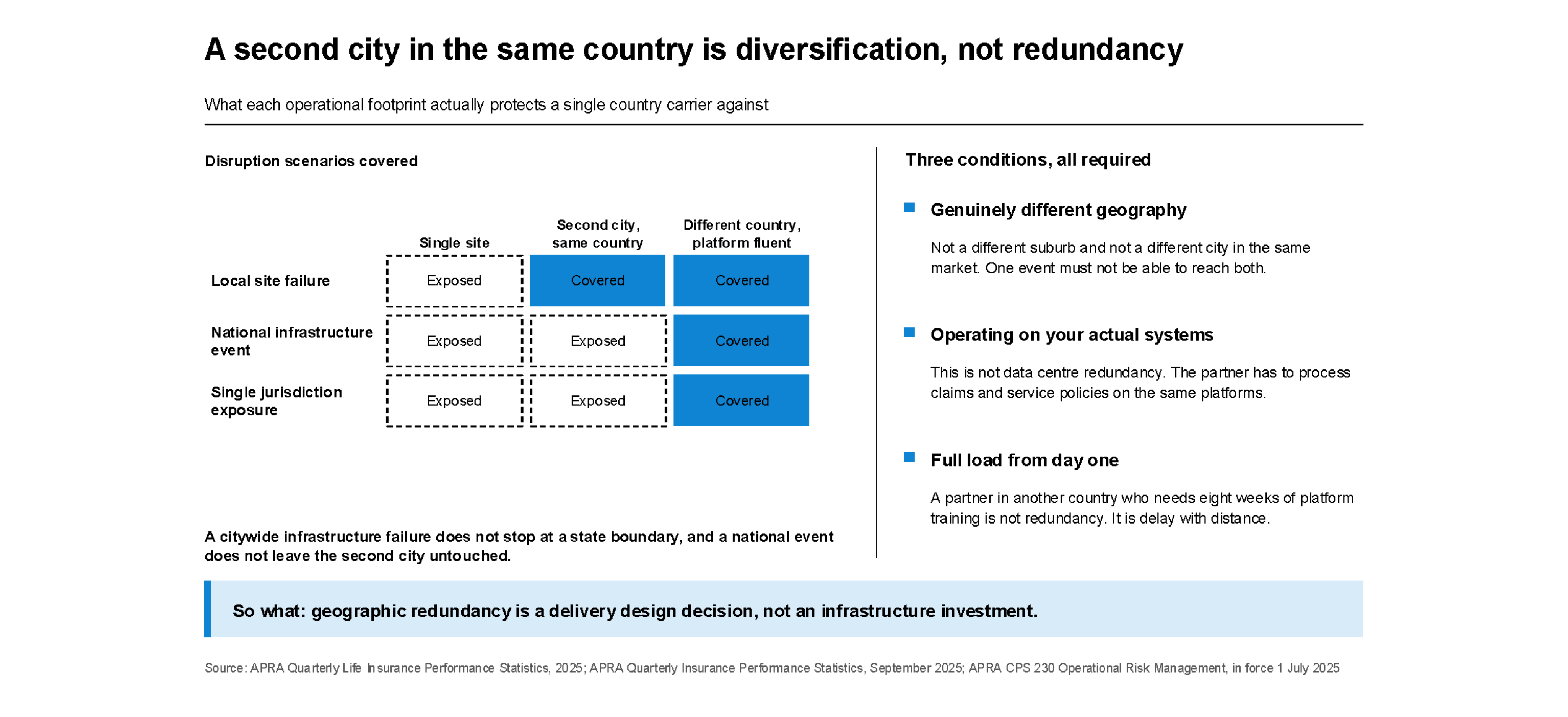
The instinct for a single-country carrier is to treat geographic redundancy as a domestic problem with a domestic solution: a second office in Melbourne to back up Sydney, or a second site in Wellington to back up Auckland. A second city in the same market is not geographic redundancy. It is geographic diversification - a different thing, with different protective value.
Both locations are subject to the same national infrastructure vulnerabilities, the same regulatory jurisdiction, and potentially the same large-scale disruption scenarios. A citywide infrastructure failure does not stop at state boundaries. A major disruption event affecting Sydney does not leave Melbourne unaffected if the disruption is national in character.
Genuine geographic redundancy for a single-country carrier requires delivery infrastructure in a genuinely different geography. Not a second city in the same market - a delivery partner whose operational base is in a different country.
The reframe is this: geographic redundancy is not an infrastructure investment problem. It is a delivery design decision.
A carrier who has engaged an operations partner with delivery infrastructure in a different geography has addressed the board question. The disruption scenario that takes the carrier's Sydney or Auckland capacity offline does not take the partner's capacity offline. Critical operations continue - on the carrier's own systems, from the partner's location.
The requirement that makes this genuinely protective is platform fluency. Geographic distance only provides protection if the partner can carry operational load from the point of activation. A delivery partner in a different country who needs eight weeks of platform training before they can process a claim is not geographic redundancy. It is geographic delay.
The arrangement that satisfies both the regulatory documentation requirement and the board's scenario follows three requirements.
First: the partner must be operating from a genuinely different geography - not a different suburb, not a different city in the same country. The separation must be such that a single disruption event cannot simultaneously affect both the carrier's primary operations and the partner's delivery capacity.
Second: the partner must be operating on the carrier's actual systems. Geographic redundancy in operations is not data-centre redundancy. It requires a partner who can process claims, manage policy servicing, and handle the critical functions the carrier needs - on the same platforms the carrier uses.
Third: the partner must be able to carry full operational load from day one of activation, without a ramp period. The arrangement that requires training before it becomes effective is not the answer the board is looking for.
When those three conditions are met, the arrangement is documentable for a CPS 230 third-party assessment or a New Zealand regulatory governance review. The question the board asked has an answer. The answer needs to be in place before the question becomes urgent.
ISSI operates as a warm second source on the platforms ANZ carriers already run. Because platform fluency on CyberLife, wmA, and Ingenium already exists, there is no ramp period before load can be carried. Delivery infrastructure in a different geography provides the separation that a second domestic site cannot. If geographic concentration exposure is active in your resilience programme, it is worth thirty minutes.
Sources: APRA Quarterly Life Insurance Performance Statistics (2025); APRA Quarterly Insurance Performance Statistics (September 2025)