

The operational team had worked with the BPO partner for three years. The metrics were green. The contract renewed without discussion. At some point in that third year, the operations lead stopped reviewing the vendor scorecard and started asking the partner what they were seeing in the claims data. That question changed the relationship. Not the contract - the relationship.
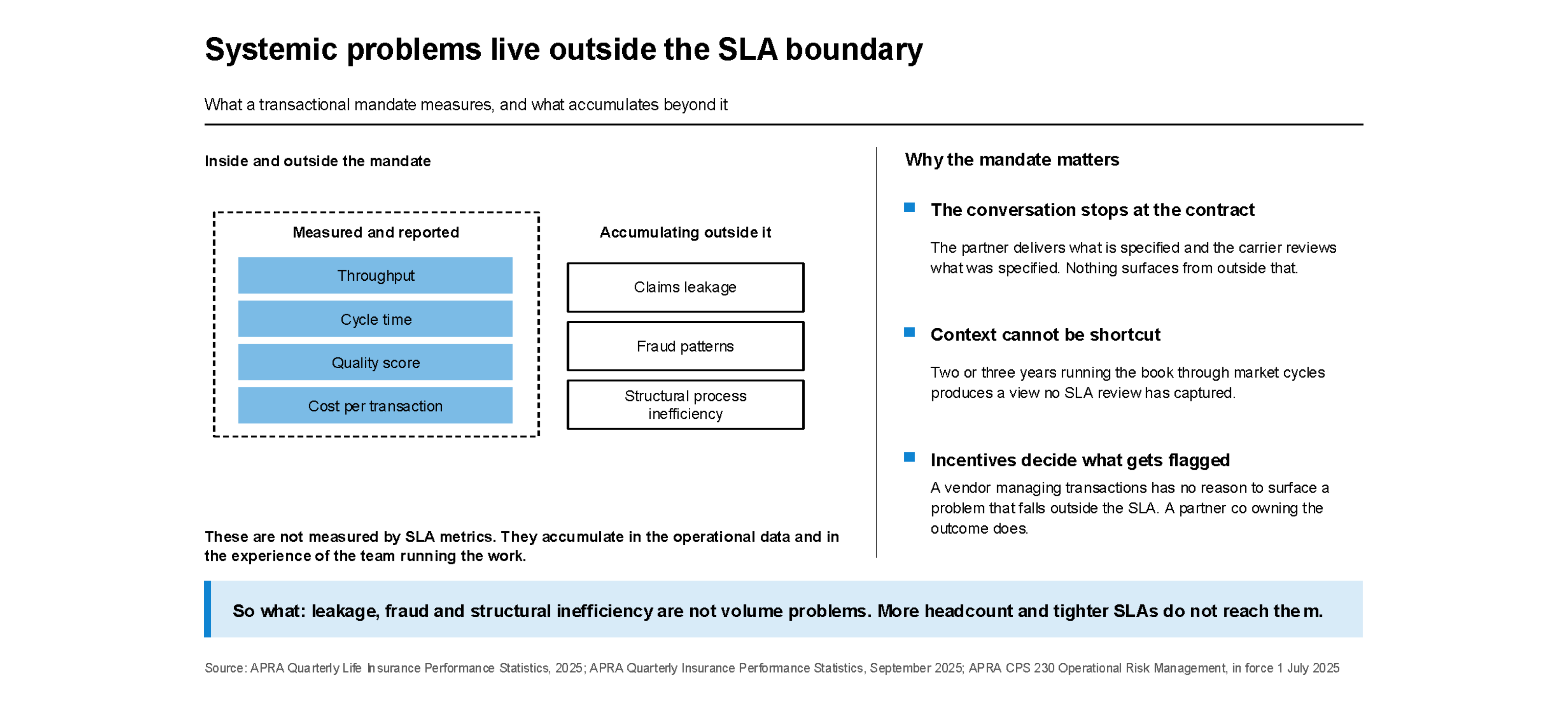
Transactional BPO relationships stay transactional for a structural reason: the mandate on both sides is to deliver against the service level agreement. The BPO delivers what is specified. The carrier reviews what was specified. The conversation stops at the contract boundary.
Systemic problems - claims leakage, fraud patterns, structural process inefficiency - live outside that boundary. They are not measured by SLA metrics. They accumulate in the operational data and in the experience of the team running the work. A vendor relationship with a limited mandate has no mechanism for surfacing them - in Australian or New Zealand insurance markets alike.
The operational insight that the BPO holds is not being accessed. The carrier does not ask, because the mandate does not extend to that conversation.
Trust is not a procurement outcome. It accumulates through sustained operational performance: commitments met, disruptions handled without incident, platform competence demonstrated under real conditions rather than in a proposal.
Two or three years of running critical operations on a carrier's platform produces a view of the business that no SLA review has ever captured - and that the carrier's own team may not have. A partner who has processed the book through market cycles, through regulatory changes, through operational pressures, has a depth of context that a new vendor cannot start with.
That accumulated context is the input to the systemic improvement conversation. Claims leakage patterns are visible to the team running the claims. Fraud indicators cluster in ways that only become apparent after extended exposure to the carrier's specific book. The process inefficiencies that add cost without adding value are most visible to the people who handle the exceptions.
The door to that conversation is reliability. It cannot be shortcut.
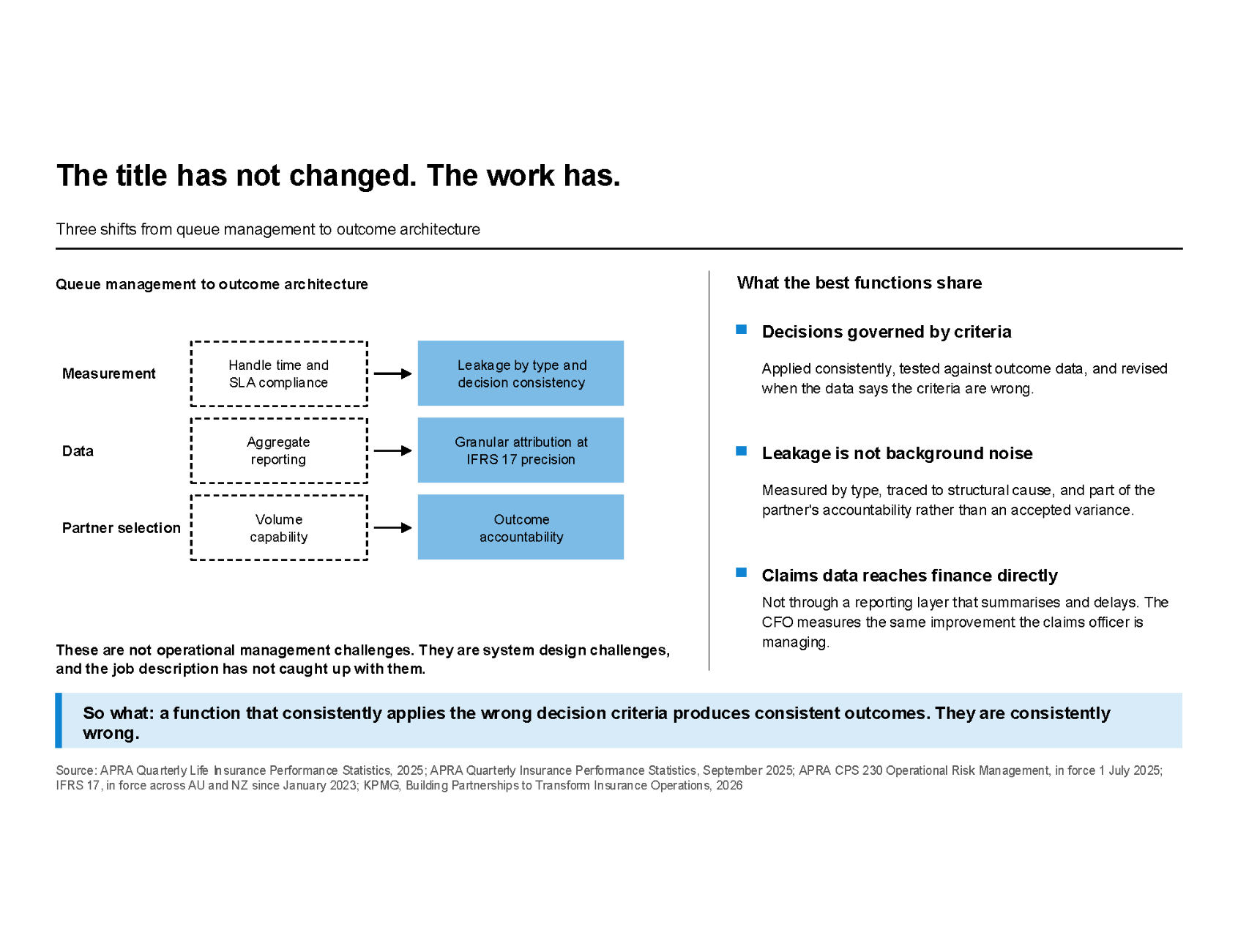
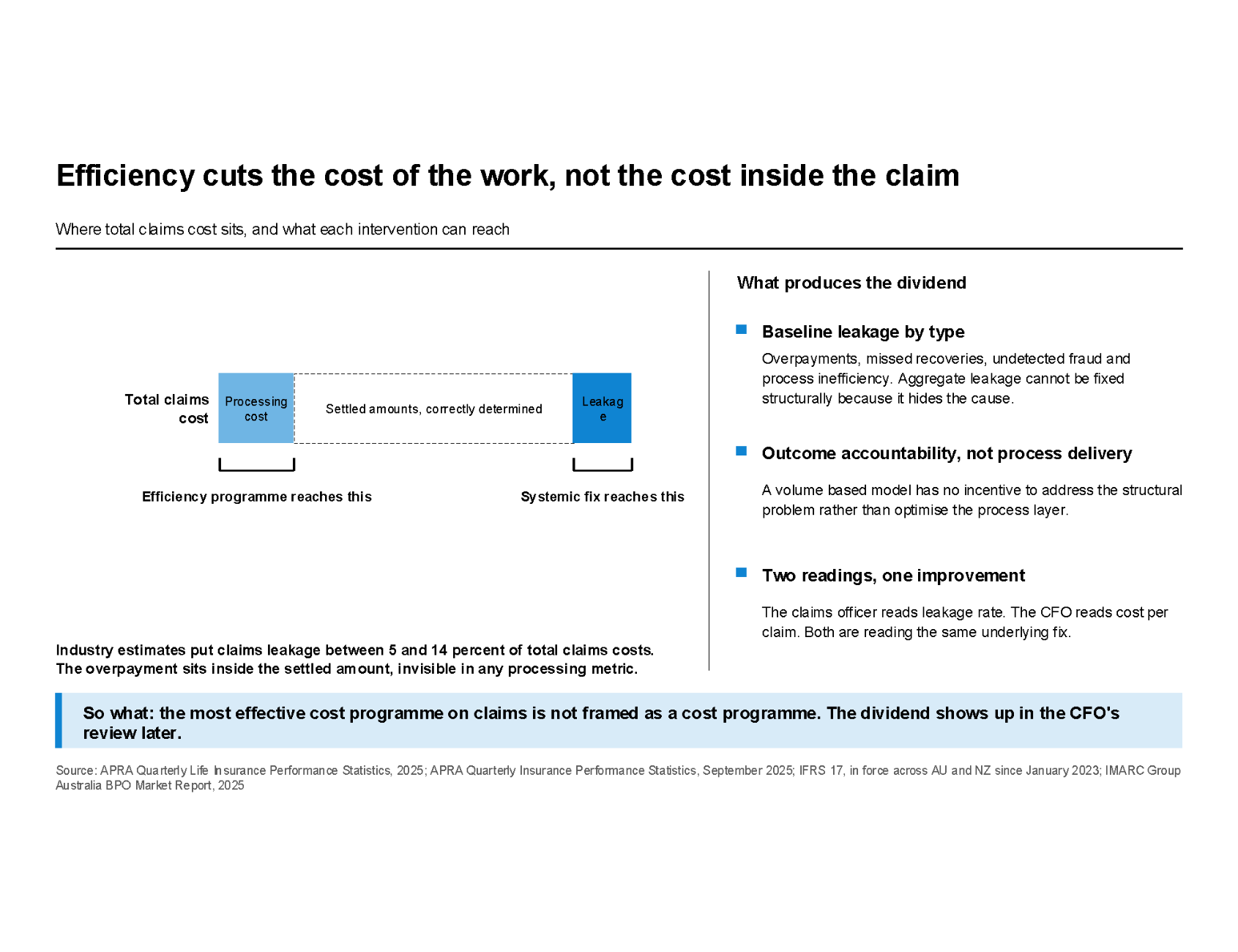
Claims leakage, fraud, and structural operational inefficiency are not volume problems. More headcount and tighter SLAs do not solve them. They are systemic problems, and they require a partner with enough operational context to diagnose root cause rather than just service volume.
The distinction between a vendor who manages transactions and a partner who co-owns outcomes is not a semantic one. A vendor who manages transactions has no incentive to surface systemic problems that fall outside the SLA. A partner who co-owns outcomes has a shared stake in solving them.
Outcome-based commercial structures - shared risk, co-owned KPIs, performance aligned to systemic improvement - are the commercial model that makes this partnership possible. They require trust as a precondition. They are only available after the reliability record has been built.
The transition from vendor to partner is rarely a formal renegotiation. It is typically prompted by one of two things.
The first is a specific systemic problem that the carrier has not been able to solve with conventional approaches. Claims leakage that keeps recurring despite process improvement programs. Fraud that persists despite detection tools. An operational cost that does not move despite efficiency initiatives. When the carrier has exhausted the conventional responses, the question of whether the BPO partner sees something that internal teams cannot becomes worth asking.
The second is a trust consolidation moment: sustained performance that causes the operations lead to recognise that their BPO partner knows the business better than any new vendor ever could. The vendor scorecard gives way to a more substantive conversation.
In both cases, the signal that the transition has happened is commercial as well as operational. The relationship moves from SLA compliance reviews to a conversation about outcomes. The mandate extends. The value delivered changes.
ISSI operates as a warm second source on the platforms ANZ carriers already run. Because platform fluency already exists, there is no ramp period before load can be carried. ISO 22301-class business continuity credentials support the reliability record that earns the deeper conversation. A relationship built on operational reliability creates the conditions for a deeper conversation about co-owning claims and fraud outcomes. If that conversation is the one worth having, it is worth thirty minutes.
Sources: APRA Quarterly Life Insurance Performance Statistics (2025); APRA Quarterly Insurance Performance Statistics (September 2025); IMARC Group Australia BPO Market Report (2025); APRA CPS 230 Operational Risk Management (effective 1 July 2025)