

Moving slowly after a successful pilot is not risk management. It is the risk. Dual-running two operational environments simultaneously - with shared accountability and overlapping cost structures - is not a managed transition. It is an unresolved one. The pilot proved the model. The consolidation phase is undoing the proof.
Dual-running is not free. Running an incumbent environment alongside an outsourced one costs money every week it continues: parallel staffing, overlapping system licensing, duplicated management overhead. Those costs compound.
APRA data shows AU insurance service expenses rose 7% year-on-year to September 2025. Operating cost discipline during transition is not optional - it is the foundation of the business case that approved the pilot. Under CPS 230, in force from 1 July 2025, a prolonged dual-running arrangement without a defined cutover date is an unresolved operational risk. The consolidation phase that was meant to protect the pilot savings is drawing on them.
The barrier to fast cutover is rarely the platform. It is the internal governance architecture that treats every transition as inherently high-risk - regardless of what the pilot data shows.
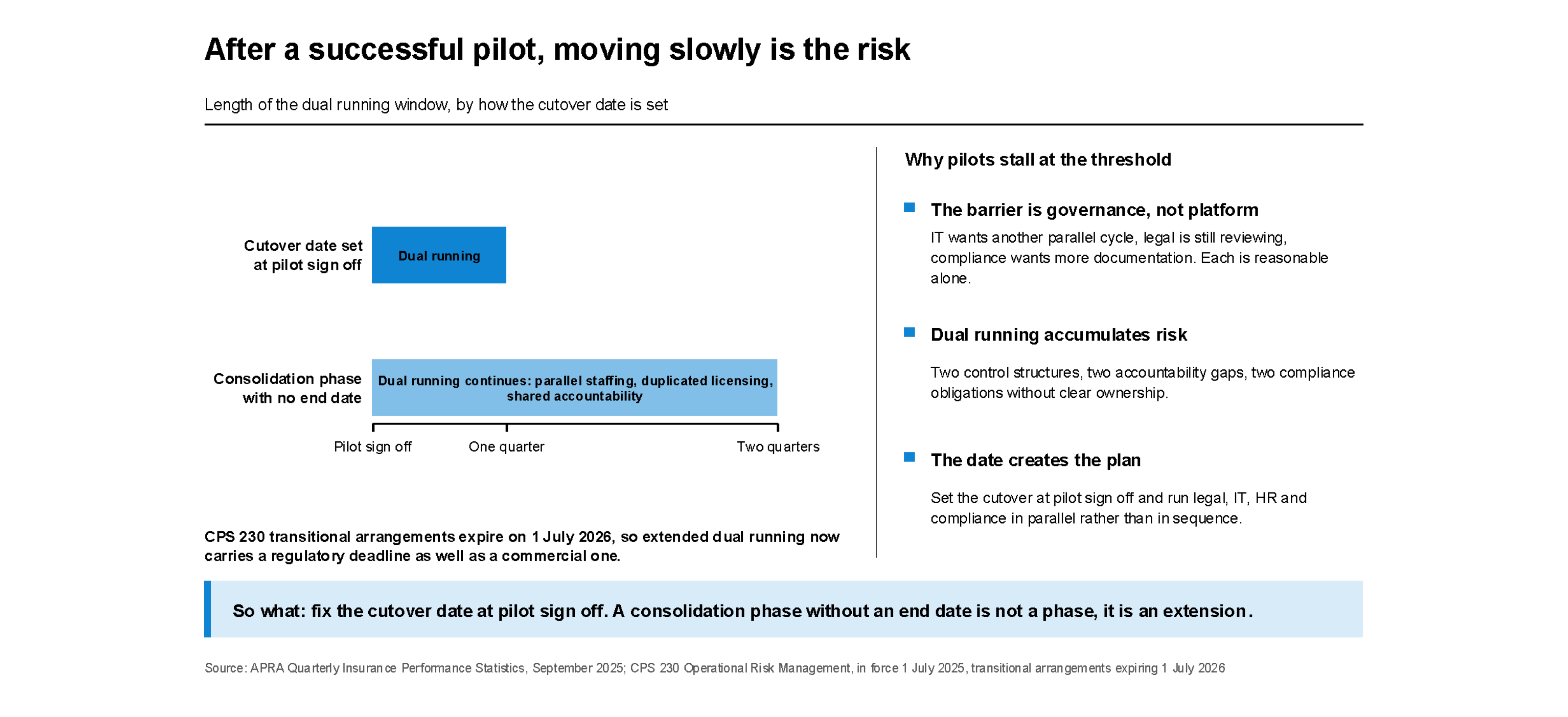
IT requests another parallel-run cycle. HR needs more time for workforce communications. Legal is still reviewing. Compliance wants more documentation. Each of these is legitimate in isolation. Together, they produce a consolidation phase that was not in the original business case and has no defined end date.
The dissonance is the signal. The pilot data says ready. The programme timeline says wait. That gap is not operational. It is political - risk aversion institutionalised into process. The consolidation phase becomes indefinite not because the transition requires it, but because the governance machine was never designed to approve fast.
The standard framing is that fast cutover trades off against risk. It does not.
Extended dual-running distributes risk across two environments simultaneously. Two control structures. Two accountability gaps. Two compliance obligations without clear ownership. That is not risk mitigation. It is risk accumulation wearing the language of caution.
The service risk that slow cutover is designed to prevent is degradation during scale-up. That risk is a function of how well the transition team knows the platform - not how long the transition takes. A team already operating the platform at production standard does not carry the ramp-up risk that justifies extended dual-running. The argument for a long consolidation phase only holds when the transition partner needs to learn the platform during the transition.
CPS 230 and NZ regulatory governance requirements both point the same direction: defined accountability, defined timelines, defined cutover plans - not indefinite parallel operation.
Three conditions determine whether a pilot converts to full deployment in one quarter or six months.
First, governance runs in parallel, not in sequence. Approvals stacked after pilot completion add months without adding risk mitigation. Legal, IT, HR, and compliance workstreams started during the final pilot phase compress the approval cycle to the actual critical path.
Second, the cutover date is set at pilot sign-off, not negotiated after three months of consolidation. A consolidation phase without a defined end date is not a phase. It is an extension. The date creates the deadline; the deadline creates the plan.
Third, scale-up draws on a team that already operates the platform. If additional headcount requires platform training, the ramp-up period is fixed and non-negotiable. If the headcount comes from a pre-trained bench, the ramp-up period does not exist.
Service continuity during cutover is protected by competence, not by timeline length. A longer transition produces more cost, not better outcomes. CPS 230 transitional arrangements expire 1 July 2026. Entities still in extended dual-running face a hard regulatory deadline, not just a commercial one.
The speed of conversion from pilot to full cutover is itself a measure of platform fluency - a team that already knows the system does not need a ramp period to scale. If compressing the cutover timeline is the next conversation, it is worth thirty minutes to discuss what a quarter-based transition looks like.
Sources: APRA Quarterly Insurance Performance Statistics, September 2025. APRA CPS 230 Operational Risk Management, in force 1 July 2025.