

The best fraud operation in the market is not the one with the most sophisticated analytics platform. It is the one that has figured out what analytics cannot do - and has designed its investigation function accordingly.
Fraud detection has absorbed significant investment across ANZ insurance over the past decade. Detection models, anomaly scoring, pattern recognition applied to claims data at scale. The investment is a rational response to a real and growing cost. APRA data shows insurance service expenses grew 7% year-on-year at industry level through September 2025, and fraud is a structural contributor to that number. But detection and recovery are not the same metric. Many operations that have invested heavily in analytics have not closed the gap between what they detect and what they recover.
At what point does your fraud analytics platform create more work for your investigators than it saves? Most fraud teams know the answer. Fewer have designed around it.
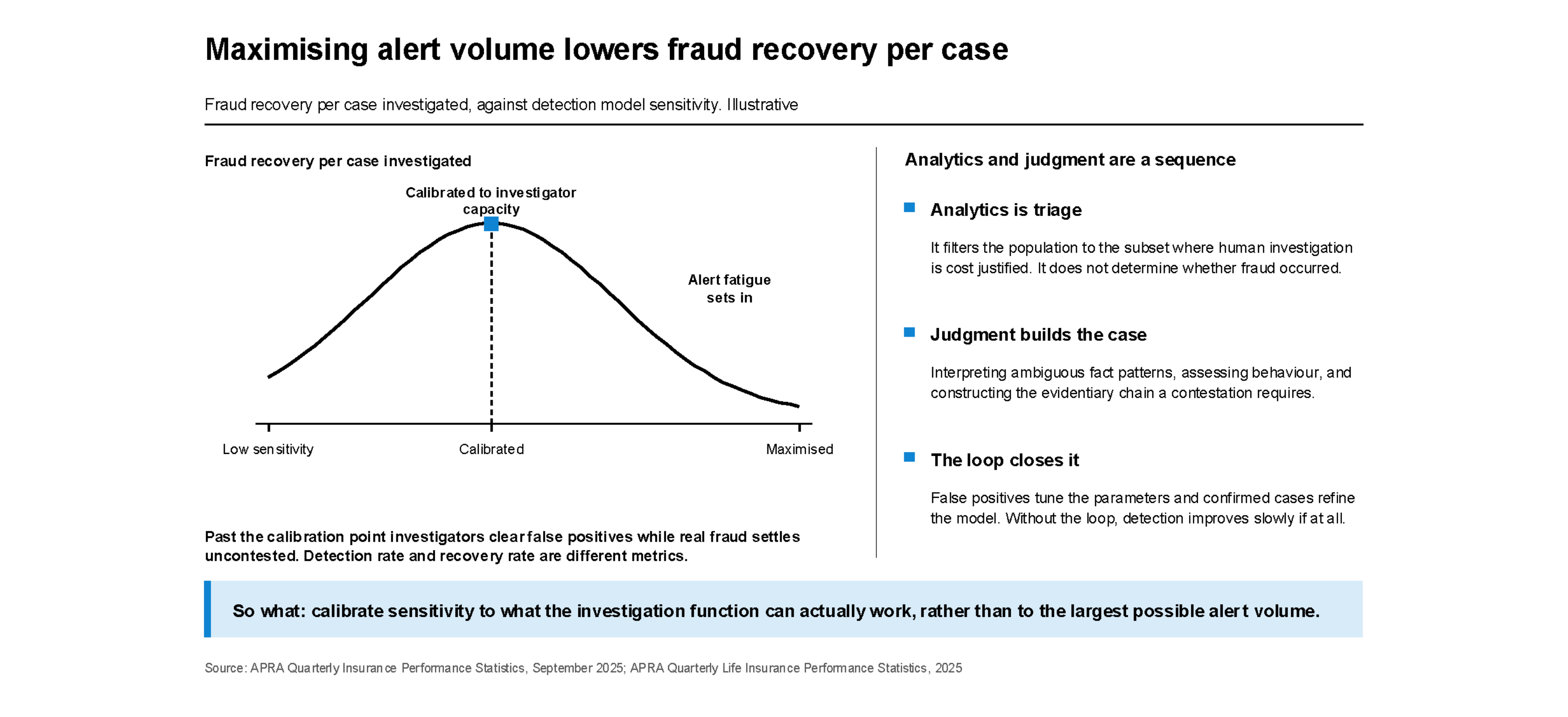
The failure mode is specific. Detection models optimised for sensitivity surface a large volume of anomalies, most of which are legitimate claims that fall outside normal patterns for reasons that have nothing to do with fraud. Investigators work through that queue. The false positive volume consumes time and expertise that would otherwise be applied to genuine cases. Alert fatigue sets in. Real fraud - the cases that actually warrant investigation - settles without contestation because the investigation function is occupied elsewhere.
The result is a detection rate that looks reasonable and a recovery rate that does not. Both numbers matter. Most operations are reporting on only one.
Analytics and judgment are not substitutes. They are a sequence.
Analytics is a triage function. It filters the claims population to the subset where human investigation is cost-justified - the cases where the anomaly pattern warrants the time, expertise, and cost of a proper investigation. That is a significant and valuable function. It is not the function of determining whether fraud has occurred, or whether a denial or recovery is defensible.
Human investigation does what the model cannot: interpret ambiguous fact patterns in context, assess claimant behaviour, construct the evidentiary chain that a contestation requires, and decide when the cost of pursuing a case is justified by the likely recovery. These are judgment calls. They require domain expertise in the specific class of fraud being investigated - policy structure, claimant behaviour patterns, legal threshold for contestation.
The operations that work best design both layers deliberately, as a sequence, with the interface between them explicitly managed.
Three design elements distinguish a well-functioning fraud operation from one that has invested in analytics without the corresponding investigation design.
First, alert calibration: model sensitivity is tuned to what the investigation function can actually work. Not maximised. Calibrated. The goal is not the largest possible alert volume - it is the alert volume that produces the best fraud recovery per case investigated. This number captures both triage quality and investigation effectiveness in a single metric.
Second, investigation capability: investigators have domain expertise in the fraud typologies they are working. Escalation pathways exist for cases that require specialist legal or clinical input. The settle-or-contest framework is explicit - investigators are not making that call on a case-by-case basis without reference to an agreed standard.
Third, feedback loop: investigation outcomes inform analytics calibration. False positives tune the detection parameters. Genuine fraud cases confirm and refine the model. Without this loop, the detection model improves only slowly, if at all.
ISSI's partnership model is structured around co-owning claims and fraud outcomes - not staffing a queue. With experience on claims-intensive platforms including PetSure's GapOnly real-time claims environment, ISSI works on an outcome-based commercial model rather than a staff-augmentation arrangement. If the balance between analytics and judgment in your fraud operation is the conversation worth having, it is worth thirty minutes.
Sources: APRA Quarterly Insurance Performance Statistics (September 2025); APRA Quarterly Life Insurance Performance Statistics (2025); IMARC Group Australia BPO Market Report (2025)