

Speed in a BPO transition is not a project management metric. It is a cost variable. The CFO who approves the partner with the faster ramp is not approving a project that moves faster. They are approving a transition that costs less - because every day the new team is still training is a day the old team is still billing.
Every BPO transition carries a structural cost that rarely appears in the business case headline: the dual-running period. This is the interval between the new partner's start date and the point where they can carry full volume - during which both teams are operational and both are being paid.
APRA data shows that other insurance expenses as a proportion of premium across Australian life insurance rose from 15% to 18% in the twelve months to June 2025. Insurance service expenses grew 7% year-on-year at industry level through September 2025. Both figures moved while carriers were actively pursuing efficiency programs. The cost keeps rising because transition overhead is built into the mechanism - and most business cases do not model it correctly.
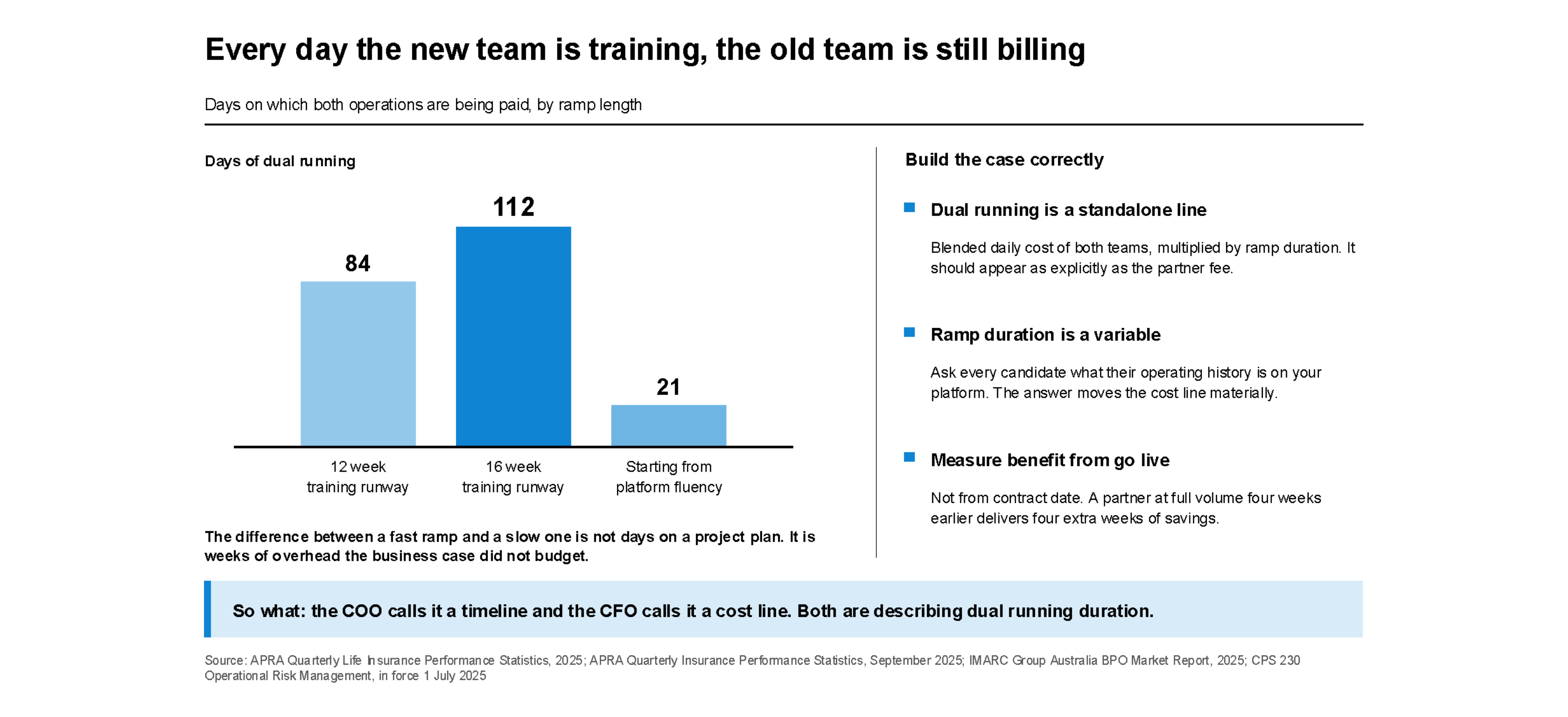
When a new BPO partner is not already fluent on the carrier's policy administration platform, the training runway begins at day one. Industry pattern puts that runway at twelve to sixteen weeks before the partner can carry full production volume without supervision. During that entire period, the outgoing team remains operational.
Dual-running is the line item most consistently underestimated in BPO transition business cases. The daily cost is the blended rate of two simultaneous operations: the new partner in ramp, the outgoing team holding volume. Multiply that by the number of days in the ramp period. For a twelve-week runway, that is eighty-four days. For a sixteen-week runway, it is one hundred and twelve. The difference between a fast ramp and a slow one is not days on a project plan. It is weeks of operational overhead that the business case did not budget for.
The CFO and COO are looking at the same number from different angles. The COO sees a transition timeline that is running long. The CFO sees a cost line that is moving in the wrong direction. They are describing the same variable: dual-running duration.
The mechanism that determines that duration is platform fluency. A partner who already operates on the carrier's policy administration system does not need a training runway. The skills exist. The ramp compresses from months to weeks - and the dual-running period compresses with it. In ANZ, where NZ regulatory governance requirements and Australia's CPS 230 (in force 1 July 2025) both require defensible third-party arrangements, a shorter transition is also a lower-compliance-overhead transition.
Three elements belong in every BPO transition business case that the CFO and COO are reviewing together.
First: calculate dual-running cost as a standalone line item. Take the blended daily cost of both operational teams and multiply by the expected ramp duration. This number should appear as explicitly as the partner's fee.
Second: treat ramp duration as a variable, not a fixed assumption. Ask every candidate partner whether they have prior operating experience on the carrier's platform. The answer changes the ramp estimate - and the dual-running cost line - materially.
Third: measure time-to-benefit from the actual go-live date, not the contract date. A partner who reaches full volume four weeks earlier delivers four additional weeks of savings - and avoids four weeks of dual-running cost.
The Australian BPO market is growing at 7.2% CAGR as more carriers recognise that targeted outsourcing, scoped to the existing platform, is a different conversation from broad-scope transformation.
ISSI's delivery team is already fluent on the platforms ANZ carriers run with a ramp-time track record on carrier platforms including PetSure. Platform fluency means the dual-running window is measured in weeks, not quarters, because there is no training runway to fund.
If total transition cost - and specifically what the dual-running period is adding to it - is live in your organisation, it is worth thirty minutes to discuss what a platform-fluent transition looks like.
Sources: APRA Quarterly Life Insurance Performance Statistics (2025); APRA Quarterly Insurance Performance Statistics (September 2025); IMARC Group Australia BPO Market Report (2025)