

The merger closed eighteen months ago. The technology consolidation roadmap is in place. The project teams are working. And yet when you look at the operations cost line, it has barely moved. You are still running two servicing teams, two sets of processes, two vendor arrangements. The synergies the business case promised are sitting in a spreadsheet. The dual-stack is still running at full cost.
Post-merger integration business cases are precise about synergy targets. They are less precise about when those synergies arrive in operations - and what keeps them from arriving.
The answer is almost always the same: the integration plan made system consolidation the prerequisite for operating-model consolidation. And system consolidation in insurance takes longer than the business case assumed.
APRA data shows that other insurance expenses as a proportion of premium across Australian life insurance rose from 15% to 18% in the twelve months to June 2025. That rise is happening while some of the largest carriers in the market are mid-integration. Acenda, formed from the merger of MLC Life and Resolution Life, is managing combined books of approximately two million policies across legacy stacks. The cost pressure is not waiting for the technology program to complete.
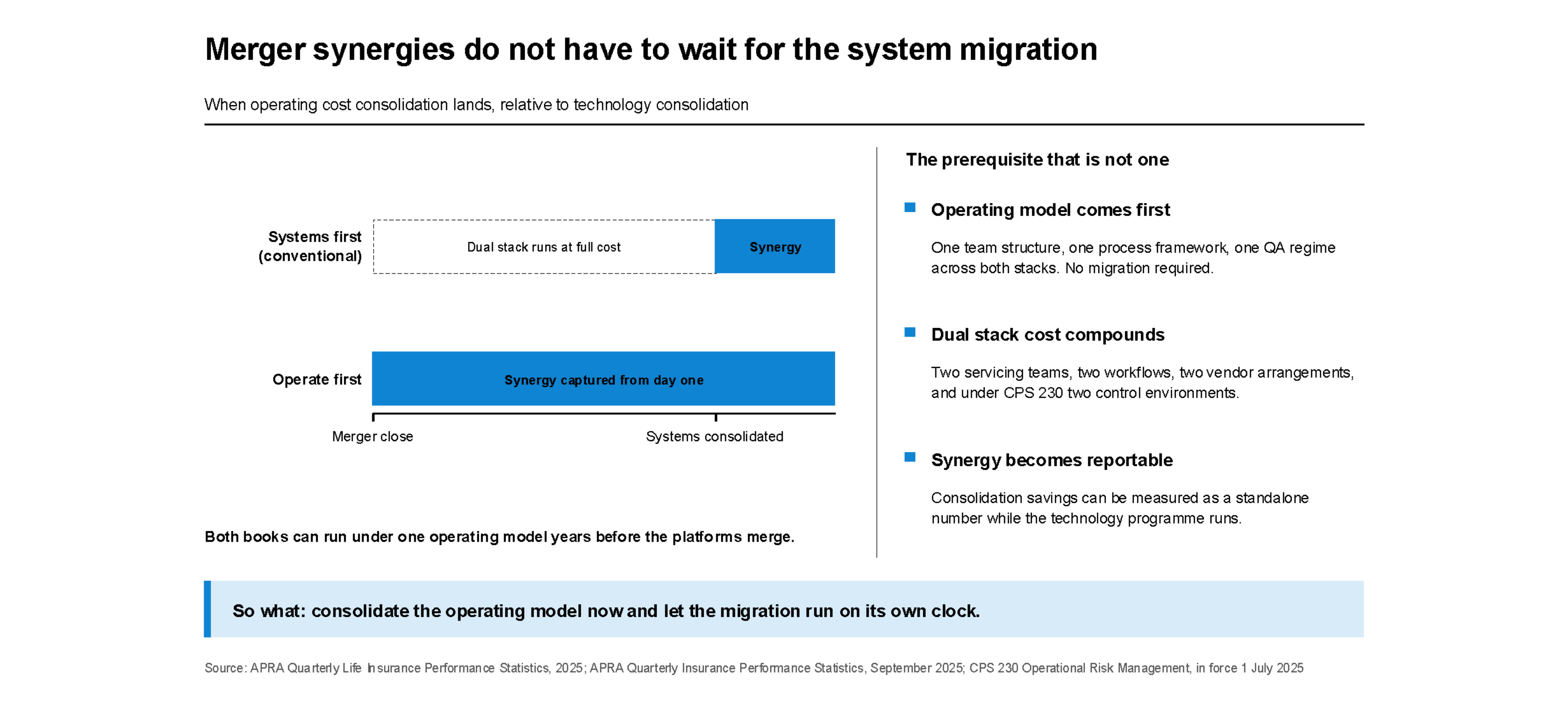
The dual-stack operating period - the window between merger close and full system consolidation - is the interval where integration cost accumulates fastest.
During this period, the carrier is running two of everything: two servicing teams calibrated to different legacy platforms, two sets of workflows that were designed independently, two vendor arrangements governing the same functions, duplicated QA and compliance frameworks, and duplicated workforce management infrastructure. None of this overhead reduces while the migration is in progress. It persists for the full duration of the technology program.
That duration is almost always longer than the integration business case assumed. In ANZ life insurance, book migrations involving legacy policy administration systems routinely run well beyond the original timeline. Insurance service expenses grew 7% year-on-year at industry level through September 2025, even as carriers pursued efficiency programs. Dual-stack cost is a structural contributor to that number.
CPS 230, which came into force on 1 July 2025, adds a compliance dimension that most integration programs did not anticipate. APRA's operational risk requirements apply to both environments simultaneously. The regulatory burden of a dual-stack operation is higher, not lower, than a consolidated one.
The assumption built into most integration business cases is that operating costs cannot be consolidated until the systems are. That assumption is the primary reason post-merger synergies arrive late.
It is also wrong.
Operating-model consolidation does not require system consolidation as a prerequisite. A partner who is already fluent on both legacy platforms can service both books - across both admin environments - under a single operating model from day one. One team structure, one process framework, one QA regime, one vendor arrangement. The cost benefit of that consolidation lands immediately, regardless of where the technology program is.
The system migration then proceeds on its own timeline, without dragging the operating cost with it. And when the migration completes, it arrives into an already-consolidated operating model rather than two separate ones.
Under CPS 230, a unified operating model with a single, auditable third-party arrangement is also a more defensible position than a fragmented dual-vendor structure that may have been inherited from either side of the merger without formal review.
The sequence that extracts synergies before system consolidation follows three steps.
First: map both books against the platforms they actually run on, not the target state. Identify where process overhead is genuinely duplicated across both stacks and where it differs because the platforms require different handling. This mapping is done on the live systems, not on a future-state architecture.
Second: consolidate the operating model across both environments simultaneously, using a partner with working fluency on both platforms. The critical requirement is that the partner does not need a ramp period on either stack. A training runway on two different legacy platforms extends the dual-stack cost period - it does not reduce it.
Third: measure the cost reduction from operating-model consolidation as a standalone number - independently of the system migration timeline. This produces a defensible before-and-after figure that demonstrates synergy delivery to the board, even while the technology program is still running.
The Australian BPO market is growing at 7.2% CAGR because more carriers are using targeted operational outsourcing to extract exactly this kind of synergy on the existing environment.
If you are managing a post-merger integration where the operational cost synergies are not tracking to plan, the conversation worth having is not about accelerating the system migration. It is about consolidating the operating model on the platforms you already have.
A structured cost diagnostic across both environments can be run on the live systems - no migration required, no parallel build.
If the dual-stack cost line is not moving, it is worth thirty minutes to discuss what operating-model consolidation could show.
Sources: APRA Quarterly Life Insurance Performance Statistics (2025); APRA Quarterly Insurance Performance Statistics (September 2025); IMARC Group Australia BPO Market Report (2025)