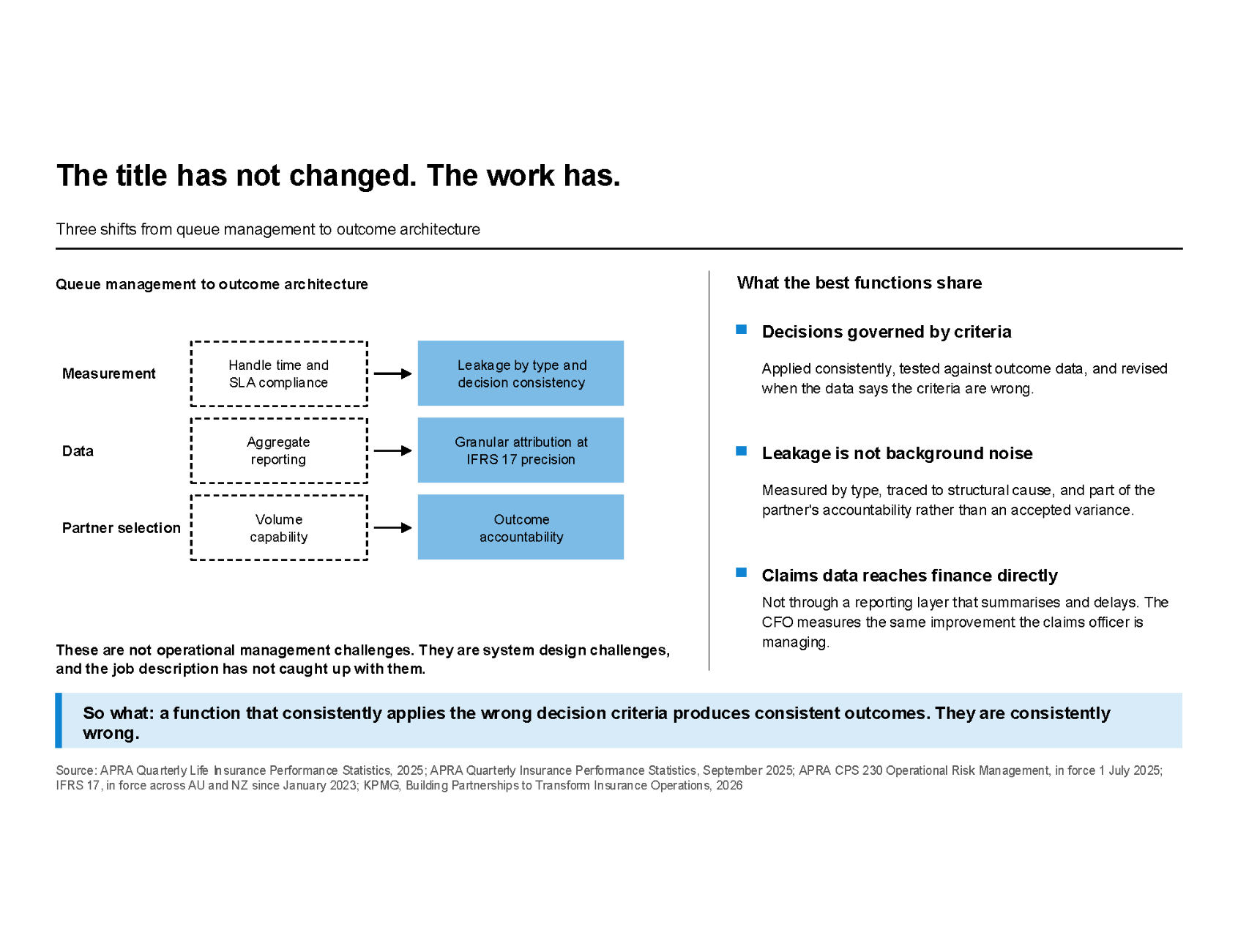


Are we paying for what they do, or for what happens? That question, asked honestly, separates every genuine co-ownership arrangement from every rebranded SLA.
The commercial model governing most carrier-BPO relationships is a service agreement: defined activities, agreed SLAs, periodic performance reviews, annual rate negotiation. That model has a structural limitation. It measures what the vendor delivers, not what the carrier achieves. When the outcome the carrier cares about is not embedded in the commercial structure, the vendor has no contractual reason to optimise for it. The account relationship may be excellent. The alignment is not.
Most carrier-BPO arrangements are running on SLA logic while talking partnership language. The language of partnership - shared goals, collaborative working, strategic alignment - is common in account management. The commercial structure that would make it real is not.
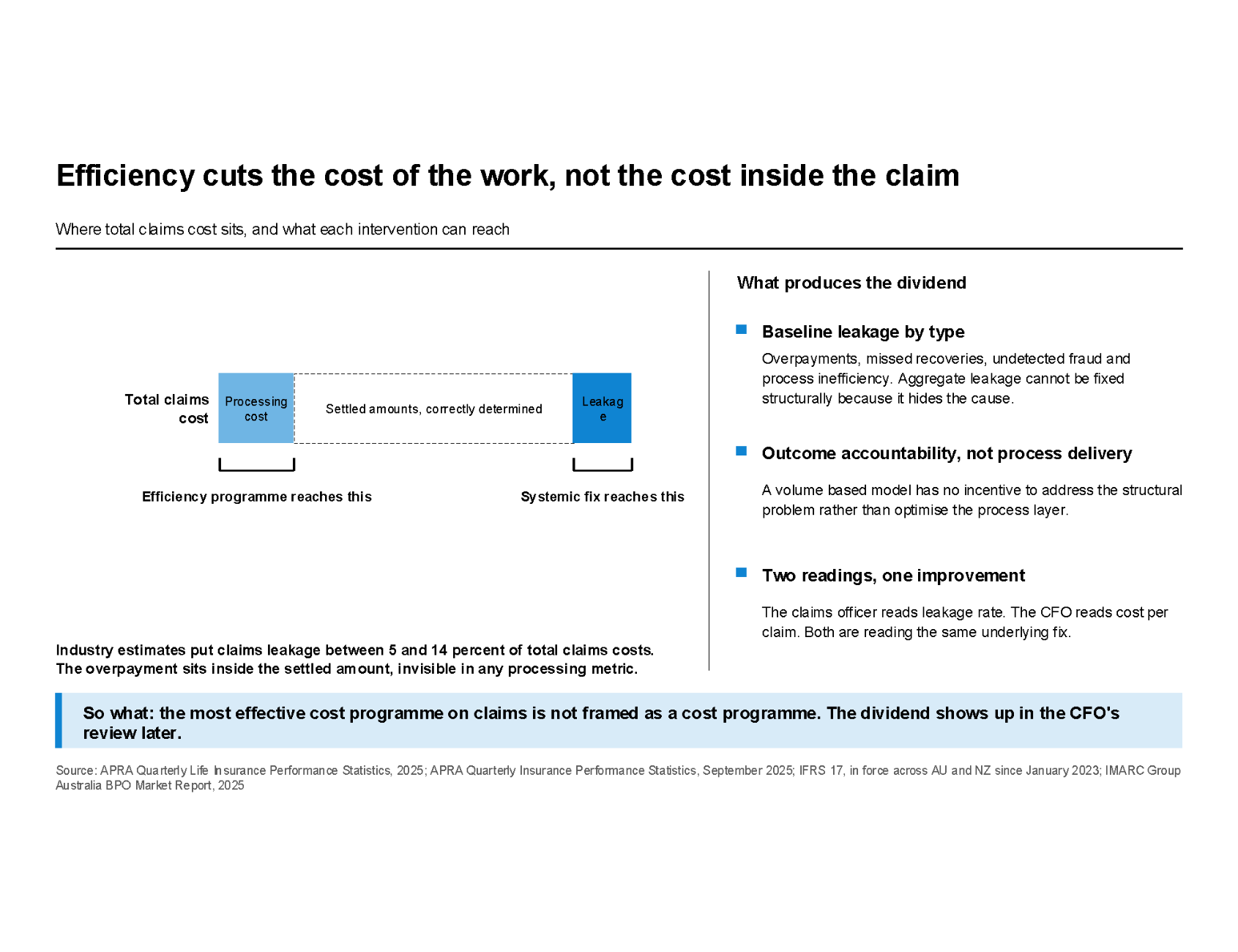
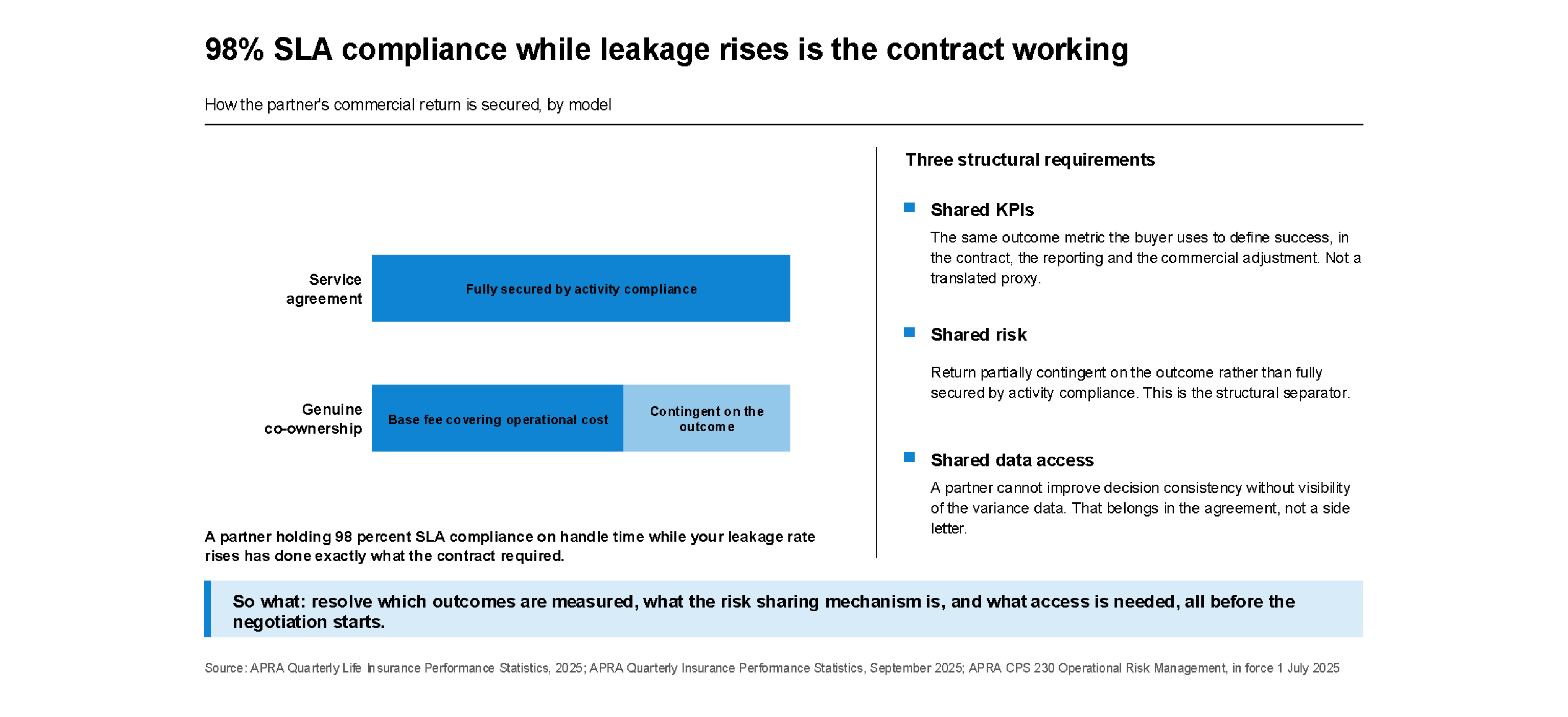
SLA-based contracts measure activity: handle time, response rates, case throughput, escalation compliance. These metrics are reasonable proxies for service delivery. They are not proxies for outcome. A vendor who maintains 98% SLA compliance on handle time while your leakage rate rises has done exactly what the contract required. The contract did not require the outcome to improve.
The question that distinguishes genuine co-ownership from a well-managed SLA: are the vendor's commercial incentives aligned to the same outcome metrics the buyer uses to define success? If the answer is no, the relationship may be collaborative. But it is not a partnership in any structural sense.
A genuine outcome-based model requires three things: shared KPIs, shared risk, and shared access to the data needed to influence the outcome.
Shared KPIs mean the metric the buyer uses to define success is the same metric the partner is commercially accountable for. Not a translated proxy. The same outcome metric - leakage rate, fraud recovery per case, decision consistency score - in the contract, the reporting, and the commercial adjustment mechanism.
Shared risk means the partner's commercial return is partially contingent on the outcome, not fully secured by activity compliance. This is what structurally separates outcome-based commercial models from service agreements with outcome language.
Shared access means the partner can see the data needed to influence the outcome. A partner managing claims decisions cannot improve decision consistency without visibility into the variance data. Data access is a structural requirement of the model. In Australia, CPS 230, in force 1 July 2025, provides a formal review trigger: third-party arrangements for critical operations must be demonstrably defensible - which includes alignment between commercial incentives and operational outcomes.
Defining the co-ownership model before the commercial negotiation begins is what separates a genuine partnership from a rebranded SLA.
Three design questions must be resolved before the contract is signed. First: which outcomes will be measured and how? The KPI set must be defined pre-contract, not derived from what the vendor's reporting system already produces. If leakage rate and decision consistency score are the outcomes that matter, the measurement methodology for each must be agreed at the outset. Second: what is the risk-sharing mechanism? A base fee covering operational cost and a variable component tied to outcome performance, with an agreed period, floor, and ceiling. The design question is what the variable component is tied to and over what measurement window. Third: what access does the partner need? Data access, system access, and operational visibility requirements belong in the commercial agreement, not in a side letter negotiated after the relationship is running.
These are the questions a genuine co-ownership negotiation resolves before signing. Both sides commit: the carrier to access and transparency, the partner to outcome accountability and commercial exposure.
ISSI's partnership model is structured around co-owning claims and fraud outcomes - not staffing a queue. With experience on claims-intensive platforms including PetSure's GapOnly real-time claims environment, ISSI works on an outcome-based commercial model rather than a staff-augmentation arrangement. If the structure of a genuine co-ownership model is the conversation worth having, it is worth thirty minutes.
Sources: APRA Quarterly Insurance Performance Statistics (September 2025); APRA Quarterly Life Insurance Performance Statistics (2025); IMARC Group Australia BPO Market Report (2025)