

The claims team that produced the leakage was, by most observable measures, performing adequately. That is not an excuse. It is a diagnosis. Leakage at scale is not a people problem. It is a process architecture problem wearing a people problem's clothes.
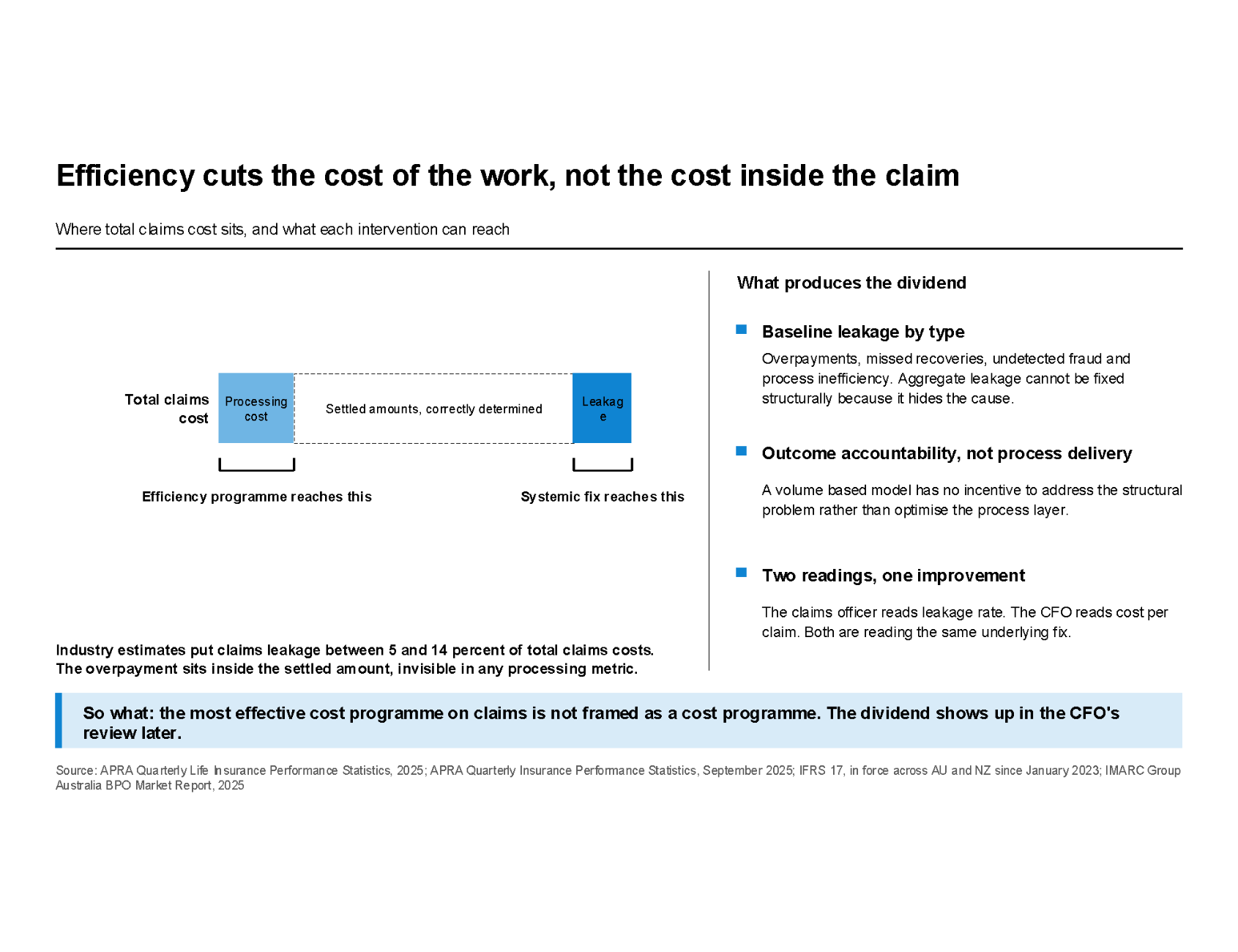
Claims leakage does not announce itself. It accumulates in the gap between what a claim should settle for and what it actually settles for - across decisions made under time pressure, by handlers working inside a process designed for throughput rather than consistency. APRA data shows insurance service expenses grew 7% year-on-year at industry level through September 2025, even as carriers invested in staffing programs aimed directly at claims costs. The expense line kept moving because the structural cause was not being addressed.
The common response is a people diagnosis. The team is undertrained. The headcount is short. Add capacity and the number improves. That logic is not always wrong. It is rarely sufficient.
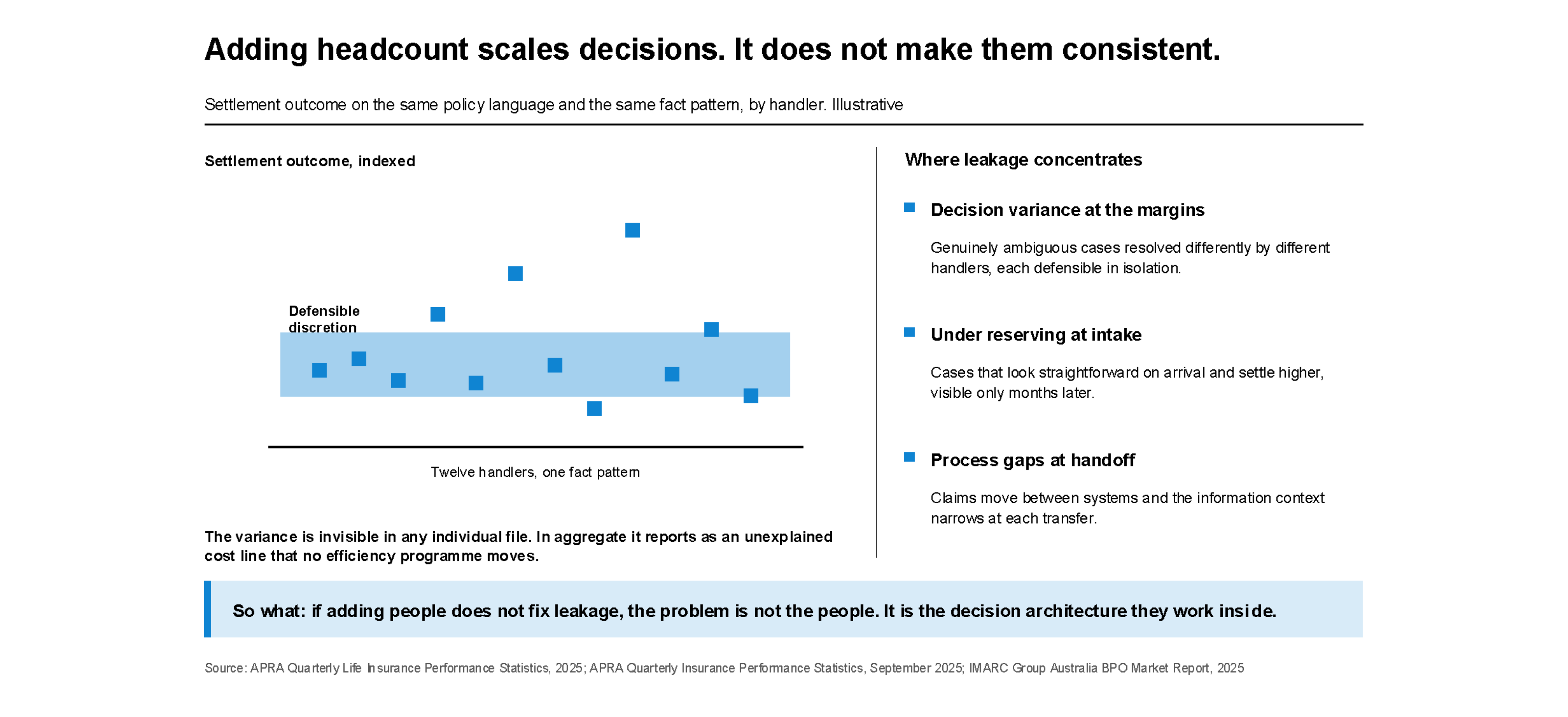
How many of your claims decisions this quarter were consistent - same policy language, same fact pattern, different handler, same outcome? The honest answer for most claims operations is: fewer than the reporting suggests.
Leakage concentrates at a few structural points: decision variance at the margins of policy, where genuinely ambiguous cases are resolved differently by different handlers; under-reserving on cases that look straightforward at intake but settle higher; and process gaps at handoff, where claims move between systems and the information context narrows. Adding headcount to these structural gaps scales the volume of decisions. It does not improve their consistency.
If adding people does not fix leakage, the problem is not the people. It is the decision architecture they are operating inside.
Decision architecture is the combination of policy guidelines, reserve frameworks, escalation pathways, and process design that shapes the space of decisions a handler can make. When that architecture is well-engineered, different handlers reach consistent outcomes on similar cases. When it is not, variation accumulates case by case - invisible in individual files, visible in aggregate as an unexplained cost line.
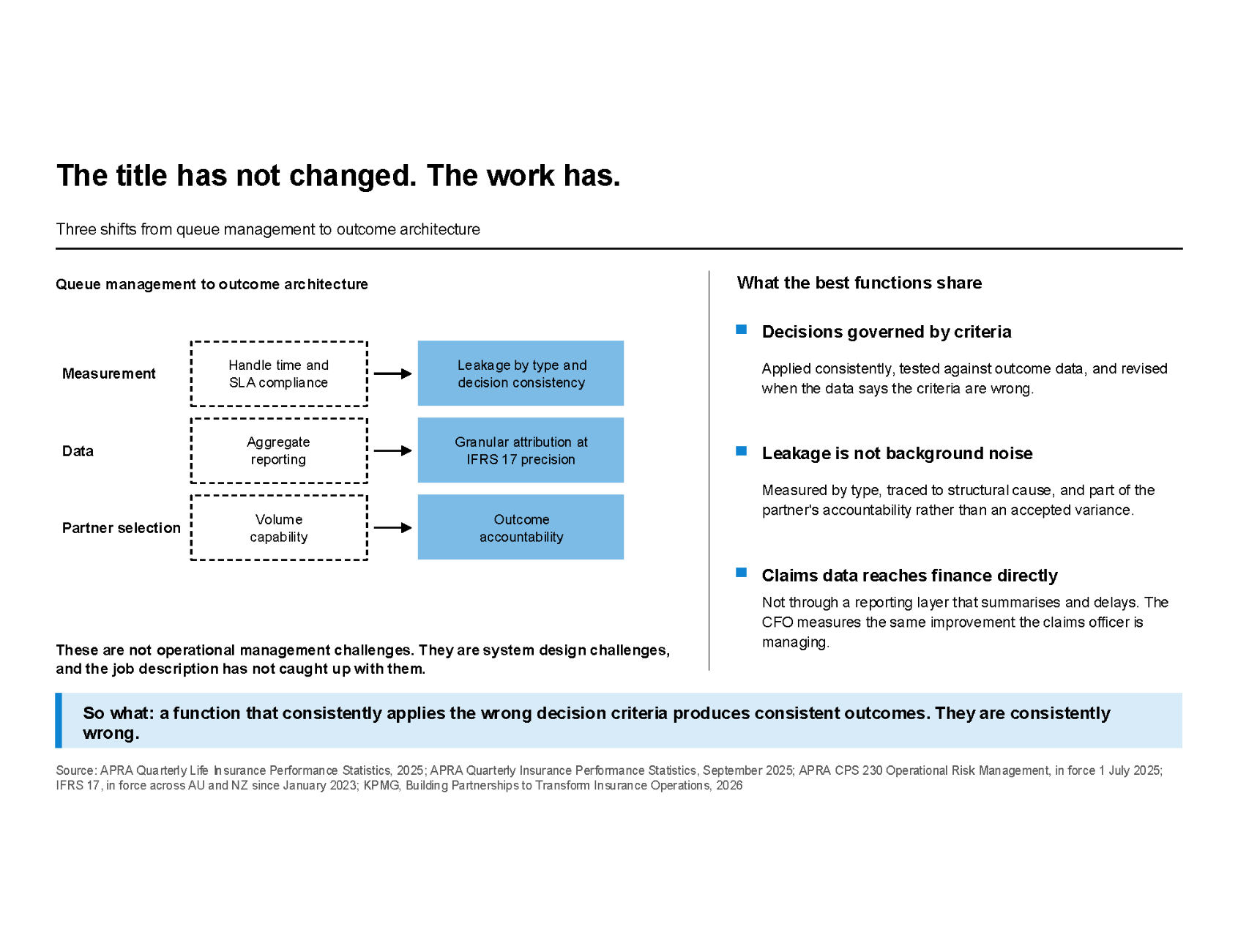
The commercial model implication is significant. A vendor who supplies headcount has no structural interest in the consistency of the decisions being made. A partner who co-owns the leakage outcome does. Shared KPIs change what the partner looks for, what it flags, and what it is accountable for delivering.
A structural approach to claims leakage follows a recognisable sequence.
The starting point is decision variance analysis: identifying where handlers on similar cases are reaching different outcomes, and whether that variance reflects defensible discretion or process ambiguity. This is a measurement exercise. It produces a map of where the decision architecture is creating inconsistency.
From that map, three redesign targets become visible. First, decision boundary clarity: where policy intent is ambiguous, making it explicit reduces handler-by-handler variation without removing legitimate judgment. Second, reserve framework calibration: cases systematically under-reserved at intake create settlement leakage visible only months later; calibrating reserves against actual settlement outcomes closes this gap. Third, escalation pathway design: routes that are slow or ambiguous are rarely used, which means complex cases that warrant a senior decision frequently do not get one.
The result is not a tighter process. It is a process that produces consistency because it gives handlers better inputs - not because it constrains their judgment.
ISSI's partnership model is structured around co-owning claims and fraud outcomes - not staffing a queue. With experience on claims-intensive platforms including PetSure's GapOnly real-time claims environment, ISSI works on an outcome-based commercial model rather than a staff-augmentation arrangement. If claims leakage as a structural problem - not a headcount one - is the conversation worth having, it is worth thirty minutes.
Sources: APRA Quarterly Life Insurance Performance Statistics (2025); APRA Quarterly Insurance Performance Statistics (September 2025); IMARC Group Australia BPO Market Report (2025)