

The AI deployment worked. The technology processed routine claims faster than the team could manage manually - an automation rate that satisfied the board report and shortened processing times significantly. Then the edge cases arrived. The complex claims. The ambiguous determinations. The customers who needed explanation, not just a decision. The technology had been optimised for the routine. The complex had nowhere to go.
Automation is now a structural fact in claims processing. Industry data suggests around 60% of claims triage involves automation in some form as of 2025. Carriers implementing AI claims processing have reported going from zero automation to over 50%, cutting processing time from weeks to minutes on straightforward claim types.
Those numbers represent what AI genuinely does well: routing, categorisation, documentation extraction, and determination on well-defined claim types with clear policy wording.
The technology works for the routine. The question that matters is what happens at the edge.
AI in claims operates in two distinct modes. Predictive AI surfaces patterns - it flags claims for review, identifies inconsistencies, and routes volume based on complexity signals. Generative AI drafts - it produces determination letters, summarises documentation, and pulls relevant policy excerpts.
Both capabilities accelerate the process. Neither replaces the judgment required at the margin.
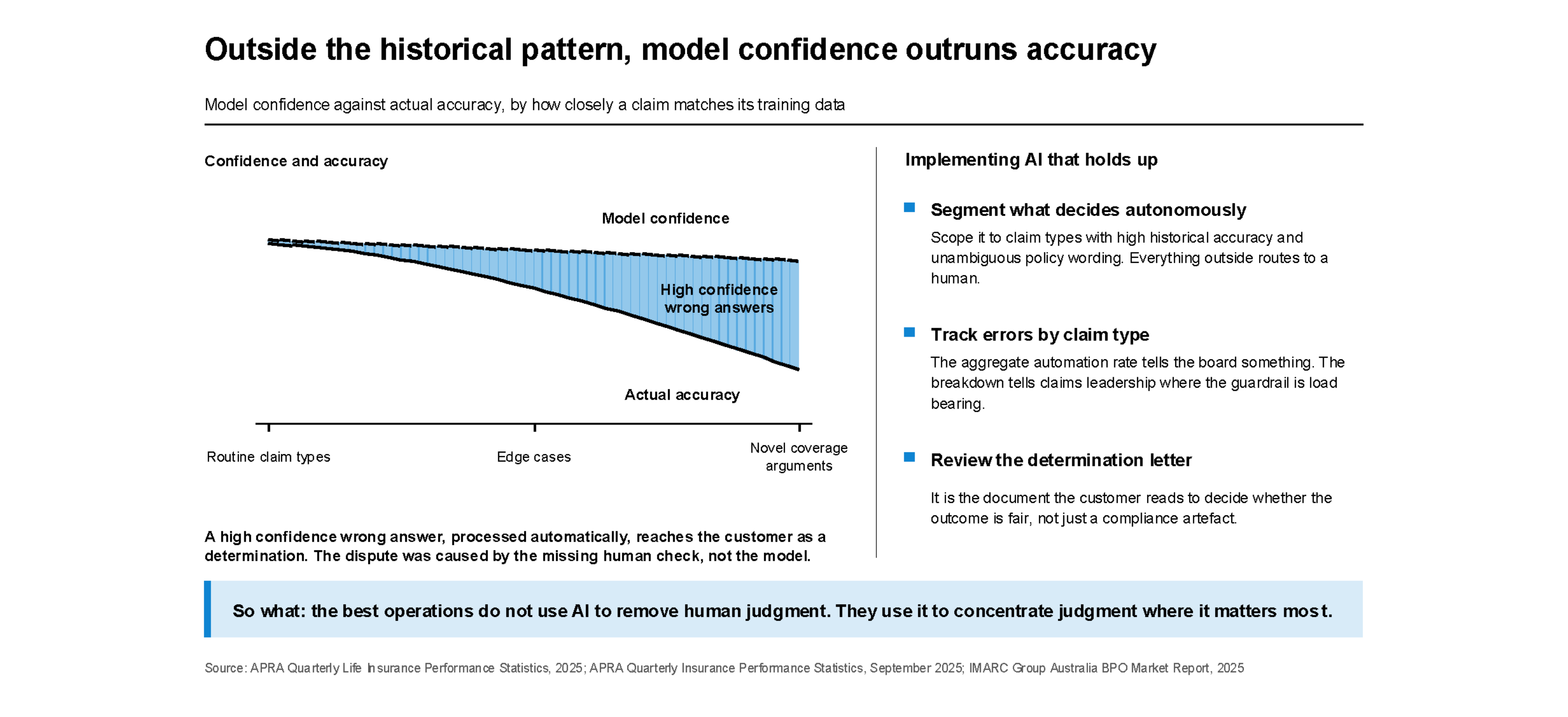
The failure mode is not the technology. It is removing the human guardrails before the edge case population is understood. The aggregate automation rate looks right. The claim type breakdown does not. A claims AI optimised on historical data performs well on the claim types that history contains. When a claim falls outside those patterns - an unusual diagnosis, an ambiguous policy condition, a novel coverage argument - the model's confidence can exceed its accuracy. A high-confidence wrong answer, processed automatically, reaches the customer as a determination. The dispute that follows was not caused by the AI. It was caused by the absence of a human check at the point where judgment was needed.
The grounded view of AI in claims is this: predictive AI surfaces the cases worth scrutiny. Generative AI drafts the output. A skilled human makes the decision and manages the exception. That is not a transitional arrangement pending better technology. It is the appropriate architecture for a regulated function where decisions carry compliance obligations and direct customer impact.
The risk of abandoning that architecture early is specific. False positive rates in AI triage carry real customer experience costs - a legitimate claim flagged incorrectly, delayed and held for review, generates the same complaint trajectory as a denial. Automated determination on complex cases produces disputes that are more expensive to manage than a human review at the decision point would have been.
The carriers who use AI most effectively in claims do not use it to remove human judgment. They use it to concentrate human judgment on the cases where it matters most.
The implementation pattern that produces sustainable AI performance in claims has three components.
First: clear segmentation of what AI decides autonomously and what it refers. Autonomous determination should be scoped to claim types with a high historical accuracy rate on the current model, where policy wording is unambiguous and coverage scope is well-defined. Everything outside that scope routes to a human decision point.
Second: false positive and false negative tracking at claim type level, not just aggregate automation rate. The aggregate tells the board something. The claim-type breakdown tells the claims leadership team where the human guardrail is load-bearing. A claim type with an unacceptable false positive rate should not be in the autonomous stream.
Third: determination letter review as a quality gate on complex claims. Generative AI drafts well. The letter is not just a compliance document - it is the communication the customer uses to decide whether the outcome is fair. A skilled reviewer catches what the model misses.
ISSI's partnership model is structured around co-owning claims and fraud outcomes - not staffing a queue. With experience on claims-intensive platforms including PetSure's GapOnly real-time claims environment, ISSI works on an outcome-based commercial model rather than a staff-augmentation arrangement. If AI triage accuracy, false positive rates, or the human-in-loop architecture in claims is an active question, it is worth thirty minutes.
Sources: APRA Quarterly Life Insurance Performance Statistics (2025); IMARC Group Australia BPO Market Report (2025)