

The deal team handed over the project plan. The TSA runs for eighteen months. The integration lead has done the maths: eighteen months to absorb a book of policies on a platform the servicing team has never operated. The training programme takes six months. The gap between the project plan and operational readiness is not a planning problem. It is a fluency problem.
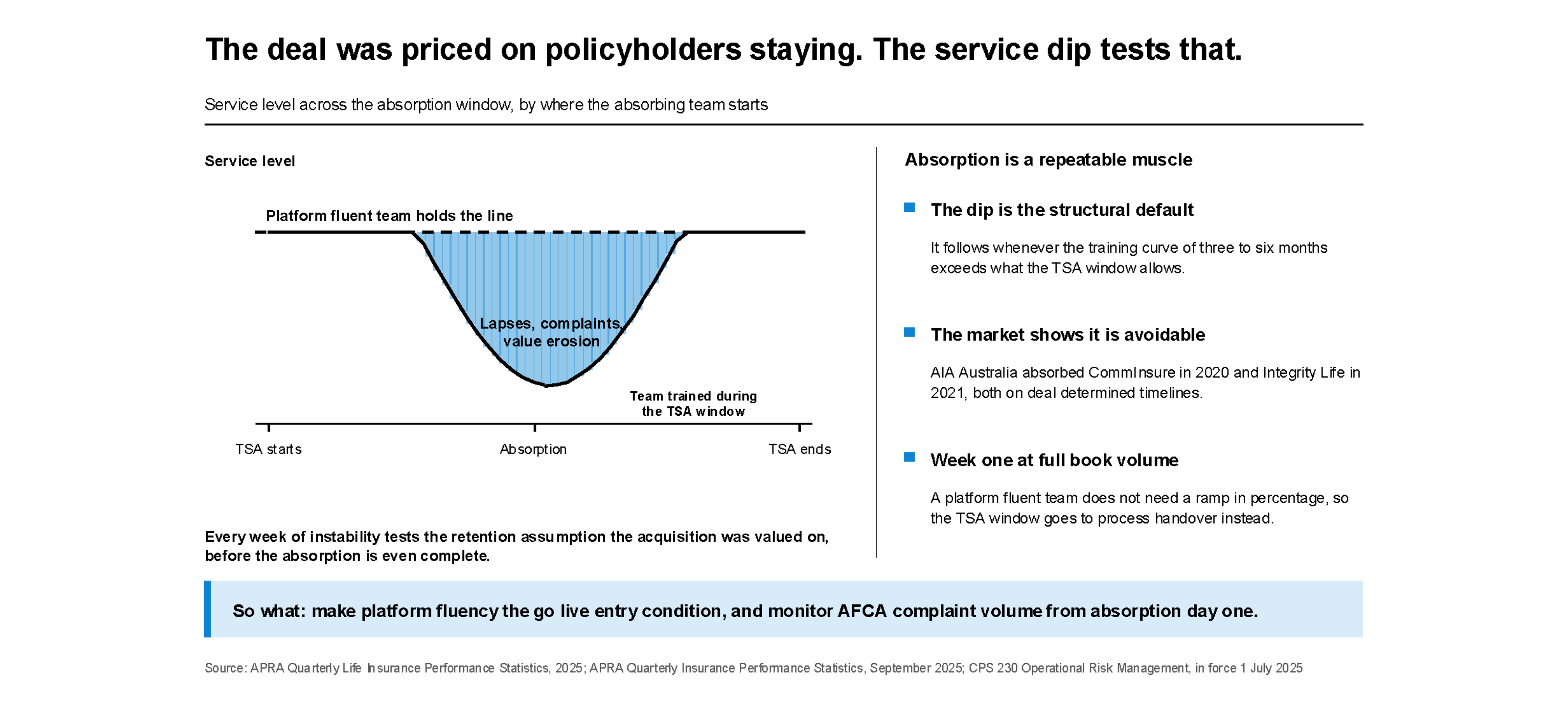
The acquisition was valued on the assumption that the policyholders remain. Every week of service instability is a week in which that assumption is tested - through lapses, complaints, and unanswered queries that erode the book's value before the absorption is complete.
Other insurance expenses as a proportion of premium across Australian life insurance rose from 15% to 18% in the twelve months to June 2025. Absorbing a book without a service dip is not a nice outcome - it is the commercial obligation the deal was built around. CPS 230, in force from 1 July 2025, requires absorbing carriers to evidence operational continuity through the absorption window.
The service dip during book absorption is the structural default when the absorbing team starts from training, not from platform fluency. It is preventable - but only if the fluency question is asked before the absorption timeline is set.
The mechanics are consistent. The TSA runs for a fixed period. The absorbing team must learn the acquired book's platform environment. Industry pattern puts ramp-to-operating-competence on these platforms at three to six months. When the training curve exceeds what the TSA window allows, the service dip follows.
AIA Australia absorbed CommInsure in 2020 and Integrity Life in 2021 - large-scale absorptions under deal-determined timelines. The market evidence is that it is achievable. The question is always where the absorbing team starts.
Book absorption is not a one-time crisis. It is a repeatable operational discipline - and the carriers that treat it as a discipline absorb without a service dip.
AIA did it twice in consecutive years. Acenda, formed from the merger of MLC Life and Resolution Life, is managing approximately two million combined policies across a multi-legacy environment - the current scale example of what absorption demands.
The differentiator is where the absorbing team starts. When the team is already fluent on the platform, the TSA window is used for process handover, not competence building. Week one is operating week one. The absorbed book is carried at volume from the first day.
A dip-free absorption requires four things from day one, not after a stabilisation period.
First: platform fluency confirmed as the operational go-live entry condition. The absorbing team demonstrates they can navigate exception-handling logic on the acquired book's platform instance before the TSA end date becomes the commitment.
Second: week-one servicing capacity planned at absorbed book volume - not a ramp-in percentage. A platform-fluent team does not need a baseline period.
Third: quality reporting active from absorption day one. Processing accuracy, first-contact resolution, and complaint rates measured from the first operating day. If a service dip is starting, it is visible before it compounds.
Fourth: AFCA complaint monitoring live from day one. Complaint volume is the earliest signal that the absorption is holding - or not.
ISSI's delivery team is already fluent on the platforms Australian life insurance books run on with a ramp-time track record on carrier platforms. In a book absorption, that fluency means the TSA window is used for process handover, and week-one capacity can be committed at absorbed book volume from day one.
If the absorption timeline has been set and operational readiness is the open question, it is worth thirty minutes.
Sources: APRA Quarterly Life Insurance Performance Statistics (2025); APRA Quarterly Insurance Performance Statistics (September 2025); IMARC Group Australia BPO Market Report (2025)