

The resilience review was supposed to take a morning. The COO had the BCM documentation in front of them - process maps, recovery time objectives, critical system dependencies. Then the claims partner joined the call. Within twenty minutes, it was clear that the partner's operational knowledge - accumulated through years of daily processing on the live system - was more current, more granular, and more actionable than anything in the internal runbooks. Nobody had designed this outcome. It had simply accumulated.
CPS 230, in force since 1 July 2025, asks every carrier a pointed question: can your material service providers maintain continuity of your critical operations when something goes wrong? For many carriers, the honest answer is unclear. The SLA vendor processing a large portion of claims volume has never been asked to prove what they know about the operation beneath the metric they report against. Task knowledge and operational knowledge are not the same thing. The gap between them is where concentration risk actually lives - and most carriers have not formally measured it.
The most accurate operational documentation in many ANZ carriers is not held by the BCM team. It is held by the claims outsourcing partner - because they are in the system every working day, and the BCM team reviews documentation once a year.
This is not an indictment of SLA-based relationships. They are designed to bound accountability precisely: the vendor performs the task, reports the metric, and the carrier retains ownership of everything else. That design is appropriate for a cost-efficiency arrangement. What it does not produce is operational depth.
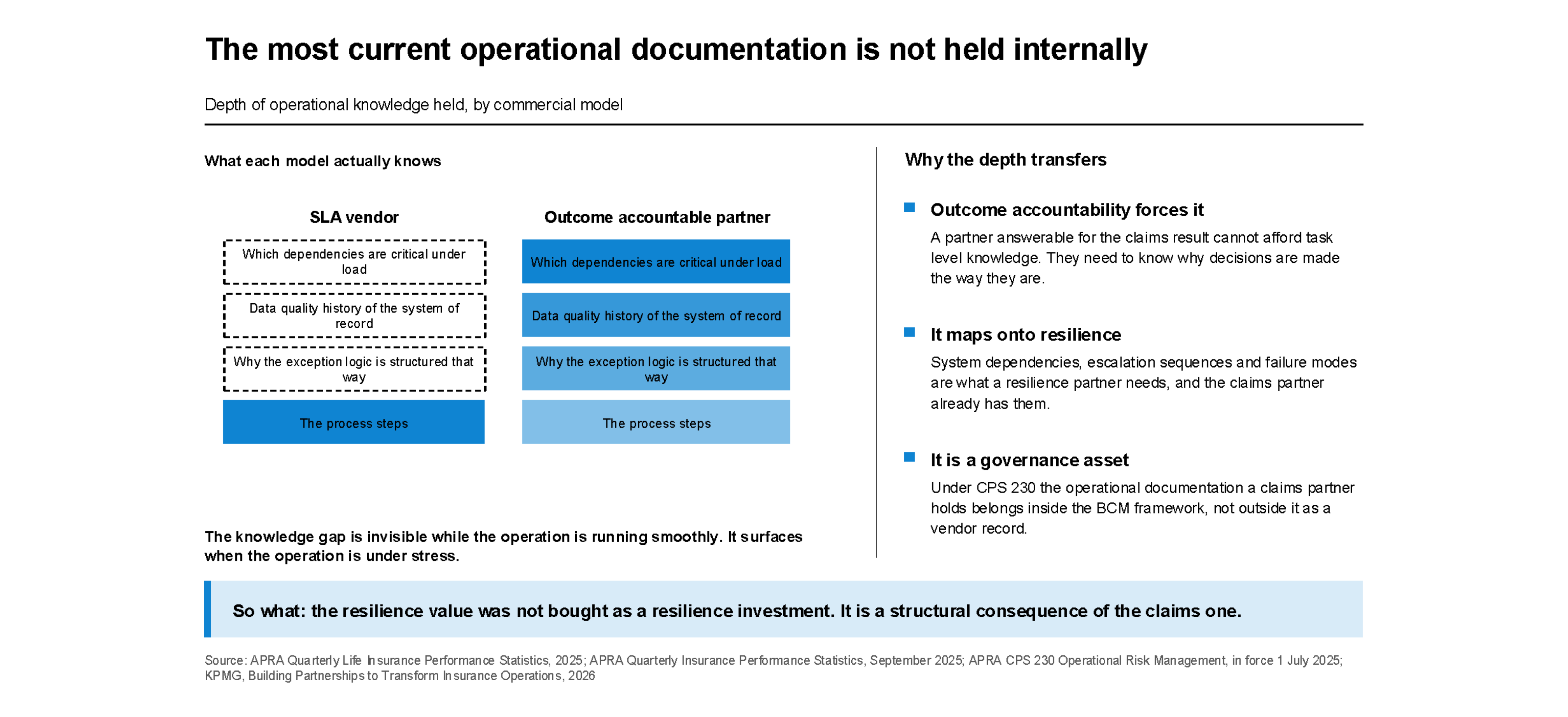
An SLA vendor knows the process. What they do not know: why the exception-handling logic is structured the way it is; what the data quality history of the system of record looks like; where escalation paths terminate; which system dependencies are genuinely critical under load. That knowledge gap is invisible when the operation is running smoothly. It surfaces when the operation is under stress.
A partner accountable for claims outcomes cannot afford task-level knowledge. They need to understand why decisions are made the way they are, how data flows through the system, where failure modes accumulate, and what the operation depends on to produce a defensible result. That understanding is accumulated daily through the work, not through documentation reviews.
Over time, that depth maps almost precisely to what a resilience partner needs. The claims partner already knows what the system depends on. They already know the escalation sequences. They already know which edge cases require human judgment and which can be handled systematically. That knowledge was not acquired as a resilience investment. It was acquired as a claims investment. The resilience value is a structural consequence - not a separate engagement. A compounding outcome.
The carriers who have built genuine operational resilience through their claims partnerships share a recognisable structure. The commercial model is built around outcome accountability, not task accountability - that accountability is what creates the institutional incentive to understand the full system, not just the assigned portion.
The partner's operational knowledge is formally recognised as a governance asset. Under CPS 230 and equivalent regulatory governance requirements from RBNZ and FMA for NZ carriers, the operational documentation a claims partner holds is part of the BCM framework - not a vendor record sitting outside it.
The dual mandate is explicit: claims outcomes and resilience capability are both in the partnership structure, not sequential goals. And because the partner already knows the platform, the data, and the operation, there is no ramp period before resilience support can be deployed. The trust built through claims co-ownership is immediately transferable to operational co-ownership.
ISSI's partnership model extends from co-owning claims outcomes to serving as a warm second source - because the same platform fluency that enables one enables the other. With experience on claims-intensive platforms including PetSure's GapOnly real-time claims environment, ISSI works on an outcome-based commercial model rather than a staff-augmentation arrangement. If the depth of the current claims relationship has not been tested against a resilience scenario, it is worth thirty minutes.
Sources: APRA Quarterly Life Insurance Performance Statistics (2025); APRA Quarterly Insurance Performance Statistics (September 2025); KPMG, "Building Partnerships to Transform Insurance Operations" (2026); IMARC Group Australia BPO Market Report (2025)