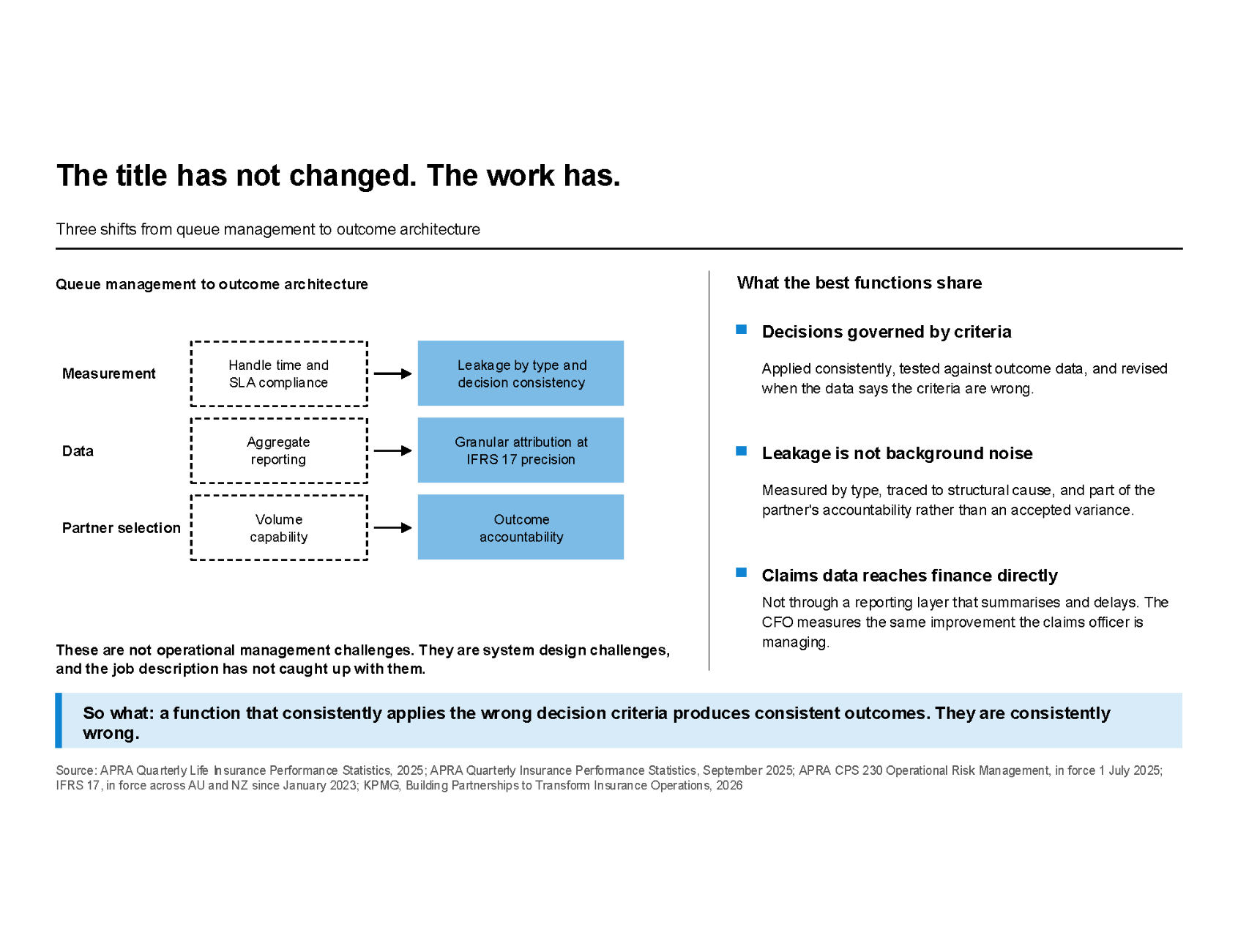


The book stopped writing new business three years ago. The headcount has come down. The systems have not changed. And yet every time you run the expense ratio, it has crept up another few basis points. You know the cost is in there somewhere. You just cannot point to where, because your reporting tells you the book-level number and nothing below it.
A closed or in-force life book does not behave the way finance models assume it will. Policy volume is fixed or declining. Revenue is not growing. The natural assumption is that cost follows volume down. It rarely does.
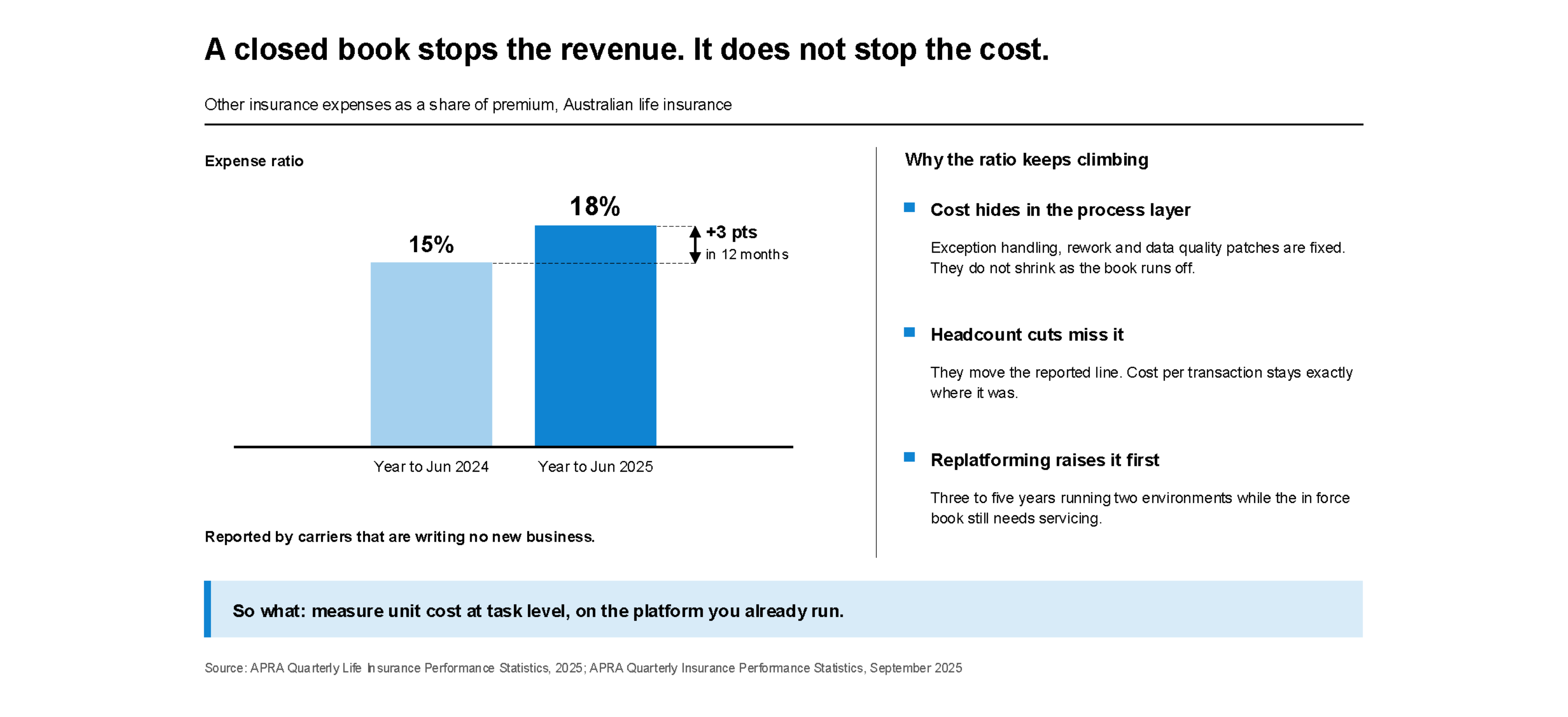
APRA data tells part of the story. Other insurance expenses as a proportion of premium across Australian life insurance rose from 15% to 18% in the twelve months to June 2025. That is a structural rise in the cost base, not a one-carrier anomaly. The carriers driving those numbers are not growing. The cost base is.
The question is where. And the answer is almost never where the first instinct points.
The common response to a rising expense ratio on a closed book is a headcount conversation. Cut the team. Renegotiate rates. Reduce the vendor footprint. These moves show up in the next reporting cycle and disappear from the cost line.
The cost that does not disappear is the cost that lives in the process layer: manual exceptions built into workflows that were designed for growth, not run-off; data quality patches applied every cycle because the legacy system of record and the downstream reporting environment were never properly reconciled; rework clusters that accumulate at handoffs between systems that were not designed to talk to each other.
Post-merger carriers running multiple admin stacks know this precisely. The process friction between two legacy environments does not reduce over time. It compounds. Insurance service expenses grew 7% year-on-year at industry level through September 2025, even as carriers pursued efficiency programs. The cost base kept moving because the right costs were not being measured.
The reason is structural. Legacy admin systems were designed for policy growth, not run-off efficiency. Measuring cost at book level tells you the outcome. It does not tell you where the unit cost is accumulating.
The instinct in the market is to solve this with a core system replacement. If the legacy platform is the source of the friction, replace it. The data on this instinct is not encouraging.
Core system migrations on closed books take three to five years to complete. During that window, the carrier is running two environments: the legacy system that still holds the in-force book, and the target system that is not yet operational at scale. Servicing cost does not fall during a migration. It frequently rises, because the teams operating the legacy system are also managing a parallel implementation.
The carriers that have moved the expense ratio on closed books have done it a different way. They mapped the process at task level on the platform they already have. They identified where rework accumulates, where exception handling adds unit cost, and where automation can be scoped within the existing system without requiring a migration as a prerequisite.
Platform fluency is the variable that determines whether this is possible. A partner who already operates on the legacy system of record can begin that mapping immediately. A partner who needs a training runway cannot.
CPS 230, which came into force on 1 July 2025, adds a compliance dimension to this calculation. Carriers now need defensible third-party arrangements for their critical operations. A BPO partner who can demonstrate platform competence on the existing system is a more defensible arrangement than one whose value is contingent on a future migration that has not started.
The pattern that delivers a measurable result on a closed book is not complicated. It follows a recognisable sequence.
First: process mapping at task level on the live system, not a future-state model. Every step in the policy servicing workflow is mapped against the actual platform, with the exception clusters and data quality interventions documented at the task level, not the process level.
Second: automation scoped to the tasks where it reduces cost without degrading accuracy. Human judgment is preserved where it is genuinely required - claims assessment, complex escalations, regulatory correspondence. Automation is applied where it is not.
Third: a controlled pilot that produces a defensible before-and-after number. Not a promised saving range. An actual measured cost-per-transaction before and after, on a defined subset of the book, before full deployment is committed.
The Australian BPO market is growing at 7.2% CAGR precisely because more carriers are recognising this model. Targeted operational outsourcing, scoped to the existing platform, with a measurable proof point before scale, is a different conversation from the broad-promise transformation engagements that have a mixed track record.
If you are managing a closed or in-force life book where the cost line keeps moving in the wrong direction, the conversation that tends to produce a result is not about transformation. It is about task-level measurement on the platform you already have.
The work begins with a structured cost diagnostic on the live system - no migration required, no parallel environment, no lengthy onboarding runway.
If the expense ratio conversation is live in your organisation, it is worth thirty minutes to discuss what task-level measurement on your existing platform could show.
Sources: APRA Quarterly Life Insurance Performance Statistics (2025); APRA Quarterly Insurance Performance Statistics (September 2025); IMARC Group Australia BPO Market Report (2025)